
Boise Multifamily Outlook: Why Apartment Demand Matters More Than the Construction Pipeline
It is easy to look at an apartment market and focus on one number: how many units are being built.
But that number doesn’t tell the whole story.
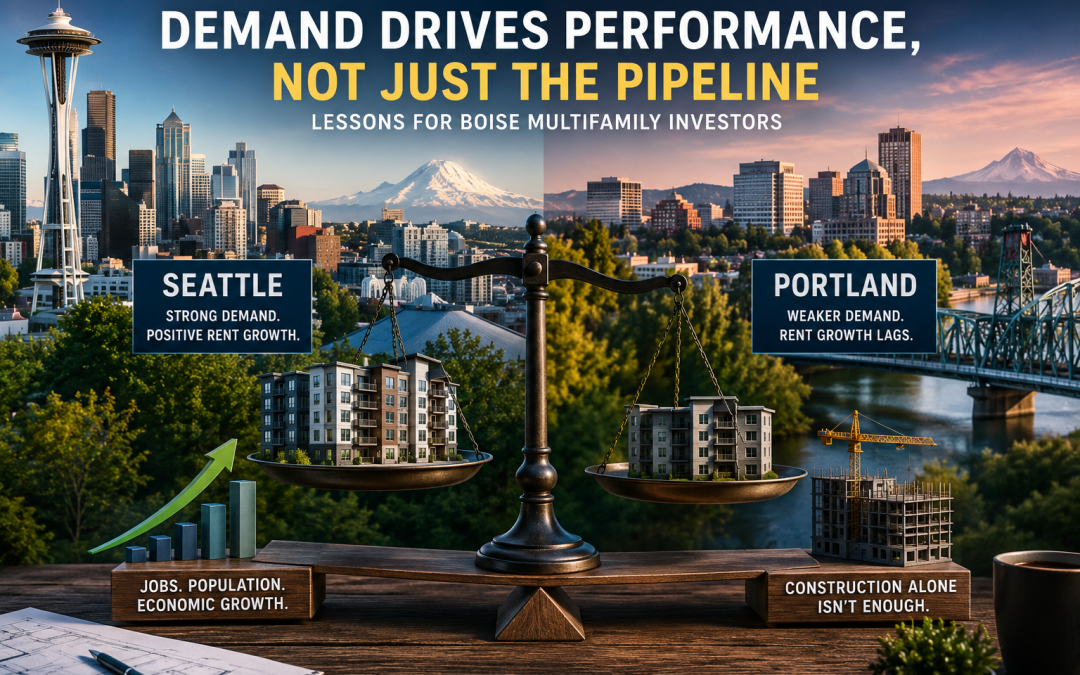
Seattle and Portland are providing a good real-world example. Seattle has far more apartments under construction, yet rents are already moving upward. Portland has much less construction underway, but rents are still struggling.
For Boise multifamily investors and developers, there is an important lesson here.
Supply matters.
But demand determines whether that supply becomes a problem.
According to analysis by Elliott Krivenko and John Gillem of CoStar Analytics, Seattle and Portland have both moved beyond the peak apartment construction cycle seen earlier this decade. Their recoveries, however, are developing very differently.
That difference provides a useful framework for thinking about Boise commercial real estate and the next stage of the Treasure Valley apartment market.
Seattle Shows Why Supply Doesn’t Tell the Whole Story
On paper, Portland might look better positioned for an apartment recovery.
CoStar reports approximately 14,600 apartment units remain under construction in the Seattle market, representing about 3.6% of existing inventory.
Portland has only about 2,400 units underway, equal to roughly 1% of its inventory.
You might expect Portland rents to recover first.
The opposite is happening.
Seattle asking rents increased about 1% during the previous 12 months, while Portland recorded a small decline.
Seattle developers and landlords aren’t completely out of the woods. Concessions remain common, particularly in neighborhoods where several new projects are competing for renters at the same time.
Some properties have reportedly offered incentives worth two or even three months of rent on a one-year lease.
Once those incentives are considered, Seattle’s effective rent growth falls to approximately 0.7%.
Still, that’s better than Portland, where effective rents declined about 0.3%.
So what is Seattle doing differently?
It isn’t really about the apartments.
It is about the people and jobs filling them.
Jobs and Population Are the Real Apartment Absorption Engine
Seattle continues to benefit from population gains and economic activity in sectors including technology, artificial intelligence, aerospace and satellite manufacturing.
Employment growth has cooled, but the market has generally maintained flat to modestly positive job trends.
Portland faces a different environment, including job losses and weaker economic momentum.
That difference is showing up in apartment demand.
Seattle recorded a net increase of roughly 7,000 occupied apartment units over the previous year. That demand was enough to absorb new deliveries and push vacancy lower.
Portland also generated apartment absorption, but the improvement hasn’t translated into broad rent growth across the metropolitan area.
This is the part of the Seattle-Portland comparison that should matter most to Boise real estate investors.
Apartment buildings don’t create renters.
Economic growth does.
Jobs create households.
Migration creates households.
New businesses create households.
Income growth gives those households the ability to pay higher rents.
Construction determines how many apartments are competing for those households.
That is why analyzing only the development pipeline can give investors an incomplete picture of a multifamily market.
What This Means for Boise Multifamily
Boise has experienced its own aggressive apartment development cycle.
Drive around Boise, Meridian, Nampa or other parts of the Treasure Valley and you can see how much multifamily product has been added.
When large numbers of apartments arrive within a relatively short period, landlords often lose some pricing power.
Vacancy can rise.
Lease-up periods can get longer.
Concessions become more common.
Rent growth slows.
That is normal.
The bigger question is what happens after construction slows.
The Seattle-Portland comparison suggests Boise multifamily investors should resist assuming that fewer new projects automatically mean rapidly rising rents.
A shrinking pipeline helps.
But the demand side still has to cooperate.
For the Boise apartment market, I would be watching several indicators closely:
- Population growth and net migration into the Treasure Valley
- Employment growth
- Major employer expansions and contractions
- Household formation
- Apartment absorption
- Vacancy trends
- Leasing concessions
- Effective rents rather than advertised rents
- New construction starts
- The geographic concentration of new apartment deliveries
Together, these indicators provide a much better picture than construction numbers alone.
Effective Rent May Tell the Better Story
Seattle also offers another lesson for Boise landlords and investors.
Don’t rely too heavily on asking rents.
A property might advertise a monthly rent of $1,800, for example, while offering several weeks of free rent.
The advertised rent hasn’t technically fallen.
The landlord’s actual income has.
That makes effective rent one of the more useful indicators during a competitive lease-up environment.
Concessions can allow landlords to protect headline rental rates while still lowering the renter’s true cost.
For investors evaluating Boise investment property, this matters because the income statement ultimately reflects the economics of the lease — not the number displayed on the property’s website.
When evaluating a multifamily acquisition, I would want to understand not only current asking rents but also:
- Free-rent periods
- Move-in incentives
- Reduced deposits
- Gift cards or other incentives
- Renewal increases
- Concession burn-off assumptions
If underwriting assumes all current concessions disappear immediately, projected NOI can become overly optimistic.
Local Insight: Boise’s Next Multifamily Cycle Will Be About Absorption
Boise’s apartment story over the next few years may be less about how much gets built and more about how quickly the market fills what has already been delivered.
That distinction matters.
When developers pull back after a construction boom, supply growth eventually slows. If population and employment continue expanding during that period, the market can gradually absorb excess inventory.
Vacancy starts falling.
Concessions shrink.
Landlords regain pricing power.
Eventually, rents begin moving again.
But the timing depends on demand.
Seattle appears to be demonstrating what happens when economic and demographic growth remain strong enough to absorb a substantial construction pipeline.
Portland demonstrates the other side of the equation: simply reducing construction doesn’t guarantee immediate rent growth if employment and household demand remain weak.
Boise could experience elements of both.
The Treasure Valley has historically benefited from population growth and migration. Those trends have helped support residential and commercial development throughout Boise, Meridian, Eagle, Nampa, Caldwell, Kuna and Star.
But multifamily investors should continue watching whether job creation keeps pace with housing growth.
That may be one of the most important variables in the next phase of the Boise apartment market.
Why This Matters Beyond Apartments
Multifamily absorption also has implications for the broader Boise commercial real estate market.
Apartments create customers.
When hundreds of units stabilize in a new development corridor, those households create demand for grocery stores, restaurants, coffee shops, fitness concepts, medical services, childcare and neighborhood retail.
That means apartment occupancy can eventually influence retail leasing in Boise.
For developers, this makes the timing of multifamily stabilization important when evaluating nearby commercial sites.
A corridor with 2,000 newly built apartments isn’t necessarily the same thing as a corridor with 2,000 newly built and occupied apartments.
Retail follows people — not building permits.
The same principle applies to investment.
Developers and investors should look beyond how many units are being constructed and ask how quickly those units are turning into occupied households.
That is the larger lesson from Seattle and Portland.
Seattle has substantially more apartment construction underway, but stronger employment and population trends are helping it work through that supply.
Portland has less construction but weaker demand, and its rental market is recovering more slowly.
For Boise multifamily investors, the takeaway is straightforward:
Don’t just count apartments.
Count jobs, households and renters.
Because when the construction cranes disappear, those demand drivers will determine how quickly Boise’s apartment market regains pricing power.
Mike Gioioso (joy-OH-so)
has for 16+ years been helping companies of all sizes buy, build, and lease perfect places for business in greater Boise, Idaho and beyond.
www.streetsmartidaho.com mike@streetsmartidaho.com 208-209-9166
Tags: #boisecommercialrealestate, #boiserealestate, #boisemultifamily, #boisemultifamilyrealestate, #boiseapartmentmarket, #boiseapartments, #boiseapartmentinvestment, #boisemultifamilyinvestment, #boiseinvestmentproperty, #boiseapartmentdevelopment, #boisemultifamilydevelopment, #boiseapartmentconstruction, #boiseapartmentrents, #boiserentgrowth