
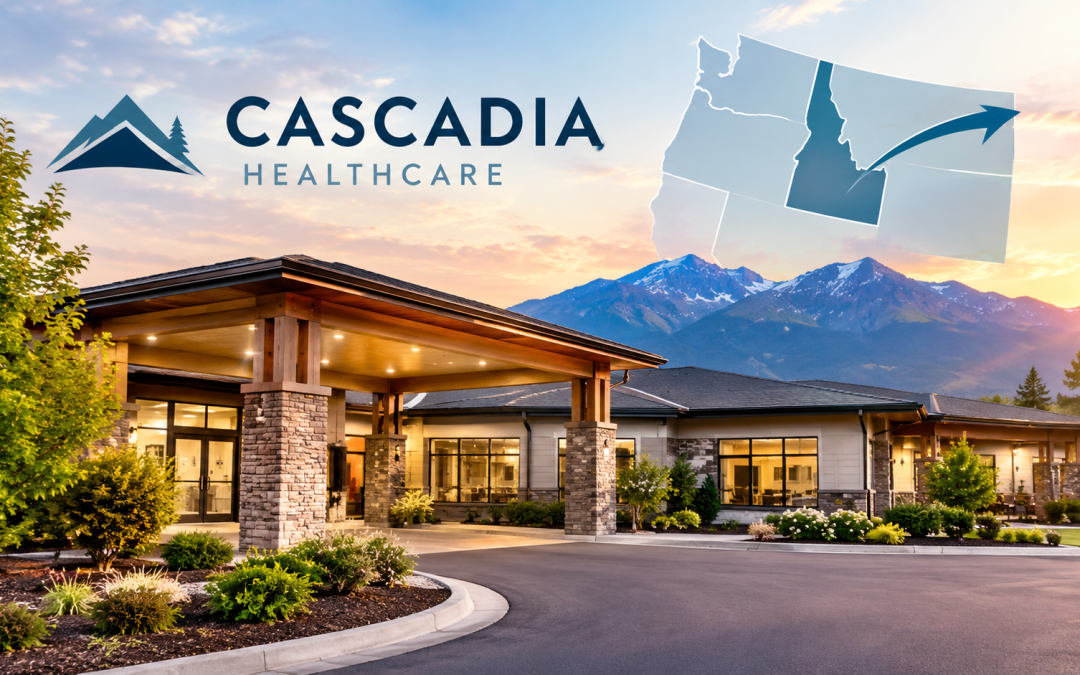
Eagle-Based Cascadia Healthcare Expands as Senior Care Real Estate Shifts Across the Northwest
An Idaho healthcare company is about to get considerably larger — and the story goes beyond healthcare.
Eagle-based Cascadia Healthcare is preparing to assume operations at a large group of skilled nursing facilities currently operated by Avamere Health Services. The transition provides another example of an important commercial real estate trend: healthcare properties can remain valuable and operational even when the company running them changes direction.
For Boise commercial real estate investors and developers, the deal also shows how Idaho-based companies are increasingly building regional footprints well beyond the Treasure Valley.
According to reporting by Hannarose McGuinness of the Eugene Register-Guard, distributed through the USA TODAY Network via Reuters Connect and published by the Idaho Business Review, Avamere is moving away from skilled nursing as it focuses more heavily on senior housing and home-based care.
That strategic shift is creating a major growth opportunity for Cascadia.
Cascadia’s Regional Footprint Is Getting Much Bigger
Sabra Health Care REIT, the landlord behind the portfolio, plans to transition all 26 skilled nursing properties currently leased to Avamere to new operators.
Twenty-two properties are expected to move to subsidiaries of Cascadia Healthcare, while four are slated for subsidiaries of another existing Sabra tenant.
The transition is scheduled for Oct. 1, subject to regulatory approvals.
Cascadia already has a significant presence in the region. The Eagle-based healthcare company operates nearly 50 skilled nursing facilities across Idaho, Oregon, Washington, Montana and Arizona, including 25 Idaho locations.
The Avamere transition would substantially expand that footprint.
Cascadia Chief Strategy Officer Steve LaForte told the Register-Guard that the company expects to take over 19 Avamere facilities in Oregon and another six in Washington. Cascadia is also taking over facilities in Eugene and Junction City.
That is significant growth for a company headquartered in the Boise metro.
But from a commercial real estate perspective, the more interesting part may be what isn’t changing.
The Real Estate Stays — Even When the Operator Changes
Healthcare real estate operates differently from traditional office or retail property.
A skilled nursing facility is highly specialized. The building, licensing, infrastructure and operational requirements make simply replacing the existing use difficult.
That means landlords often have a strong incentive to find another qualified healthcare operator when a tenant leaves rather than repositioning the property for an entirely different use.
That appears to be happening here.
Avamere is making a corporate decision to move away from skilled nursing. Sabra, meanwhile, isn’t abandoning the properties. Instead, the healthcare REIT is placing new operators into them.
For commercial real estate investors, that distinction matters.
An operator leaving does not automatically mean the underlying real estate has failed.
Sometimes the issue is the tenant’s corporate strategy, operating model or portfolio priorities rather than the physical asset itself.
Healthcare landlords therefore need to evaluate more than traditional real estate fundamentals such as location, building quality and rent.
Operator strength matters enormously.
So do reimbursement structures, staffing, regulatory compliance, hospital relationships and local demand for care.
Operational Performance Can Become a Real Estate Issue
The Avamere transition also highlights another characteristic of healthcare commercial real estate: the quality of operations can directly affect the investment.
Inspection records cited in the original reporting show deficiencies at several Oregon facilities.
Avamere Rehabilitation of Eugene received a $36,472 fine following an August 2024 inspection that identified 31 deficiencies. A Junction City facility was fined $8,678 following deficiencies identified during a 2024 inspection.
More recent inspections identified additional deficiencies at some locations.
Cascadia’s existing Creekside facility in Eugene also received three deficiencies in a May 2026 report.
These aren’t simply healthcare management statistics.
For an owner of specialized medical or senior-care real estate, regulatory problems can eventually become property problems.
Poor operations can affect occupancy, revenue, staffing, licensing and ultimately a tenant’s ability to support rent.
That is one reason underwriting healthcare investment property requires a deeper look at the operating business than investors might conduct with a typical retail, office or industrial tenant.
Why This Matters for Boise Commercial Real Estate
The transaction is happening largely outside Idaho, but there are several reasons Boise commercial real estate professionals should pay attention.
First, Cascadia is headquartered in Eagle.
An Idaho-based healthcare operator expanding across multiple Western states is another sign that the Boise metro is becoming home to companies capable of operating at a regional scale.
That can eventually influence demand for corporate office space, professional services, healthcare administration and related businesses throughout the Treasure Valley.
Second, demographics continue to support interest in healthcare and senior-oriented real estate.
As the population grows and ages, demand doesn’t stop with hospitals and doctors’ offices. It extends into rehabilitation centers, skilled nursing, assisted living, memory care, home healthcare and other specialized services.
For Boise development, that creates opportunities — but specialized healthcare properties also carry risks that ordinary commercial buildings may not.
Developers need to think about who will operate the facility long before construction begins.
Investors need to understand the financial health and regulatory history of the tenant.
Landlords need to consider how easily another qualified operator could step in if the original tenant leaves.
And brokers need to understand both sides of the equation: the real estate and the operating business.
Local Insight: Watch the Operator as Closely as the Property
One lesson from this transaction applies directly to Boise investment property.
A great building does not automatically make a great healthcare investment.
In traditional commercial real estate, investors often begin with location, rent, lease term, tenant credit and replacement cost. Those are still important for healthcare properties, but they aren’t enough.
I would add several questions:
- How strong is the operator financially?
- What is the facility’s occupancy history?
- How dependent is revenue on Medicare or Medicaid reimbursement?
- Does the operator have a strong regulatory record?
- How difficult would it be to replace that operator?
- What capital improvements will the property require?
- How does the facility fit into the surrounding hospital and healthcare network?
The Cascadia-Avamere transition demonstrates why these questions matter.
Avamere is stepping away from skilled nursing, yet the properties themselves aren’t necessarily going dark. Sabra is working to install experienced replacement operators and maintain continuity at the facilities.
That is one of the defining characteristics of specialized healthcare real estate: sometimes the operator changes while the underlying use and investment strategy remain intact.
For Boise-area investors watching senior housing, medical office and healthcare commercial real estate, understanding that separation between the business and the building can lead to much better investment decisions.
Cascadia’s expansion is also worth watching for another reason. A company headquartered in Eagle is becoming an increasingly significant skilled nursing operator across the Western United States.
As Boise companies grow beyond Idaho, their expansion can have ripple effects back home — from corporate employment and office demand to healthcare partnerships, development opportunities and investment activity.
That makes this more than an Oregon nursing-home story.
It is another example of an Idaho-based company becoming a larger regional player in an increasingly specialized segment of commercial real estate.
Mike Gioioso (joy-OH-so) has for 16+ years been helping companies of all sizes buy, build, and lease perfect places for business in greater Boise, Idaho and beyond.
www.streetsmartidaho.com mike@streetsmartidaho.com 208-209-9166
Tags: #boisecommercialrealestate, #boiserealestate, #idahocommercialrealestate, #idahorealestate, #boisehealthcarerealestate, #idahohealthcarerealestate, #boisemedicalrealestate, #idahoseniorhousing, #boiseseniorhousing, #skillednursingrealestate, #healthcareinvestmentproperty, #boiseinvestmentproperty, #idahoinvestmentproperty, #healthcarereit, #seniorcarerealestate