
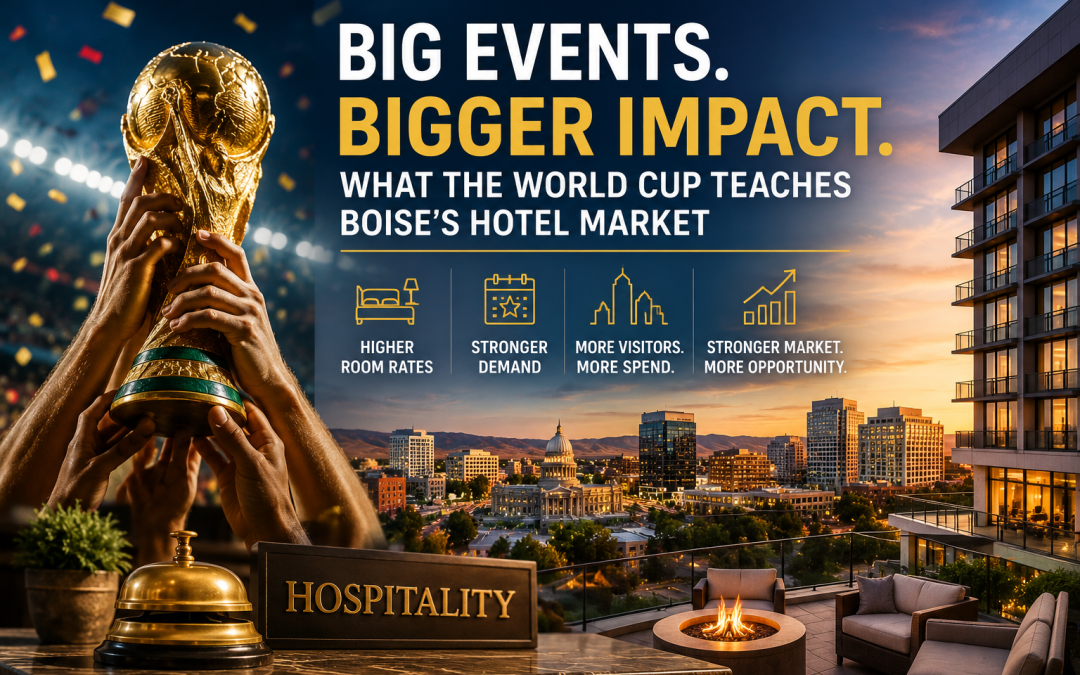
What Boise Hotels Can Learn From the World Cup’s Massive Hospitality Boost
A full hotel isn’t always the most profitable hotel.
That may be one of the most interesting commercial real estate lessons coming out of the 2026 FIFA World Cup.
Hotels across U.S. host cities benefited from the tournament, but much of the financial upside came from charging more for rooms rather than simply filling more of them. And the cities that performed best had something else working in their favor: multiple major events happening at the same time.
For Boise commercial real estate investors, hotel owners, developers and tourism-related businesses, that provides a useful lesson about what really drives hospitality performance.
According to analysis by Didio Pequeno of CoStar Analytics, average hotel room rates across the 11 U.S. World Cup host markets increased 28.2%, while overall occupancy was essentially flat, declining 0.4%.
In other words, the World Cup became primarily a pricing opportunity.
And some cities captured that opportunity exceptionally well.
Big Events Created Pricing Power, Not Just More Visitors
Before the tournament began, hospitality professionals expected the World Cup to have a greater impact on hotel rates than occupancy.
That prediction largely proved correct.
Hotels were able to charge substantially higher prices because visitors were competing for rooms during specific high-demand periods.
San Francisco produced the strongest overall hotel performance among the U.S. host markets.
Revenue per available room, commonly called RevPAR, increased 54%. Average daily rate rose 33%, while occupancy climbed 16%.
But the World Cup wasn’t working alone.
San Francisco was also hosting major technology conferences, including large artificial intelligence and data events. Additional citywide activities created even more demand.
That combination is important.
A major event can fill rooms.
Several major events occurring close together can create compression — the situation where demand becomes strong enough across a market that hotels gain significant pricing power.
Miami experienced something similar.
Its average daily room rate jumped 47%, the strongest increase among the host markets, helping push RevPAR up 39%.
Dallas recorded approximately 35% RevPAR growth and a 32% increase in average room rates.
The Dallas market also benefited from hosting nine World Cup matches and serving as the tournament’s International Broadcast Center. That brought journalists, production crews and support personnel who needed rooms beyond the individual match dates.
New York’s RevPAR increased 31% as World Cup activity overlapped with an unusually active entertainment and events calendar.
The lesson isn’t simply that soccer fans book hotel rooms.
The bigger lesson is that overlapping demand generators can dramatically change hotel economics.
Why This Matters for Boise Hospitality Real Estate
Boise obviously isn’t New York, Miami or San Francisco.
And that’s exactly why this comparison is useful.
Hospitality demand in a smaller metropolitan market can be particularly sensitive to the event calendar.
A major convention, sporting event, concert, tournament, festival or university event can quickly absorb available rooms.
When several events overlap, hotels may gain significant pricing power.
For Boise hotel investors, that means market analysis should go well beyond annual occupancy.
I would want to understand:
- Average daily rate by month
- RevPAR by season
- Weekday versus weekend performance
- Convention and group demand
- Boise State event demand
- Youth and amateur sports activity
- Downtown Boise events
- Major concerts and festivals
- Corporate travel
- Government-related travel
- Seasonal tourism patterns
A hotel’s annual occupancy number can hide a lot.
Two hotels might produce similar annual occupancy while generating very different revenue because one property captures high-rate nights more effectively.
That distinction matters when evaluating Boise investment property.
Pricing Power Can Matter More Than Occupancy
Consider a simplified example.
A hotel could increase occupancy from 75% to 80% while keeping room rates flat.
That’s helpful.
But another hotel could remain at roughly 75% occupancy while increasing its room rate substantially during high-demand periods.
Depending on operating costs and the size of the rate increase, the second hotel could produce stronger revenue growth.
That is essentially what makes the World Cup results interesting.
Across the host cities, occupancy didn’t dramatically increase overall.
Room pricing did.
For investors underwriting Boise hotels, that means the question shouldn’t simply be:
“How full is this hotel?”
It should also be:
“How much pricing power does this property have when Boise gets busy?”
That answer can depend heavily on location.
A downtown Boise hotel may benefit from conventions, government activity, entertainment and walkability.
Properties near Boise Airport have another set of demand generators.
Hotels positioned near major sports facilities, medical centers or employment corridors may have completely different customer mixes.
Understanding those demand sources is critical to understanding the real estate.
Events Can Create a Commercial Real Estate Ripple Effect
The World Cup numbers also demonstrate something that extends beyond hotels.
Visitors don’t spend money only on rooms.
They eat.
They shop.
They use transportation.
They visit bars.
They attend entertainment venues.
They buy services.
They explore surrounding neighborhoods.
That creates economic activity across multiple commercial property types.
For Boise retail leasing, this is particularly important.
A strong events calendar can help support downtown restaurants, entertainment concepts and retailers even when the permanent residential population alone might not justify the same sales volumes.
Hotels themselves can also act as demand generators for nearby commercial tenants.
A restaurant located next to a successful hotel effectively gains access to a constantly rotating population of potential customers.
The same can be true for coffee shops, convenience retailers, entertainment businesses and personal services.
This is why hospitality development should not always be evaluated in isolation.
Hotels can become part of a larger commercial ecosystem.
Local Insight: Boise Should Think in Terms of Event Stacking
The most interesting lesson from the World Cup isn’t that enormous sporting events are good for hotels.
We already know that.
The bigger takeaway is what happened when major events overlapped.
San Francisco wasn’t relying exclusively on soccer. Technology conferences and other large gatherings were happening around the same period.
Dallas wasn’t benefiting only from fans attending matches. Its role as the broadcast center created extended room demand from media and production personnel.
New York combined tournament activity with an already packed citywide calendar.
That is what Boise should pay attention to.
For a market our size, strategically coordinating large events could create meaningful economic impact.
Imagine a major downtown convention occurring alongside a Boise State home game, a large youth sports tournament and a major concert.
That combination can create something much more powerful than any individual event.
Hotels gain pricing power.
Restaurants get busier.
Retailers see additional traffic.
Transportation demand increases.
Entertainment venues benefit.
And visitors experience a city that feels active.
From a Boise development standpoint, this can also strengthen the case for additional hospitality, entertainment and mixed-use investment in the right locations.
But developers should remain disciplined.
One strong weekend doesn’t justify building a hotel.
The investment still needs multiple year-round demand generators.
That means understanding corporate travel, conventions, government activity, tourism, sports, healthcare, education and entertainment together.
The Bigger Boise Commercial Real Estate Opportunity
There is another reason this matters.
Boise’s ability to host larger events depends partly on its commercial infrastructure.
Hotel rooms matter.
Convention and meeting facilities matter.
Restaurants and entertainment matter.
Airport connectivity matters.
Transportation matters.
Downtown walkability matters.
Those pieces reinforce one another.
More hotel capacity can make larger events possible.
More events can support stronger hotel economics.
Stronger visitor traffic can support additional restaurants and retail.
More amenities can make Boise more attractive for future events.
That creates a cycle that can influence Boise commercial real estate well beyond hospitality.
The 2026 World Cup produced extraordinary hotel results because it created something every hotel owner wants: pricing power.
But the best-performing markets didn’t rely on a single source of demand.
They stacked events, visitors, conferences, entertainment and business activity on top of one another.
For Boise hotel owners, developers and commercial real estate investors, that’s the lesson worth remembering.
Don’t just count hotel rooms.
Don’t just count visitors.
Look at the calendar.
Because when multiple demand generators converge at the same time, the value of every available room — and potentially the commercial real estate surrounding it — can change very quickly.
Mike Gioioso (joy-OH-so) has for 16+ years been helping companies of all sizes buy, build, and lease perfect places for business in greater Boise, Idaho and beyond.
www.streetsmartidaho.com mike@streetsmartidaho.com 208-209-9166
Tags: #boisecommercialrealestate, #boiserealestate, #boisehotelmarket, #boisehotels, #boisehospitalityrealestate, #boisehospitalitymarket, #boisehotelinvestment, #boiseinvestmentproperty, #boisehoteldevelopment, #boisedevelopment, #idahocommercialrealestate, #idahohotelmarket, #idahohospitalityrealestate, #idahohotelinvestment, #treasurevalleycommercialrealestate