
Boise Adds Affordable Housing as The Sherwood Moves Into Construction
Boise’s housing challenge isn’t simply about building more units. It’s also about creating housing that reaches people the traditional market has difficulty serving.
A new development near Boise State University shows one way the city and private-sector partners are approaching that problem.
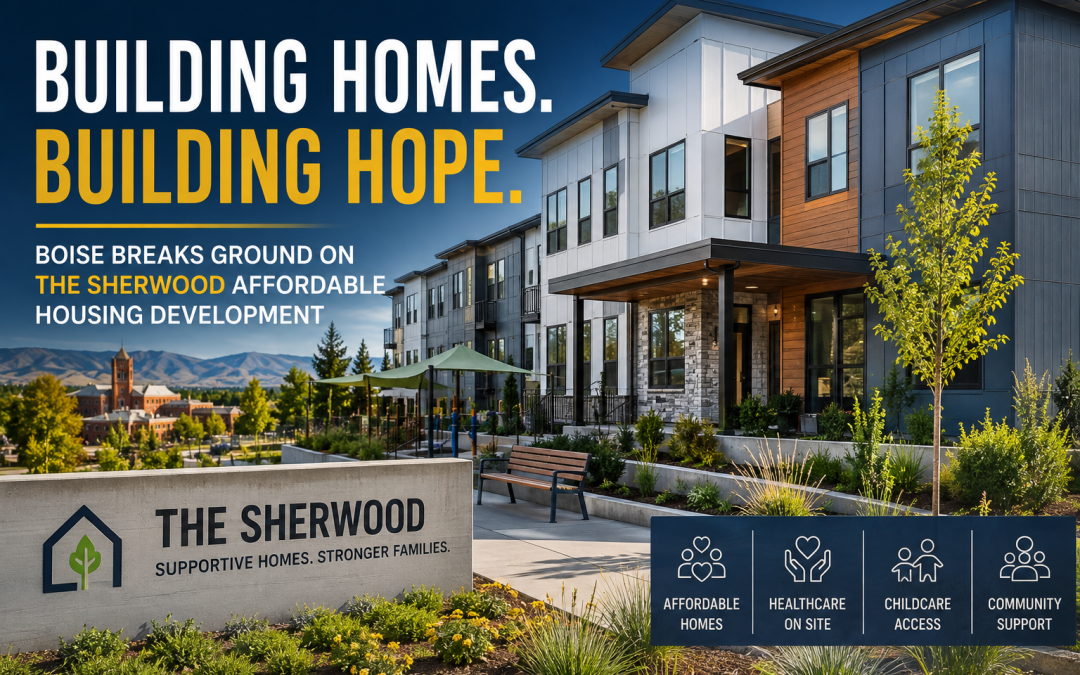
According to reporting by IBR Staff in the Idaho Business Review, Boise recently broke ground on The Sherwood, a 48-unit permanent supportive housing development planned for the Luke District near the western edge of the Boise State University campus. The original Idaho Business Review article, “Boise breaks ground on The Sherwood affordable housing development,” was published August 14, 2026.
The project is significant because it combines housing, services, health care, childcare, and publicly supported land into one development.
From a Boise commercial real estate perspective, that combination may be just as important as the number of apartments being built.
The Sherwood Combines Housing With Services
The Sherwood isn’t being designed as a conventional apartment complex.
Its primary focus will be families with children transitioning out of homelessness, making it the first permanent supportive housing project of its kind in Idaho focused mainly on this group, according to the Idaho Business Review.
The development will contain 48 apartments with a mix of two- and three-bedroom units.
But the housing is only part of the project.
Plans also include a daycare center and community space where CATCH and Terry Reilly Health Services can provide services to residents.
Additional amenities are expected to include a community lounge, classroom, computer lab, demonstration kitchen, playground, and courtyard.
That creates something closer to a small supportive community than a traditional apartment building.
The development is being advanced through a partnership involving the City of Boise, CATCH, Terry Reilly Health Services, and Northwest Real Estate Capital Corp.
The land was acquired through Boise’s Housing Land Trust.
That piece of the structure deserves attention.
Land Cost Is Becoming a Bigger Part of Boise’s Housing Equation
Boise’s rising land values have been good news for many property owners.
They’re much more challenging for affordable housing development.
Every dollar spent acquiring land is another dollar that ultimately has to be covered through rents, financing, subsidies, equity, grants, or some combination of those sources.
That means reducing the initial land burden can materially change whether a housing project is financially possible.
The Sherwood demonstrates one approach.
Instead of expecting a conventional developer to acquire land at full market pricing and somehow produce deeply affordable housing afterward, the city can use its land strategy as part of the project’s capital structure.
That doesn’t eliminate development costs.
Construction still has to be financed.
Infrastructure still has to be installed.
Architects, engineers, contractors, and consultants still have to be paid.
Operating expenses don’t disappear either.
But controlling the land can remove one major obstacle.
For Boise development, this is worth watching because land has become one of the most important variables affecting what gets built and where.
Public-Private Partnerships Could Become More Common
The Sherwood also illustrates why complicated housing problems often require complicated partnerships.
A traditional market-rate apartment developer usually has a fairly straightforward goal: build a property, lease apartments, generate enough income to cover expenses and debt, and produce an acceptable return on investment.
Permanent supportive housing works differently.
The residents may need services that extend far beyond providing an apartment.
That can include health care, case management, childcare, education, employment support, and other resources.
One organization isn’t necessarily equipped to provide all of that.
The Sherwood brings several specialties together.
The City of Boise can contribute land and public investment.
Northwest Real Estate Capital brings housing and development experience.
CATCH provides expertise related to homelessness and housing stability.
Terry Reilly Health Services brings health care directly into the project.
That combination allows the real estate to become a platform for delivering services.
From a commercial real estate standpoint, that’s an increasingly important concept.
Buildings aren’t always the final product.
Sometimes they’re infrastructure supporting a larger community objective.
Why Boise Commercial Real Estate Should Pay Attention
Affordable housing can sometimes be treated as a separate issue from commercial real estate.
In reality, the two are closely connected.
Businesses need employees.
Employees need somewhere they can afford to live.
When housing costs rise much faster than wages, employers can have difficulty recruiting and retaining workers.
That can affect restaurants, retailers, medical providers, manufacturers, construction companies, hospitality businesses, and professional-service firms.
It can eventually affect retail leasing Boise businesses as well.
A company evaluating a new Boise location isn’t looking only at rent.
It’s also evaluating whether it can hire enough people to operate that location.
Housing availability becomes part of that calculation.
The relationship works in the other direction too.
Adding housing near employment, education, transit, health care, and commercial services can strengthen surrounding areas.
More residents create additional demand for groceries, restaurants, childcare, medical services, personal services, and neighborhood retail.
Housing development and commercial development are therefore interconnected.
Boise Is Approaching an Affordable Housing Milestone
The Sherwood also contributes to a much larger housing effort.
Construction is expected to be completed during the winter of 2027.
Once these 48 apartments are added, Boise says it will have surpassed 1,000 affordable homes either completed or under construction since 2020.
That’s a meaningful milestone.
But Boise’s continued population growth means the affordability challenge isn’t likely to disappear simply because a certain number of units has been reached.
Housing demand is constantly moving.
Population changes.
Wages change.
Interest rates change.
Construction costs change.
Land values change.
Apartment rents change.
Home prices change.
That means affordable housing isn’t a problem that gets permanently “solved” with one development.
It requires an ongoing pipeline.
Local Insight: The Land May Be the Most Important Part of the Deal
From a Boise commercial real estate perspective, The Sherwood’s most interesting feature may be the city’s use of its Housing Land Trust.
Real estate development starts with land.
If the land basis doesn’t work, very little else matters.
That’s especially true for affordable housing, where rents can’t simply be increased until the development pencils.
As Boise land becomes more valuable, cities, nonprofits, developers, and housing organizations will likely need to become increasingly creative about site control.
That could mean land trusts.
It could mean long-term ground leases.
It could mean redevelopment of publicly owned property.
It could mean partnerships with churches, nonprofits, health care organizations, or other institutions that control underused land.
It could also mean incorporating affordable units into larger mixed-income developments.
For developers, those structures can create opportunities that wouldn’t exist under a conventional land purchase.
For Boise landlords and investors, additional housing can strengthen the overall labor market and support continued economic growth.
For businesses and tenants, greater housing availability can help expand the pool of workers who can realistically live near their jobs.
And for surrounding commercial properties, additional residents can increase demand for neighborhood services.
The Sherwood is only 48 units.
In a growing metro area, that number alone won’t change Boise’s housing market.
But the development model is important.
Land, housing, health care, childcare, and community services are being brought together through several public and private organizations instead of expecting a single party to solve every part of the problem.
Boise’s next phase of growth will require more than simply adding buildings.
It will require figuring out how housing, jobs, transportation, services, and commercial development fit together.
The Sherwood provides one example of what that can look like.
Mike Gioioso (joy-OH-so)
has for 16+ years been helping companies of all sizes buy, build, and lease perfect places for business in greater Boise, Idaho and beyond.
www.streetsmartidaho.com mike@streetsmartidaho.com 208-209-9166
Tags: #boisecommercialrealestate, #boiserealestate, #boiseaffordablehousing, #boisehousingdevelopment, #boisehousingmarket, #boisedevelopment, #boiseresidentialdevelopment, #boisemultifamily, #boisemultifamilydevelopment, #boiseapartmentdevelopment, #affordablehousingboise, #affordablehousingdevelopment, #boisesupportivehousing, #permanentsupportivehousing, #thesherwoodboise