
Boise Real Estate Branding: What TJ Pierce’s Mid-Century Strategy Says About Building a Niche
There is a natural temptation in real estate to chase every possible deal.
More listings. More clients. More property types. More leads.
TJ Pierce built his Boise real estate business around almost the opposite idea: get very specific about what you do, become known for it, and have enough patience to let the reputation grow.
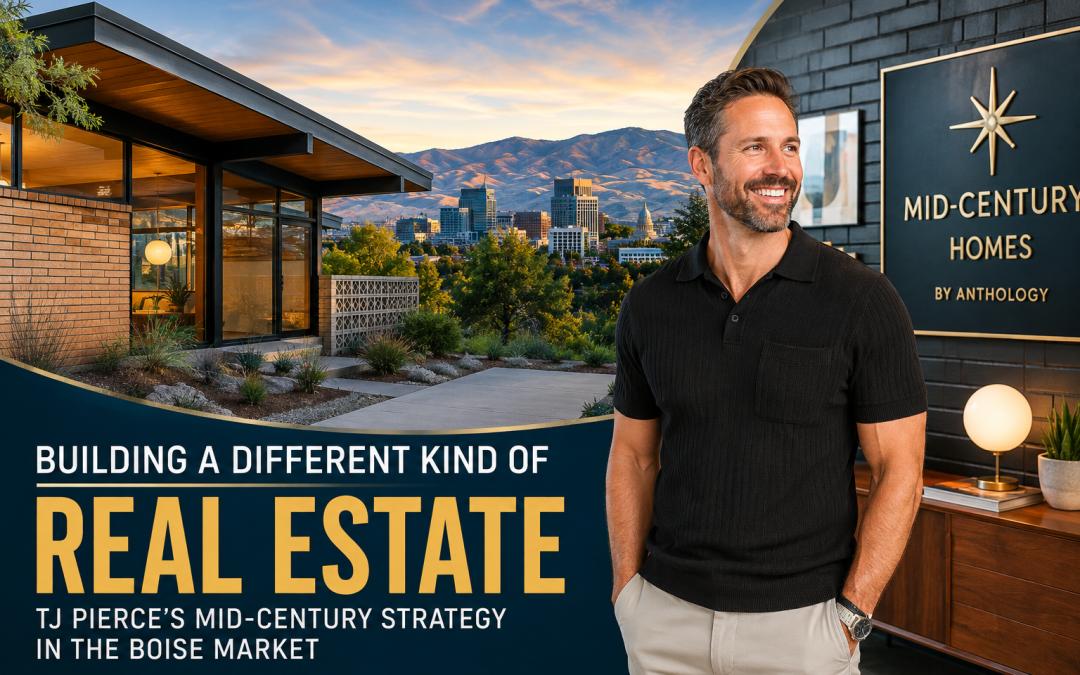
According to reporting by Marc Lutz in the Idaho Business Review, Pierce founded Mid-Century Homes by Anthology around his interest in mid-century modern architecture and has spent years developing a business focused on people who share that interest. You can read Lutz’s original Idaho Business Review interview here: https://idahobusinessreview.com/2026/08/18/tj-pierce-building-mid-century-modern-real-estate-boise/
Although Pierce works primarily in residential real estate, there are some valuable lessons in his story for Boise commercial real estate professionals, landlords, developers and business owners.
A Narrow Niche Can Create a Bigger Brand
Pierce didn’t begin his career in real estate.
His background included church ministry and corporate sales. During his sales career, he became increasingly interested in how companies spent money on marketing and attracting customers.
That interest eventually collided with another passion: mid-century architecture.
Instead of becoming a general residential agent, Pierce built his business around that architectural niche.
That decision came with a trade-off.
A specialist intentionally walks away from business that doesn’t fit the brand. Pierce told the Idaho Business Review that staying disciplined about what the company would and would not pursue was difficult, particularly during slower periods when inventory within the niche became limited.
But specialization also gives a company something valuable: identity.
People can understand what the business represents.
That’s a lesson that translates directly into Boise commercial real estate.
Think about a shopping center that becomes known for restaurants. A medical project that attracts complementary healthcare practices. An industrial development designed specifically around contractors and service businesses.
Trying to appeal to everyone can sometimes create a property that doesn’t stand out to anyone.
A clear identity can make marketing easier.
Real Estate Decisions Don’t Have to Happen Quickly
Another interesting part of Pierce’s story is how he approaches major decisions.
He described a process of thinking through problems, talking with people he trusts, gathering perspectives and then deciding whether an opportunity deserves the investment.
His company’s Boise office is a good example.
Mid-Century Homes by Anthology operated for nine years without its own dedicated brick-and-mortar location. Eventually, Pierce saw enough value in a property at 3130 W. State Street to change that strategy.
That’s a significant point for anyone involved in retail leasing Boise, office leasing or commercial property development.
Not every business needs real estate immediately.
And sometimes the best leasing conversation starts with understanding whether a company actually needs space at all.
A tenant should be asking:
- Will this location help us attract customers?
- Will it help recruit or retain employees?
- Does it reinforce our brand?
- Can the business comfortably support the occupancy cost?
- Is the location flexible enough for our future plans?
A commercial lease can be one of a company’s largest long-term financial commitments.
Waiting for the right location can sometimes be more valuable than simply taking the first acceptable space.
Boise Development Is Creating More Opportunities for Specialized Concepts
Pierce’s niche also reflects something happening across the broader Boise real estate market.
As the Treasure Valley grows, the market becomes large enough to support increasingly specialized businesses.
That matters for Boise development.
A smaller market may favor businesses designed to appeal to the widest possible audience. But population growth can create enough customers for concepts built around narrower interests.
We already see this in commercial real estate.
Specialty fitness concepts, boutique medical practices, niche restaurants, experiential retail, beauty and wellness businesses, specialized childcare operators and other focused concepts continue to search for space across Boise, Meridian, Eagle, Nampa, Caldwell and Star.
These tenants aren’t always looking for the biggest building.
They’re looking for the right building.
For landlords, that changes the leasing conversation.
A 1,500-square-foot space with the right visibility, parking and neighboring businesses may be much more valuable to a specialized tenant than a larger space in the wrong location.
That means understanding the tenant’s customer can be just as important as understanding the tenant’s square-footage requirement.
Patience Matters in Commercial Real Estate Too
One of the strongest themes from Pierce’s interview is patience.
Building a specialized company takes time because saying yes selectively also means saying no frequently.
Commercial real estate works much the same way.
Developers sometimes wait years for the right site.
Investors may review dozens of properties before making an acquisition.
Tenants can spend months searching for a location.
Landlords occasionally benefit from leaving a space vacant rather than signing a tenant whose use, credit or lease structure creates problems later.
There is always pressure to get a deal done.
But getting a deal done and getting the right deal done are not necessarily the same thing.
That distinction becomes even more important when you’re dealing with a five-, seven- or ten-year lease.
A Physical Location Can Be Part of the Brand
Pierce’s decision to eventually establish a dedicated Boise location is another piece of the story worth examining.
Real estate isn’t simply overhead.
For some businesses, the building itself becomes part of the customer experience.
Architecture, signage, landscaping, neighboring tenants, visibility and even the history of a property can reinforce what a company wants customers to feel about its brand.
This is especially important in retail leasing Boise and other customer-facing uses.
A law firm and a coffee shop may technically be able to occupy the same amount of square footage, but their real estate needs are completely different.
The same applies to a boutique fitness studio, restaurant, dentist, daycare or specialty retailer.
When companies evaluate Boise commercial property, I encourage them to think beyond rent per square foot.
Ask what the location communicates.
Does the building look like your company?
Does the neighborhood match your customer?
Will people remember where you are?
Does being there make the business stronger?
Those questions can sometimes matter more than saving a dollar or two per square foot.
Local Insight: Specialists Can Become Destination Businesses
Pierce’s strategy highlights something I think will become increasingly important as the Treasure Valley gets larger.
Boise businesses don’t necessarily have to appeal to everyone.
They need enough of the right customers.
That distinction can influence commercial development and leasing.
A highly specialized business may be able to draw customers from Boise, Meridian, Eagle, Nampa and beyond because people are willing to travel farther for something they cannot easily find elsewhere.
That can turn a niche operator into a destination tenant.
For commercial property owners, those businesses can be interesting prospects because their site-selection criteria may differ from conventional retailers.
Some need highway visibility.
Others need character.
Some want new construction.
Others specifically want an older building that helps tell their story.
Understanding those differences can uncover opportunities in buildings that might otherwise be overlooked.
Pierce’s experience also reinforces a broader business lesson: differentiation has value.
Whether you’re building a real estate brokerage, opening a restaurant, developing a shopping center or investing in Boise commercial real estate, being clearly known for something can be more powerful than trying to be everything to everybody.
The challenge is having enough patience to give that strategy time to work.
Mike Gioioso (joy-OH-so) has for 16+ years been helping companies of all sizes buy, build, and lease perfect places for business in greater Boise, Idaho and beyond.
www.streetsmartidaho.com mike@streetsmartidaho.com 208-209-9166
Tags: #boiserealestate, #boisecommercialrealestate, #boiserealestatemarket, #boiserealestatebusiness, #boiserealestateagents, #tjpierceboise, #tjpiercerealestate, #midcenturyhomesbyanthology, #boisemidcenturymodern, #boisemidcenturyhomes, #midcenturymodernboise, #boisearchitecture, #boisebusiness, #boiseentrepreneurs, #boisesmallbusiness, #boisebusinessgrowth