
Ashley Furniture’s Warehouse Move Offers a Lesson for Boise Industrial Real Estate
Selling a massive distribution center doesn’t always mean a company is leaving a market.
Sometimes it means the company wants a different kind of footprint.
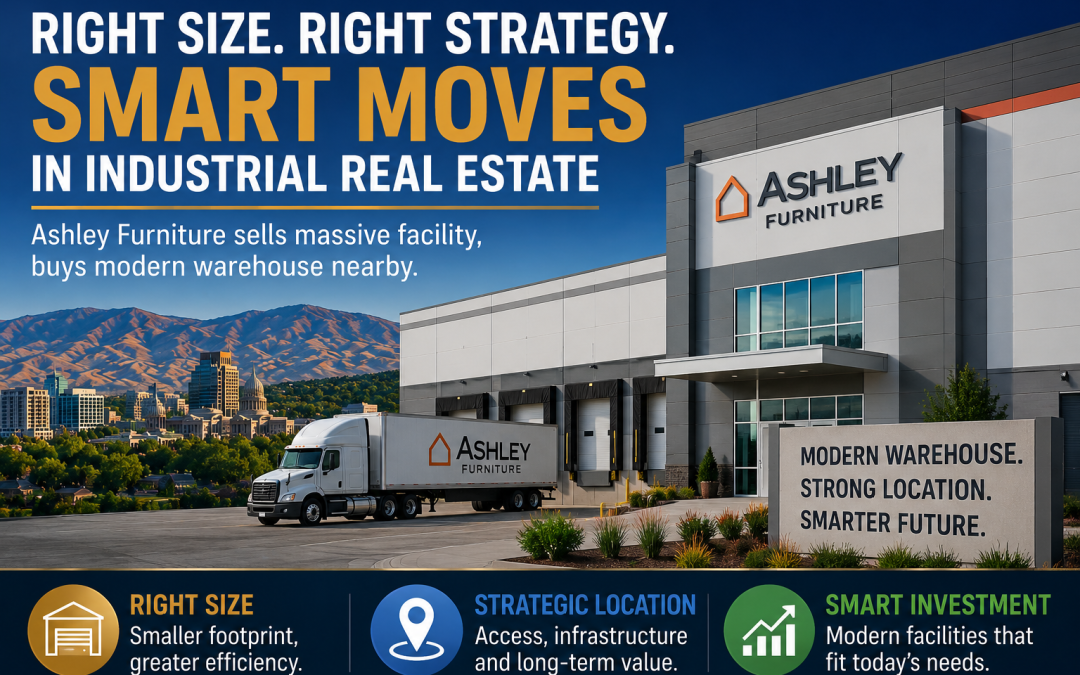
That appears to be the story behind Ashley Furniture’s latest move in Washington. After selling a huge South Puget Sound distribution property to Amazon, the national furniture retailer has purchased a newer, significantly smaller warehouse in nearby Tacoma.
According to reporting by Randyl Drummer of CoStar News, Ashley Furniture acquired a recently constructed industrial building near the Port of Tacoma for just under $34 million.
The original CoStar News article can be found here: https://product.costar.com/home/news/389002182
While the transaction happened hundreds of miles from Boise, the strategy behind it is worth watching. Large companies across the country are reconsidering how much warehouse space they need, where they need it and what building features justify paying for newer industrial real estate.
Ashley Sold Big — But Didn’t Abandon the Market
The sequence of transactions is what makes this story interesting.
Ashley previously owned a roughly 1.1 million-square-foot distribution center in Spanaway, Washington. Earlier this year, the company sold that facility, along with nearby development land, to Amazon for approximately $220 million.
According to CoStar, that was one of the largest commercial real estate transactions recorded in Pierce County.
A sale of that magnitude naturally raised questions.
Was Ashley shrinking its regional operations?
Was the company leaving South Puget Sound?
Was this another example of a furniture retailer reducing its real estate footprint as housing and consumer spending slowed?
The company’s next move provides some context.
Ashley purchased a warehouse of more than 205,000 square feet at 10922 E. 34th Avenue in Tacoma.
That’s dramatically smaller than its former 1.1 million-square-foot distribution center.
But it also means the company is putting capital back into the same general market.
That’s an important distinction.
This looks less like a complete market exit and more like a real estate reset.
Modern Industrial Buildings Still Have an Advantage
The Tacoma property was completed approximately two years ago and was originally developed as Bridge Point Tacoma 210.
The building includes features that large distribution and logistics users frequently prioritize, including roughly 36- to 40-foot clear heights, 50 dock-high loading positions, two grade-level doors, trailer parking and substantial employee parking.
The location adds another advantage.
It sits near the Port of Tacoma and within a federal foreign trade zone, which can provide customs-related benefits for certain companies involved in importing and distribution.
In other words, Ashley didn’t simply buy a smaller warehouse.
It bought modern logistics infrastructure.
That’s relevant to Boise development.
Industrial tenants increasingly compare buildings based on much more than square footage and asking rent. Clear height, loading, truck circulation, trailer storage, power, freeway access and overall operating efficiency can determine whether a building works.
An older warehouse may offer cheaper rent.
But if a company can move more product through a modern building with fewer operational headaches, the newer property may ultimately provide better economics.
That is one reason newer industrial buildings can remain competitive even when overall vacancy increases.
What Boise Industrial Real Estate Can Learn From the Deal
The Treasure Valley isn’t Tacoma.
We don’t have a major seaport, and Boise’s industrial market serves a different mix of users.
But the broader occupier strategy translates surprisingly well.
Companies are constantly asking a basic question:
How much real estate do we actually need?
During periods of rapid growth, businesses often expand warehouse networks, increase inventory and secure additional space.
When growth slows, priorities change.
Companies begin looking harder at occupancy costs, transportation expenses, inventory levels and warehouse productivity.
The result doesn’t always mean leaving a market.
Sometimes it means consolidating.
A company might move from several buildings into one.
Another might sell a large owned facility and lease something smaller.
A distributor might trade an older warehouse for a newer building with better loading and clear height.
A business may decide that 100,000 efficient square feet works better than 150,000 square feet that doesn’t match its operations.
That’s why industrial leasing should begin with operations rather than simply a square-footage requirement.
Bigger Isn’t Always Better
The difference between Ashley’s former and new facilities illustrates an important point for industrial tenants.
Real estate should fit the business.
Owning or leasing more space than a company needs can become expensive quickly.
Every additional square foot can bring additional costs for rent or debt service, taxes, insurance, maintenance, utilities and labor.
There can also be opportunity costs.
Capital tied up in an oversized facility can’t be deployed somewhere else in the business.
That makes efficiency increasingly important.
For Boise industrial tenants, I would look carefully at how a building functions before focusing exclusively on its size.
Can trucks enter and leave efficiently?
Is there enough loading?
Is the clear height useful for the company’s storage system?
Is there unnecessary office space?
Does the property have room for trailers or outdoor storage if needed?
How far is the facility from Interstate 84?
Where are employees and customers located?
Those questions can change the economics of a property significantly.
Why Investors Should Watch Right-Sizing
There’s also an investment angle.
When a major tenant reduces its footprint, it is easy to assume that demand is weakening.
Sometimes that’s true.
But sometimes the company is simply becoming more efficient.
Those are two very different situations.
For industrial investors, understanding why a tenant moves is increasingly important.
If companies are leaving a market altogether, that’s one signal.
If they’re remaining in the market but moving into newer or more efficient buildings, that’s another.
The second scenario can create a widening gap between industrial properties.
Modern buildings with strong loading, good access and efficient layouts may continue attracting tenants.
Older properties with functional limitations could face more pressure.
That doesn’t necessarily make older industrial buildings bad investments.
Many smaller Boise businesses actually need older, flexible and relatively affordable space.
Contractors, automotive users, service companies and local distributors may not need a modern institutional warehouse.
The key is understanding which tenant the building is designed to serve.
What This Could Mean for Boise Development
Boise and the broader Treasure Valley have added a substantial amount of industrial development during the region’s growth cycle.
As that inventory matures, developers may need to think more carefully about what comes next.
Building another warehouse simply because industrial performed well in the past isn’t enough.
Future projects need to answer specific demand.
That might mean smaller divisible spaces.
It might mean modern distribution buildings.
It could mean flex industrial designed for local businesses.
Or it may mean properties with more yard space, power or specialized infrastructure.
Location will remain critical as well.
The I-84 corridor through Boise, Meridian, Nampa and Caldwell gives the Treasure Valley a natural industrial spine. But access to an interchange isn’t the only consideration.
Truck circulation, workforce availability, nearby housing and the distance between a warehouse and its customers all matter.
As industrial occupiers become more selective, these differences become more important.
Local Insight: Watch What Companies Keep, Not Just What They Sell
The headline number in this story is hard to ignore.
Ashley Furniture sold a roughly 1.1 million-square-foot distribution property for about $220 million.
But I think the more interesting part of the story is what happened afterward.
Ashley bought another warehouse in the same region.
The new property is much smaller, relatively new and designed around modern distribution requirements.
That’s a useful reminder when evaluating Boise commercial real estate activity.
A company selling a building doesn’t automatically mean it is leaving.
A tenant reducing square footage doesn’t automatically mean the business is failing.
And a large vacant industrial building doesn’t automatically mean the entire market is oversupplied.
Real estate decisions are increasingly about efficiency.
For Boise industrial investors, landlords and developers, I think that makes building functionality more important than ever.
The winners won’t necessarily be the biggest warehouses.
They’ll be the properties that allow businesses to operate efficiently at the size they actually need.
Mike Gioioso (joy-OH-so) has for 16+ years been helping companies of all sizes buy, build, and lease perfect places for business in greater Boise, Idaho and beyond.
www.streetsmartidaho.com mike@streetsmartidaho.com 208-209-9166
Tags: #boisecommercialrealestate, #boiserealestate, #boiseindustrialrealestate, #boiseindustrialmarket, #boiseindustrialproperty, #boisewarehousespace, #boisewarehousemarket, #boiseindustrialleasing, #boisecommercialproperty, #boisedevelopment, #boiseindustrialdevelopment, #treasurevalleycommercialrealestate, #treasurevalleyindustrialrealestate, #treasurevalleydevelopment