
Office Building Sells at 21% Below Asking Price: Lessons for Boise Commercial Real Estate Investors
Office real estate isn’t dead.
But investors are demanding a much better reason to buy it.
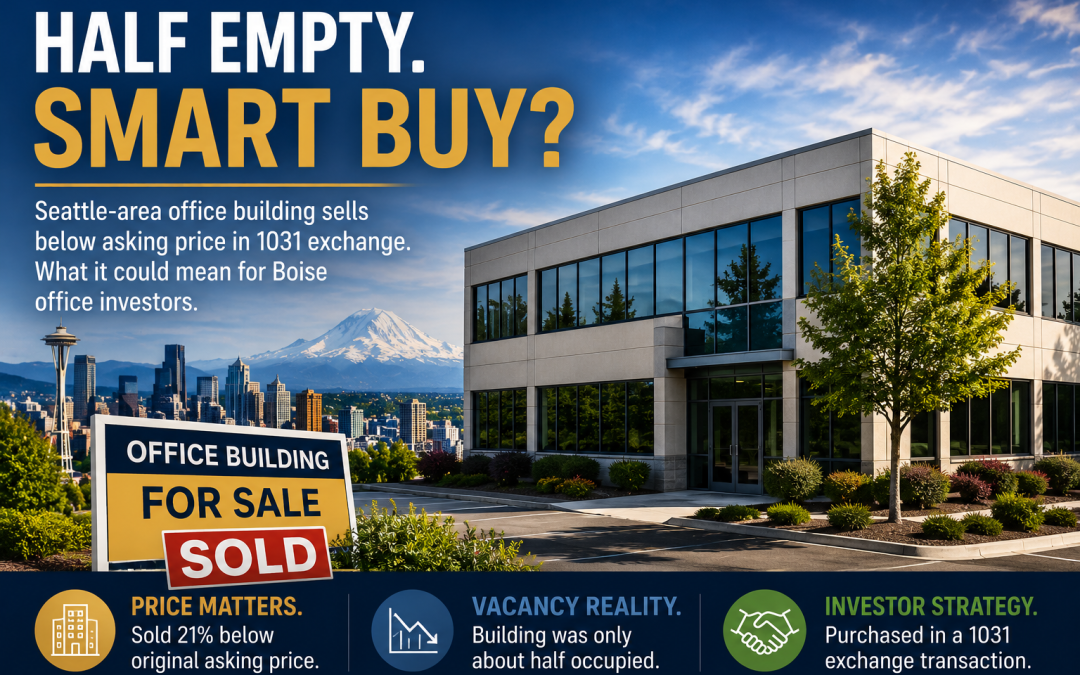
A recent Seattle-area transaction provides a good example. A nearly 60,000-square-foot office building changed hands for $7.75 million after spending almost a year on the market. The property was only about half occupied, and the final price came in well below where the seller originally started.
For Boise commercial real estate investors, the transaction offers a useful look at today’s office market: vacancy creates risk, pricing matters, and properties that need work can still attract capital when the basis makes sense.
According to reporting by Georgina Brown with CoStar AI and CoStar Research, Rosen Harbottle Commercial Real Estate acquired Building C at Northview Corporate Center in Lynnwood, Washington, from MJR Development.
The original CoStar News article can be found here: https://product.costar.com/home/news/887437939
The Numbers Tell the Story
The property at 20816 44th Ave. W. contains 59,219 square feet and was built in 1990.
The building originally came to market at $9.8 million.
After 303 days of marketing, it sold for $7.75 million, or approximately $131 per square foot.
That puts the final transaction about $2.05 million below the original asking price—a discount of roughly 21%.
There is another important number.
The building was only about 49% occupied when it sold, according to CoStar data.
Put those pieces together and you have a transaction that says quite a bit about today’s office investment market.
The buyer wasn’t acquiring a fully stabilized income property.
It was buying existing occupancy plus a substantial amount of vacant space and the opportunity—or risk—of leasing that space over time.
That requires a very different investment strategy.
Vacancy Is Becoming Part of the Investment Thesis
For years, investors often looked for stabilized office properties with long leases, strong tenants and predictable income.
That market still exists.
But today’s office environment has created another category of opportunity: properties with vacancy that can potentially be acquired at a lower basis.
A 49%-occupied building can look frightening if you’re focused exclusively on current income.
An investor looking at the same building may see something different.
They may see existing tenants covering part of the property’s operating costs while providing an opportunity to create value through leasing.
That’s the key distinction.
Vacancy itself isn’t necessarily the deal breaker.
The question is whether the purchase price adequately compensates the buyer for the leasing risk.
For Boise office investors, that means underwriting needs to go well beyond calculating an in-place cap rate.
You need to understand what it could actually cost to stabilize the property.
That can include tenant improvements, leasing commissions, free rent, architectural work, renovations, carrying costs and the time required to find tenants.
A cheap office building can become very expensive if it sits half empty for another three years.
Price Per Square Foot Is Becoming More Important
The roughly $131-per-square-foot purchase price is also worth paying attention to.
Why?
Because today’s office market is increasingly about basis.
Investors aren’t just asking what income a property produces today.
They’re asking:
What am I paying compared with replacement cost?
How much additional capital will the building require?
What rent do I need to justify the purchase?
Can competing landlords offer better space?
And what is the property worth if leasing takes longer than expected?
Those questions are highly relevant to Boise commercial real estate.
Boise office properties vary enormously.
A newer downtown building is a very different investment from an older suburban office property.
Medical office is different from traditional professional office.
A small owner-user building can trade differently from a multi-tenant investment property.
That’s why broad statements like “office is struggling” don’t tell us enough.
Some buildings will struggle.
Others may become interesting specifically because their prices have adjusted.
The 1031 Exchange Adds Another Layer
The Lynnwood acquisition was completed as part of a 1031 exchange.
That matters.
A 1031 exchange can allow a qualifying real estate investor to defer recognition of certain capital gains when proceeds are reinvested into qualifying replacement property, subject to detailed IRS rules and deadlines.
That can influence buyer behavior.
An exchange buyer may be evaluating a property differently from someone simply deciding whether to deploy fresh investment capital.
There is often a deadline involved.
The investor may also be comparing the property against a limited group of replacement opportunities.
But that doesn’t mean exchange buyers will simply overpay.
In a market where financing costs remain important and office fundamentals vary dramatically from building to building, investors still need a defensible basis.
For Boise investment property owners considering a sale, this is one reason properly positioning a property for 1031 buyers can matter.
Properties with durable income, strong locations or identifiable upside can appeal to investors trying to redeploy proceeds.
What This Means for Boise Office Owners
The biggest lesson for Boise landlords may be pricing.
The Washington property spent 303 days on the market before selling roughly 21% below its initial asking price.
That’s a reminder that the market eventually establishes the price.
A seller can choose an asking price.
Buyers determine whether that price works.
If a property has meaningful vacancy, upcoming lease expirations or significant capital requirements, buyers are likely to build those risks into their offers.
Owners who price based on yesterday’s market can end up spending months waiting for a buyer who never appears.
Meanwhile, carrying costs continue.
Taxes continue.
Insurance continues.
Maintenance continues.
Vacant suites continue producing no rent.
Sometimes a lower price today produces a better financial outcome than chasing a higher price for another year.
Opportunity for Owner-Users
There is another angle that could become increasingly important in Boise.
Partially occupied office buildings can sometimes attract owner-users.
Imagine a business that needs 10,000 or 20,000 square feet.
Instead of leasing, it might purchase a larger building, occupy part of it and lease the remaining space to other tenants.
That can turn real estate from an operating expense into a long-term asset.
It isn’t right for every company.
Owning brings additional responsibilities and ties up capital.
But when office pricing adjusts enough, the economics can become interesting.
This could create opportunities in the Boise office market, particularly for established professional firms, healthcare providers and other businesses with predictable long-term space requirements.
Local Insight: Office Isn’t One Market Anymore
I think one of the biggest mistakes investors can make right now is treating “office” as one property category.
It’s becoming increasingly fragmented.
A well-located medical office building can behave very differently from a traditional corporate office property.
A small Boise owner-user building can have a completely different buyer pool from a large multi-tenant asset.
Newer buildings with good parking and amenities may outperform outdated properties only a few miles away.
And a half-empty building purchased at the right price may ultimately outperform a fully leased building purchased too aggressively.
That’s why basis matters.
For Boise commercial real estate investors, I would focus less on whether office is broadly “good” or “bad” and more on the individual property’s fundamentals.
Look at location.
Look at replacement cost.
Look at parking.
Look at tenant improvements.
Look at competing vacancy.
Look at the tenants already there.
Most importantly, realistically calculate how much money and time it will take to stabilize the property.
The Lynnwood transaction provides a useful example.
A nearly 60,000-square-foot office property sat on the market for close to a year, sold below its initial asking price and was only around half occupied when the transaction closed.
Yet a buyer still stepped forward.
That’s the opportunity emerging in parts of today’s office market.
The next cycle of office investing may be less about buying perfectly stabilized properties and more about finding buildings where the price has adjusted enough to make the risk worth taking.
For Boise investors with capital, patience and strong leasing knowledge, that’s a market worth watching.
Mike Gioioso (joy-OH-so) has for 16+ years been helping companies of all sizes buy, build, and lease perfect places for business in greater Boise, Idaho and beyond.
www.streetsmartidaho.com mike@streetsmartidaho.com 208-209-9166
Tags: #boisecommercialrealestate, #boiserealestate, #boiseofficemarket, #boiseofficerealestate, #boiseofficeinvestment, #boiseofficebuildings, #boiseofficespace, #boiseofficeleasing, #boisecommercialproperty, #boiseinvestmentproperty, #boiserealestateinvesting, #boisecommercialrealestateinvestment, #boiseofficevacancy, #boiseofficevacancyrates, #boiseofficesales, #boisecommercialpropertyvalues