
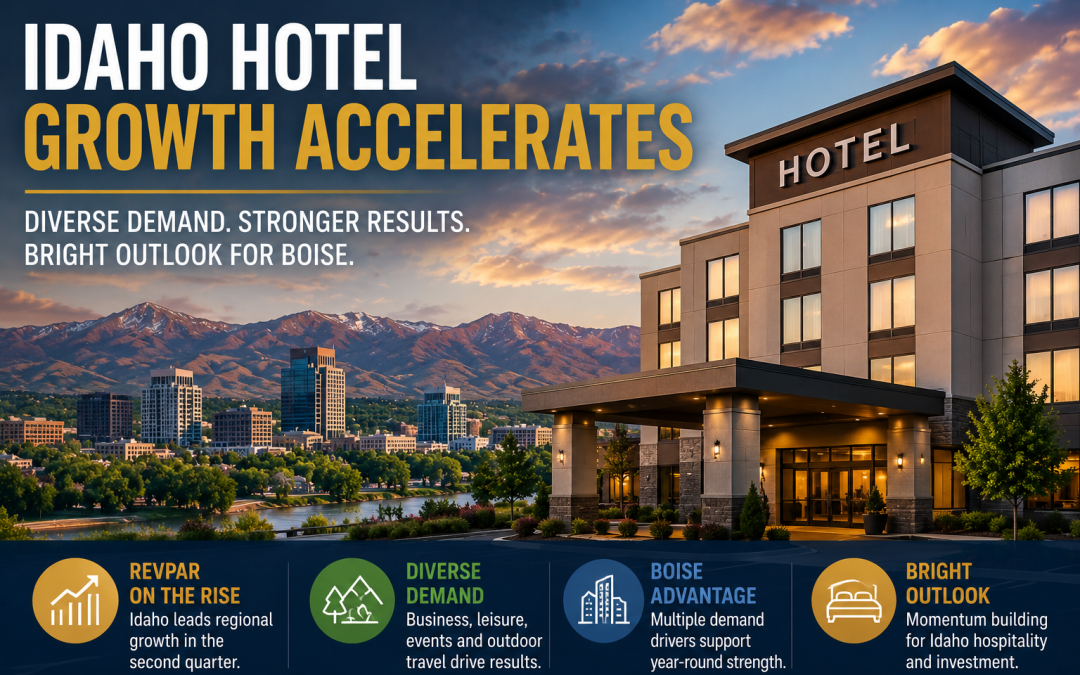
Idaho Hotel Growth Accelerates: What Mountain West Trends Could Mean for Boise Commercial Real Estate
Idaho hotels quietly had one of the stronger first halves of the year in the Mountain West.
Even more interesting is how that growth developed.
Hotel performance in Idaho accelerated during the second quarter, while several neighboring resort markets were still recovering from a difficult winter. For Boise commercial real estate investors and developers, that points to an important advantage: demand tied to a diverse local economy can provide another layer of support beyond tourism alone.
According to reporting by Michael Stathokostopoulos of CoStar Analytics, Idaho posted 6.1% year-to-date growth in revenue per available room, or RevPAR, through the first half of 2026.
Read the original CoStar News analysis here: https://product.costar.com/home/news/1777643104
The bigger story isn’t simply that hotel revenue increased. It’s where the growth occurred and what appears to be driving it.
Idaho Hotel Performance Accelerated in the Second Quarter
RevPAR is one of the most useful measurements in the hotel business because it combines occupancy and room rates into a single performance indicator.
Idaho’s numbers strengthened considerably as 2026 progressed.
According to CoStar, statewide RevPAR growth increased from 3.1% during the first quarter to 8.1% in the second quarter.
That’s a meaningful acceleration.
CoStar pointed to outdoor recreation and expanding regional business travel as contributors to Idaho’s performance.
Across the Mountain West, Montana led first-half growth at 9%, followed by Salt Lake City-Ogden at 7.3%.
Idaho’s 6.1% placed it among the region’s stronger-performing hotel markets, ahead of Colorado Springs at 5.8%, southern Utah at 4.7% and Denver at 3.1%.
Not every market experienced growth.
Parts of Utah, Wyoming and Colorado remained below their previous-year RevPAR levels through the first half, although second-quarter results showed improvement.
That difference matters.
Hotel performance is highly sensitive to what brings visitors into a market.
Some destinations depend heavily on skiing.
Others depend on summer recreation.
Major cities may benefit from corporate travel, conventions, healthcare, government, sporting events and leisure visitors simultaneously.
The more diverse the demand base, the less dependent a hotel can be on one particular travel season.
Boise Has an Important Advantage: Multiple Sources of Demand
This is where the Mountain West data becomes especially relevant to Boise commercial real estate.
Boise isn’t purely a resort destination.
People come here for many different reasons.
Business travel brings visitors into the Treasure Valley throughout the year. Boise State University creates another source of demand. Government activity, healthcare, youth sports, conventions, concerts, family visits and outdoor recreation all contribute to hotel stays.
Then there is the broader growth of the Treasure Valley itself.
Companies opening locations in Boise, Meridian, Nampa and surrounding communities create business travel.
Construction projects bring contractors and consultants.
Corporate relocations generate temporary lodging needs.
New residents often have family and friends visiting.
Sporting events bring teams and families into the market.
Those individual sources may seem small, but collectively they can create a more durable hotel demand base.
Salt Lake City provides an even larger example of the same concept.
CoStar reported that Salt Lake City-Ogden RevPAR growth increased from 6.1% in the first quarter to 8.5% in the second.
The market benefits from technology, healthcare, government, conventions and tourism rather than relying on a single industry.
Major public and private investments are adding another layer of potential demand, including the redevelopment surrounding the Delta Center and Salt Palace and preparations for the 2034 Winter Olympics.
Boise obviously operates at a much smaller scale.
But the underlying lesson applies.
Diverse economies can make hotel markets more resilient.
Resort Markets Show Why Seasonality Matters
The contrast with resort-oriented Mountain West destinations is worth watching.
Several tourism-heavy markets had difficult first quarters before improving substantially during spring and early summer.
Northern Utah, for example, went from a 6.8% RevPAR decline during the first quarter to 5.9% growth in the second.
A broader Colorado resort-oriented area moved from a 7% decline to 3.1% growth.
Wyoming improved as well, narrowing its first-quarter decline substantially during the second quarter.
These swings illustrate one of the biggest risks in hospitality investment: seasonality.
Weather can affect ski seasons.
Wildfires can disrupt summer tourism.
Poor snowpack can reduce winter travel.
Economic uncertainty can change vacation spending.
A hotel that depends primarily on one tourism season can experience major fluctuations in revenue.
Urban hotels aren’t immune to downturns, but having multiple demand generators can provide some protection.
That’s something Boise hotel investors should consider when underwriting properties.
The question shouldn’t simply be, “How many tourists visit Boise?”
It should be, “How many different reasons do people have to stay overnight in Boise?”
That’s a much more useful question.
What This Means for Boise Hotel Development
Strong RevPAR growth naturally attracts developer attention.
But one good year doesn’t automatically mean Boise needs more hotel rooms.
Hotel development requires a deeper look at supply and demand.
Developers should be asking:
- How many rooms are already under construction?
- Which hotel segments are performing best?
- Where is occupancy strongest?
- What happens during slower months?
- Are new demand generators coming into the submarket?
- How much does a new hotel need to charge to justify today’s construction costs?
Location matters enormously.
A downtown Boise hotel serves a different guest than a property near the airport.
A Meridian hotel near major employment and healthcare centers may have a different demand profile from one positioned primarily around interstate traffic.
Hotels near sports facilities can benefit from tournaments and youth travel.
Properties near major employers may capture corporate stays.
Extended-stay hotels can serve relocating employees, construction crews and people between permanent residences.
That means the strongest development opportunity isn’t necessarily where the most hotels already exist.
It may be where demand is growing faster than room supply.
Hospitality Growth Can Benefit More Than Hotels
There is another Boise commercial real estate angle that shouldn’t be overlooked.
Hotel demand creates activity for surrounding businesses.
Visitors eat at restaurants.
They buy coffee.
They shop.
They use entertainment venues.
They rent vehicles.
They visit breweries, attractions and recreation businesses.
That makes hotel development potentially valuable to neighboring retail properties.
A successful hotel can effectively add a temporary population to a trade area every night.
For retail leasing Boise, that’s important.
Restaurants and service businesses located near hotels may have access to customers who aren’t reflected in traditional residential demographic reports.
This is especially relevant in downtown Boise and around major employment, entertainment and transportation corridors.
When evaluating retail sites, I think landlords and tenants should pay more attention to hotel room counts and visitor traffic around the property.
Residential population tells only part of the story.
Investors Still Need to Be Careful
A 6.1% increase in Idaho RevPAR is encouraging.
An 8.1% second-quarter increase is even more interesting.
But hotel real estate remains operationally intensive.
Unlike many traditional commercial properties, hotel revenue can change every night.
A warehouse tenant might sign a seven-year lease.
A hotel effectively has to lease its rooms again tomorrow.
That creates opportunity during strong periods, but it also creates volatility.
Investors need to look beyond headline RevPAR growth.
Operating expenses matter.
Labor costs matter.
Insurance matters.
Property improvement plans matter.
Franchise fees matter.
Financing costs matter.
And new competition can change performance quickly.
A hotel showing strong revenue growth can still produce disappointing investment returns if expenses increase even faster.
That’s why hotel underwriting needs to focus on net operating income, not simply room revenue.
Local Insight: Boise’s Diversity May Be Its Best Hotel Story
The most encouraging part of the CoStar report isn’t that Idaho beat several neighboring markets.
It’s that Idaho’s performance strengthened as the year progressed.
For Boise, I think the bigger opportunity is the diversity of demand developing across the Treasure Valley.
We’re not relying exclusively on ski visitors.
We’re not relying exclusively on summer tourism.
And we’re not relying exclusively on corporate travel.
Boise has pieces of all of them.
Add population growth, business expansion, healthcare, Boise State, government, sporting events, conventions and outdoor recreation, and you get a hotel market supported by many different reasons to visit.
That doesn’t eliminate risk.
But it can make demand more durable.
For Boise hotel investors and developers, I would watch three things closely: the pace of new room construction, which submarkets are producing the strongest year-round occupancy, and whether business travel continues expanding alongside population and employment.
If demand continues growing from multiple sources while hotel supply remains disciplined, Boise hospitality real estate could remain an interesting part of the broader Boise commercial real estate market.
And for retail landlords and developers, stronger hotel performance can be good news even if you never own a hotel.
More overnight visitors ultimately mean more people eating, shopping, spending and moving through the Treasure Valley.
That’s economic activity commercial real estate can use.
Mike Gioioso (joy-OH-so) has for 16+ years been helping companies of all sizes buy, build, and lease perfect places for business in greater Boise, Idaho and beyond.
www.streetsmartidaho.com mike@streetsmartidaho.com 208-209-9166
Tags: #boisecommercialrealestate, #boiserealestate, #boiseofficemarket, #boiseofficerealestate, #boiseofficeinvestment, #boiseofficebuildings, #boiseofficespace, #boiseofficeleasing, #boisecommercialproperty, #boiseinvestmentproperty, #boiserealestateinvesting, #boisecommercialrealestateinvestment, #boiseofficevacancy, #boiseofficevacancyrates, #boiseofficesales, #boisecommercialpropertyvalues