
Airport Expansion Boom Creates New Commercial Real Estate Opportunities
Airports are becoming much more than places to catch a flight. Across North America, they are being rebuilt as major retail centers, employment hubs, transportation gateways, and showcases for their regions.
That shift carries an important lesson for Boise commercial real estate: When passenger growth pushes an airport to expand, the effects can spread far beyond the terminal.
According to reporting by Andy Peters in CoStar News, airports across the United States and Canada are investing billions of dollars to replace aging facilities, increase capacity, improve security, and create a better passenger experience.
Passenger Growth Is Driving a Major Building Cycle
Airport infrastructure is struggling to keep pace with air travel.
The number of passengers boarding flights in the United States is projected to rise from approximately 819.5 million in 2023 to 1.28 billion by 2040, according to figures cited by CoStar. At the same time, many terminals, runways, security areas, and baggage systems were designed decades ago for much smaller crowds.
Airports Council International estimates that U.S. airports will require at least $174 billion in infrastructure investment between 2025 and 2029. That money may support:
- Larger and more efficient terminals
- Additional gates and expanded runways
- Improved passenger drop-off and pickup areas
- Modern security checkpoints
- New parking structures
- Deferred maintenance
- More retail, restaurant, and lounge space
Projects are already underway or recently completed in markets including Portland, Charlotte, New York, San Diego, Montreal, Houston, Los Angeles, and Pittsburgh.
Most airport improvements are funded through a mix of tax-exempt revenue bonds, government grants, passenger charges, airport business income, and—in certain cases—private capital.
This creates a long pipeline of work for architects, engineers, contractors, building-material suppliers, concession operators, and commercial real estate professionals.
Modern Airports Are Becoming Retail Destinations
One of the biggest changes inside today’s airports is the growing focus on food, shopping, and hospitality.
These uses are not simply added for passenger convenience. They are important sources of airport revenue. Restaurants, stores, duty-free businesses, lounges, and other concessions encourage passengers to arrive earlier, stay longer, and spend more money.
Portland International Airport offers a strong example. Its renovated terminal includes a large collection of Oregon-based businesses, including local coffee companies, restaurants, retailers, and well-known regional brands.
This approach gives travelers an immediate sense of place. Instead of creating a terminal that could be located anywhere, Portland designed an environment that feels connected to the Pacific Northwest.
That strategy matters for retail leasing. Airports can give local operators access to a large and steady customer base, but airport locations are not suitable for every tenant. Businesses must be able to handle extended hours, strict security rules, complicated deliveries, staffing challenges, and unusually high customer volume.
For established regional brands, however, an airport storefront can serve two purposes at once: a profitable location and a highly visible marketing platform.
Airport planners are also paying closer attention to where businesses are placed. In Portland, public feedback helped preserve restaurants and stores before the security checkpoints. Those spaces can serve airport employees, arriving passengers, and people meeting or dropping off travelers—not only ticketed passengers.
Regional Design Is Becoming Part of the Investment
Modern airport projects increasingly use local architecture, materials, businesses, and cultural references to introduce travelers to a city.
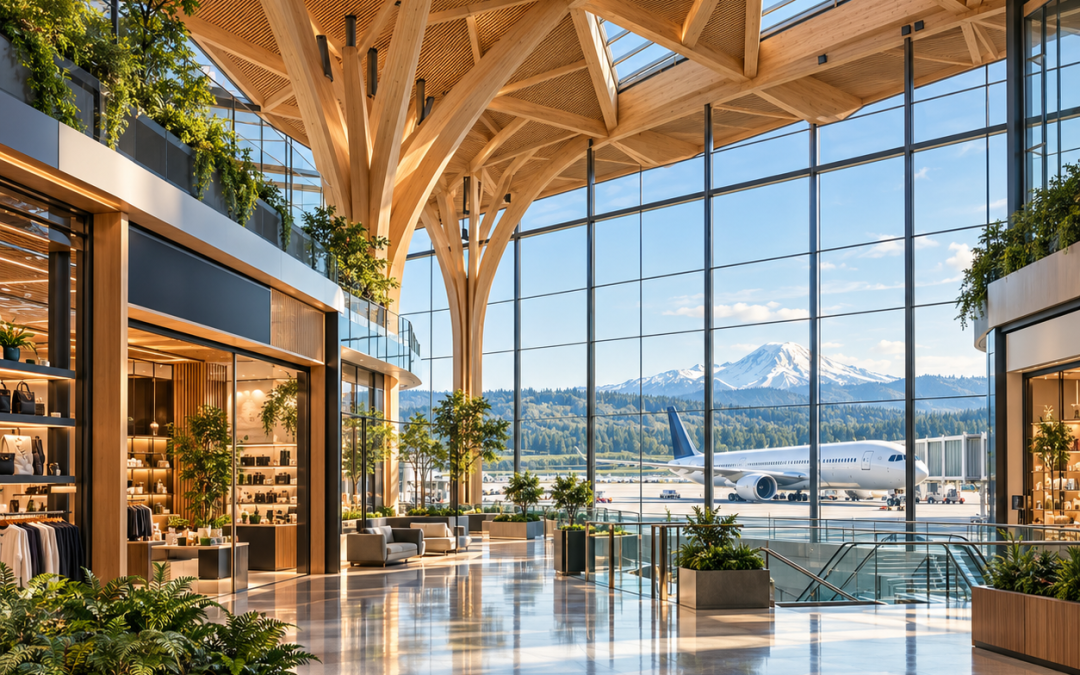
Portland’s new terminal features an expansive mass-timber roof built with Douglas fir sourced from Oregon and Washington. Natural light and live plants support the terminal’s Pacific Northwest identity while also helping improve the building’s overall atmosphere and efficiency.
Charlotte Douglas International Airport took a different approach. Its renovated lobby uses colors, public art, skyline views, and a restored statue of Queen Charlotte to connect the airport to the history and visual identity of the city.
These design decisions may attract attention, but appearance is not the primary reason airports are being rebuilt. The main goal is to remove operational problems.
Airports need enough gates, functional security areas, easier passenger circulation, dependable baggage systems, and adequate ground transportation. Successful design supports those needs while also giving visitors a positive first impression.
That distinction applies to commercial development in Boise as well. A building can look impressive, but it must still work for tenants, customers, employees, and property owners. Good commercial real estate design starts with access, circulation, visibility, parking, operations, and flexibility.
Why This Matters for Boise Commercial Real Estate
An airport is an economic engine whose impact extends well beyond its property boundaries.
As passenger activity increases, nearby areas can experience stronger demand for:
- Hotels and short-term lodging
- Restaurants and convenience retail
- Rental-car and parking facilities
- Warehouses and last-mile distribution space
- Aviation-related industrial buildings
- Office and training facilities
- Service businesses supporting travelers and employees
For Boise development, the national airport investment cycle is worth watching because it shows how transportation growth can reshape surrounding real estate.
Investors should pay attention to land availability, zoning, transportation access, utility capacity, and future road improvements around airport-oriented districts. The strongest opportunity may not always be inside the terminal. It may be a nearby industrial site, hotel parcel, restaurant location, service business, or redevelopment property that benefits from expanding passenger and employment activity.
Landlords should also consider how airport-related tenants use space. These businesses may require early or late operating hours, strong signage, easy vehicle access, secure storage, delivery flexibility, and dependable parking.
Developers should avoid assuming that rising passenger counts automatically justify every project. Airport-area real estate can face height restrictions, noise impacts, specialized zoning, traffic challenges, and limitations related to flight paths. Careful due diligence remains essential.
For retail leasing in Boise, airport growth can also create opportunities for recognizable Idaho companies. Travelers often want local food, products, and experiences. A strong regional operator may help an airport create a sense of place while gaining exposure to residents, business travelers, and visitors.
Local Insight: Function Comes First
My biggest takeaway is that airport construction is not simply an architecture story. It is a capacity and commercial real estate story.
Airports renovate because something is no longer working. Passenger lines are too long. Gates are too limited. Road access is congested. Parking is inadequate. Buildings cost too much to operate. Retail areas fail to capture available spending.
The best projects solve those problems while creating new income and presenting a stronger regional identity.
That same principle should guide Boise commercial real estate decisions. Whether the project is an airport terminal, shopping center, industrial building, or mixed-use development, the property must make life easier for the people using it. Attractive design is valuable, but access, efficiency, tenant mix, flexibility, and long-term operating performance will determine whether the investment succeeds.
Mike Gioioso (joy-OH-so) has for 16+ years been helping companies of all sizes buy, build, and lease perfect places for business in greater Boise, Idaho and beyond.
www.streetsmartidaho.com mike@streetsmartidaho.com 208-209-9166
Tags: #boisecommercialrealestate, #boiserealestate, #boisedevelopment, #boiseairportdevelopment, #boiseairport, #airportcommercialrealestate, #airportexpansion, #airportredevelopment, #airportinfrastructure, #airportretail, #airportconcessions, #retailleasingboise, #boiseretailrealestate, #boiseindustrialrealestate, #boiseinvestmentproperty, #boisecommercialdevelopment, #treasurevalleycommercialrealestate