
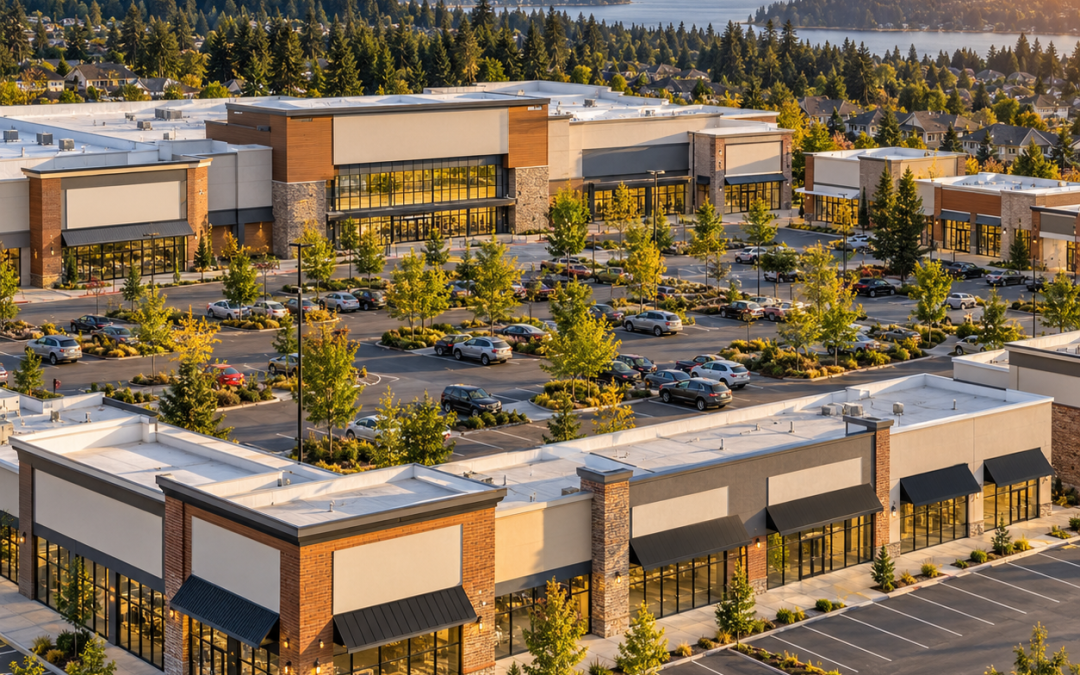
Grocery-Anchored Retail Deal Offers Lessons for Boise Shopping Center Investors
Large shopping centers are attracting investor attention again—but buyers are not necessarily looking for perfect properties.
A recent Washington transaction shows why a strong grocery anchor, steady customer traffic, and meaningful vacancy can make an older retail center appealing. For Boise commercial real estate investors, the deal offers a useful look at how experienced buyers evaluate value-add retail properties.
According to reporting by Randyl Drummer in CoStar News, Tourmaline Capital purchased South Sound Center in Lacey, Washington, for $44.1 million. The California investment firm added the property to its growing portfolio of retail and mixed-use assets across the western United States.
A Strong Anchor Changes the Investment Story
South Sound Center is a nearly 400,000-square-foot shopping center located about five miles east of downtown Olympia. It sits on approximately 31 acres and is one of the larger retail properties in the South Puget Sound region.
The center includes several nationally recognized tenants:
- Trader Joe’s
- Marshalls
- PetSmart
- Michaels
- Target
Trader Joe’s signed a new 10-year lease in November 2025, giving the center an important source of stability before the sale.
That lease likely played a major role in the property’s appeal. Grocery stores create frequent visits and tend to remain more resistant to online competition than many traditional retail categories. A dependable grocer can also help surrounding tenants by bringing customers to the property several times per month rather than only for occasional purchases.
The center reportedly attracts approximately five million visits each year. That level of activity gives the new owner a strong foundation for renewing tenants, filling vacancies, and recruiting businesses that benefit from regular consumer traffic.
This is an important lesson for retail leasing in Boise. A shopping center should not be judged only by its building age or current appearance. The quality of its anchors, customer traffic, access, tenant mix, and surrounding population may be more important to its long-term value.
Vacancy Can Represent Risk—or Opportunity
South Sound Center was approximately 81% occupied when it sold. That means close to one-fifth of the center remained available for lease.
Some investors may view that vacancy as a warning. Tourmaline Capital appears to see potential upside.
Based on the reported size and purchase price, the acquisition works out to roughly $110 per square foot. With approximately 19% vacancy, the center may have around 76,000 square feet of space available, although the exact amount would depend on the property’s final rentable area.
If Tourmaline can lease a meaningful portion of that space, improve the tenant mix, and increase rents over time, the center’s net operating income and market value could rise. Physical improvements may also help reposition the property and attract stronger tenants.
This is a classic value-add retail strategy:
- Buy a property with a strong location and dependable anchors.
- Improve leasing, operations, and the physical environment.
- Increase occupancy and rental income.
- Create a more valuable and financeable asset.
The opportunity is real, but so is the execution risk. Large vacancies can take time and money to fill. Older centers may also require expensive improvements to roofs, parking lots, mechanical systems, storefronts, lighting, landscaping, and signage.
A buyer must understand whether the vacant space matches current tenant demand. A former big-box space, for example, may need to be divided into smaller suites or converted for entertainment, fitness, medical, education, or other nontraditional retail uses.
What Boise Investors and Landlords Should Watch
This sale comes during an active period for grocery-anchored shopping centers in the Seattle and Olympia region. CoStar reported that retail property sales in the broader market could match or exceed the $1.3 billion recorded in 2025.
Boise is a different market, but several of the same investment principles apply.
Grocery-anchored centers across the Treasure Valley can offer durable traffic and a range of leasing opportunities. The most attractive properties typically combine a productive anchor with good visibility, convenient access, strong nearby households, and space that can adapt to changing tenant demand.
For investors evaluating Boise commercial real estate, key questions include:
- How long is the anchor tenant committed to the property?
- Does the anchor generate traffic for the smaller tenants?
- How much income is concentrated in one or two businesses?
- Are existing rents above or below the current market?
- What improvements will be required over the next several years?
- Can the vacant spaces be leased in their current condition?
- Does the property have excess land or redevelopment potential?
- Are access, parking, and signage competitive with newer projects?
Landlords should also pay attention to the balance between national and local tenants. Major brands can strengthen credit and customer recognition, while good local operators can make a center feel more relevant to the surrounding community.
For tenants, an established shopping center may provide more visibility and customer traffic than a newer but less proven project. However, businesses should examine where their suite sits within the center, how customers move through the property, and whether the anchor’s shoppers overlap with their target audience.
Local Insight: Older Retail Can Still Create New Value
My takeaway is simple: A shopping center does not need to be fully leased or newly built to attract serious capital.
South Sound Center dates back to the 1960s, yet its location, national tenants, grocery anchor, and annual traffic made it an appealing investment. Its vacancy may actually be part of the reason the buyer pursued it because empty space creates room to improve income.
The same idea applies to Boise development and investment property decisions. Some of the best opportunities may be older centers with solid real estate but weak leasing, outdated branding, or an incomplete tenant mix.
The key is separating a fixable problem from a permanent one.
Vacancy caused by poor marketing, tired storefronts, or passive ownership may be corrected. Vacancy caused by weak access, declining traffic, an oversized building, or limited tenant demand can be much harder to solve.
Before buying a value-add shopping center, investors should study leasing demand, tenant improvement costs, expected downtime, capital repairs, and realistic rent levels. The right property can reward patient ownership, but the business plan must be based on achievable leasing—not optimistic assumptions.
Mike Gioioso (joy-OH-so) has for 16+ years been helping companies of all sizes buy, build, and lease perfect places for business in greater Boise, Idaho and beyond.
www.streetsmartidaho.com mike@streetsmartidaho.com 208-209-9166
Tags: #boisecommercialrealestate, #boiserealestate, #boiseretailrealestate, #boiseshoppingcenters, #boiseinvestmentproperty, #boisecommercialproperty, #retailleasingboise, #boiseretailinvestment, #boisedevelopment, #groceryanchoredshoppingcenters, #groceryanchoredretail, #shoppingcenterinvestment, #valueaddretailproperty, #retailpropertyinvestment, #shoppingcenterredevelopment