
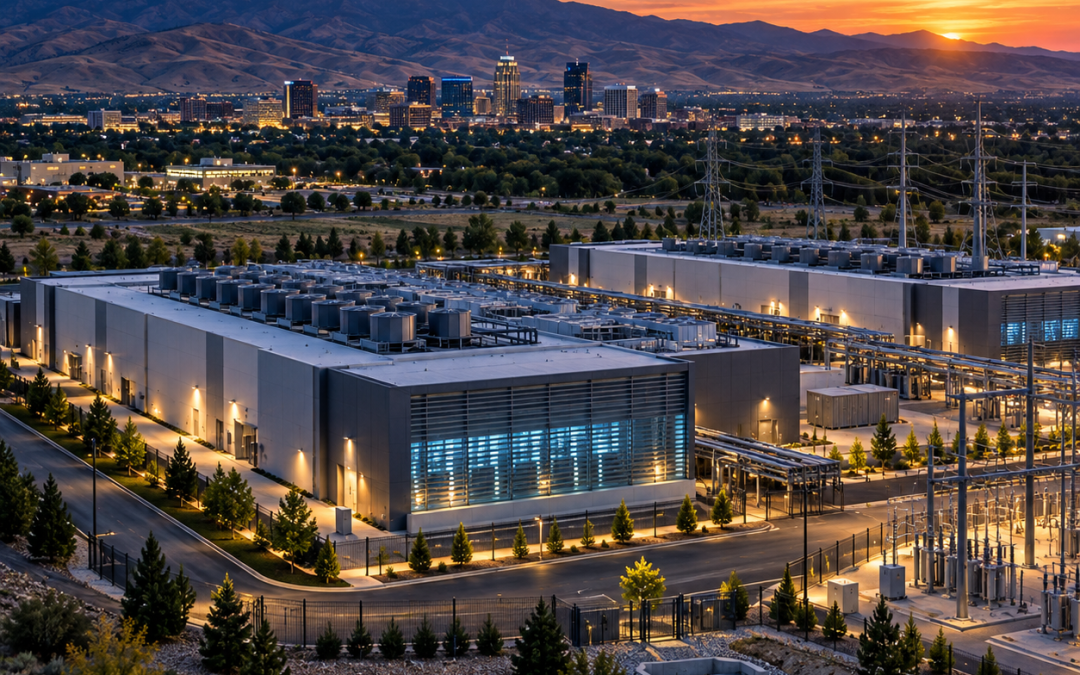
Data Center Growth Is Becoming a Real Estate and Community Planning Issue
Artificial intelligence may live online, but the infrastructure supporting it has a very large physical footprint.
Data centers require land, industrial-scale buildings, dependable power, cooling systems, fiber connections, and extensive utility infrastructure. As development accelerates, communities are asking harder questions about who receives the economic benefits—and who pays for the supporting infrastructure.
According to reporting by Lou Hirsh in CoStar News, data center development is becoming an issue in elections and public debates across several states. The report also explored the uncertain economic effects of artificial intelligence and a proposal to place computing equipment underwater near Alaska.
For Boise commercial real estate, the larger message is clear: Data centers are no longer just technology projects. They are land-use, utility, economic development, and public-policy decisions.
Data Center Approvals Are Facing More Public Scrutiny
The rapid construction of AI infrastructure has created opposition in communities around the country.
Residents and public officials are raising questions about electricity demand, water consumption, tax incentives, utility costs, noise, land use, and the number of permanent jobs created after construction is complete.
These concerns have entered political discussions in Ohio, Texas, Michigan, Missouri, Pennsylvania, and Utah, according to CoStar’s reporting. In Ohio, a Republican Senate campaign organization warned that disputed data center projects could affect voter attitudes in a competitive U.S. Senate race.
The issue is not limited to one party or state. Communities are increasingly asking three basic questions:
- Who benefits from the project?
- Who pays for the required infrastructure?
- Why is the development good for the community?
Those are reasonable commercial real estate questions as well.
A large project may increase the tax base and generate construction activity, but it can also require major investments in substations, transmission systems, roads, utilities, and emergency services. If those costs are passed to residents or unrelated businesses, public support can disappear quickly.
Developers should expect data center applications to receive more scrutiny than a typical industrial building. Community engagement, infrastructure planning, and clear explanations of local benefits may become as important as site control and financing.
AI Investment Could Reshape Industrial Real Estate
The financial scale of the AI boom is difficult to ignore. Global investment in data centers and related AI infrastructure has been projected to exceed $7 trillion by 2031, according to Goldman Sachs figures cited in the CoStar report.
The possible economic payoff is also significant—but far from certain.
Oxford Economics estimates that steady AI adoption could raise U.S. productivity by approximately 3.5% over the next decade. Its modeling also shows a much wider range of possible outcomes, depending on how quickly companies adopt the technology and how well labor markets adjust.
A successful expansion could create demand for:
- Data center campuses
- Power-generation and utility sites
- Advanced manufacturing facilities
- Equipment warehouses
- Fiber and telecommunications infrastructure
- Contractor and engineering space
- Offices for technical and operations teams
However, the investment cycle carries risk. If AI does not produce the expected business returns, companies may reduce or delay infrastructure spending. Regulatory delays, power shortages, equipment costs, and public opposition could also slow development.
Labor disruption adds another layer of uncertainty. AI may improve productivity, but rapid job displacement could reduce household income and consumer spending if workers cannot move into new roles quickly enough.
That would affect more than the technology sector. Retail leasing, office demand, housing, hospitality, and other parts of commercial real estate depend on healthy employment and consumer activity.
Local Impact for Boise Development
The Treasure Valley offers several features that can attract technology and infrastructure investment, including available land, a growing population, an established technology sector, and access to regional transportation routes.
But a suitable data center site requires much more than acreage.
Before pursuing this type of Boise development, investors and property owners should examine:
- Available electrical capacity
- The timing and cost of connecting to the power grid
- Water requirements and cooling alternatives
- Fiber availability and redundancy
- Zoning and entitlement requirements
- Environmental and neighborhood impacts
- Backup power and fuel-storage needs
- Noise from cooling and electrical equipment
- Distance from homes and other sensitive uses
- Construction timelines for supporting infrastructure
Power may be the most important factor. A property can have good zoning, strong access, and plenty of land but still be unsuitable if the required electricity is unavailable or would take years to deliver.
This changes how certain industrial properties should be marketed. A site near transmission infrastructure, substations, major fiber routes, or existing utility capacity may have strategic value that is not obvious from its location or acreage alone.
However, property owners should not assume that proximity to a power line guarantees capacity. Utility studies, engineering work, and direct coordination with service providers are essential before advertising a site for a power-intensive use.
Landlords should also be careful when evaluating smaller technology tenants. Data-intensive users can require additional power, cooling, security, backup generation, and building improvements. The lease must clearly address who pays for upgrades, how equipment is removed, and what happens if the tenant’s power needs increase.
Innovation Is Pushing Data Centers Beyond Traditional Sites
The physical challenges associated with data centers are encouraging developers to consider unusual locations and construction methods.
CoStar highlighted a DeepGreen Cook Inlet SPV proposal involving subsea computing equipment and tidal energy infrastructure near Alaska. The concept is designed to use surrounding water for passive cooling while reducing some of the land and utility constraints affecting traditional projects.
Since the original CoStar report, the Federal Energy Regulatory Commission published a notice concerning the preliminary permit application. The federal notice describes a proposed system with hundreds of marine turbines, subsea computing pods, and an underwater power and fiber connection. A preliminary permit would support feasibility studies; it would not authorize construction.
The concept remains highly unusual, and it faces technical, environmental, regulatory, and financial questions. Similar ideas have generated opposition elsewhere.
Still, the proposal demonstrates how valuable power and cooling capacity have become. Developers are exploring locations that would have seemed unrealistic only a few years ago because conventional sites increasingly face land, energy, and community constraints.
Local Insight: Community Support Is Now Part of Site Selection
My take is that the next generation of data center deals will not be decided by land price alone.
Power availability, infrastructure costs, public trust, and political acceptance will increasingly determine which projects move forward. A site may look excellent on paper, but community opposition or a delayed utility connection can change the entire investment.
For Boise commercial real estate investors, that means due diligence needs to begin earlier and reach further. Buyers should speak with utilities, planning departments, engineers, economic development groups, and neighboring property owners before making major commitments.
Developers should also provide specific answers about employment, tax revenue, water use, energy demand, noise, infrastructure costs, and long-term community benefits. Broad promises about innovation may not be enough.
For local governments, the challenge is finding a balance. Communities want economic growth and technology investment, but they also need to protect residents, water resources, utility customers, and future development capacity.
The strongest data center projects will likely be those that solve an infrastructure problem rather than create one. In the Boise market, a well-located and carefully planned facility could support investment and expand the tax base. A poorly planned project could consume valuable resources while delivering fewer local benefits than expected.
Data center development is therefore becoming more than a specialized industrial real estate category. It is a test of how communities manage rapid growth, new technology, and limited infrastructure.
Mike Gioioso (joy-OH-so) has for 16+ years been helping companies of all sizes buy, build, and lease perfect places for business in greater Boise, Idaho and beyond.
www.streetsmartidaho.com mike@streetsmartidaho.com 208-209-9166
Tags: #boisecommercialrealestate, #boiserealestate, #boisedatacenters, #idahodatacenters, #boiseindustrialrealestate, #boisedevelopment, #boisetechnologysector, #boiseaiinfrastructure, #artificialintelligencerealestate, #aidatacenters, #datacenterdevelopment, #datacenterinvestment, #industrialpropertyboise, #idahocommercialrealestate, #treasurevalleycommercialrealestate, #powerinfrastructure, #utilitycapacity