
Data Centers in Space Could Reshape Technology Real Estate on Earth
The next major data center may not be built in an industrial park. It could be launched into orbit.
That idea still sounds futuristic, but investors are placing serious money behind it. Technology companies are exploring space-based computing as traditional data centers face land shortages, power constraints, cooling demands, and growing resistance from communities.
According to reporting by Lou Hirsh in CoStar News, satellite technology company Starcloud raised $250 million to expand its work on orbital data centers. The investment provides another sign that the physical infrastructure behind artificial intelligence is becoming a major commercial real estate and economic development issue.
For Boise commercial real estate, the story is not really about whether a data center will soon orbit over Idaho. It is about what companies are willing to do to overcome the challenges of building these facilities on the ground.
Investors Are Funding a New Type of Infrastructure
Starcloud is based in Redmond, Washington, and was founded in 2024. Its latest funding round valued the business at approximately $2.3 billion and increased its total capital raised to $450 million.
The $250 million round was led by Manhattan West. Other participants included Nvidia, Cisco Investments, Cedar Capital, Goanna Capital, Standard Capital, and existing investors.
Reuters also reported that the company plans to use the money for manufacturing expansion, engineering work, and the equipment required for future spacecraft.
Starcloud’s long-term vision is enormous: a network of 88,000 satellites capable of providing 20 gigawatts of computing capacity. That remains a goal rather than an operating data center network. No complete commercial data center currently operates in space.
The company has already taken smaller steps toward proving the concept. It worked with Nvidia on a satellite launched in November 2025 and is preparing additional equipment for a future mission. The hardware must function under conditions that are very different from those inside an ordinary industrial building.
Space-based computing equipment must withstand radiation, extreme temperatures, launch forces, and limited repair access. Cooling is also handled differently. Instead of using the air- and water-based systems found in ground facilities, orbital hardware may depend on large radiators to release heat.
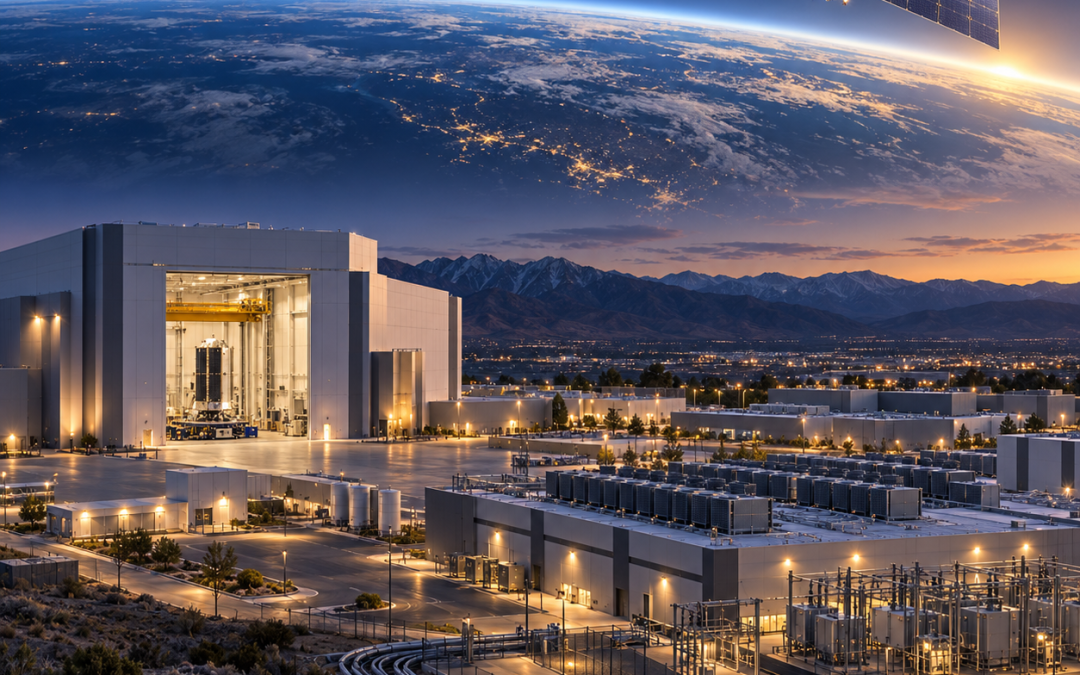
Starcloud is developing its next generation of spacecraft at a new 100,000-square-foot manufacturing facility in Woodinville, Washington. That building is an important part of the commercial real estate story.
Even if future computing moves off the planet, companies will still need real estate on Earth for:
- Research and engineering
- Satellite manufacturing
- Component storage
- Testing and assembly
- Mission operations
- Launch support
- Offices and employee training
- Supply-chain and contractor activity
In other words, orbital data centers would not eliminate demand for industrial real estate. They could create a new category of specialized manufacturing and support facilities.
Why Companies Want to Move Computing Off the Ground
Artificial intelligence requires massive computing power. That demand is pushing companies to build larger data centers, install more advanced chips, and secure enormous amounts of electricity.
Goldman Sachs has projected that worldwide spending on data centers and related AI systems could exceed $7 trillion by 2031, according to the figures cited by CoStar.
But building these facilities on Earth is becoming more difficult.
Communities are raising concerns about water consumption, electrical demand, utility costs, noise, land use, and tax incentives. In some markets, a lack of power is delaying projects even when developers have land and approvals.
Space-based systems are being presented as one possible solution. In orbit, solar energy may be more consistent because it is not affected by clouds or ordinary weather. Orbital facilities would also avoid some of the land and water constraints faced by traditional projects.
However, the concept introduces a different set of problems:
- High launch expenses
- Difficult equipment repairs
- Radiation exposure
- Heat management
- Communications delays and capacity
- Space debris
- Equipment replacement
- Regulatory approvals
- Environmental concerns
- Dependence on launch schedules
The technology may eventually become workable, but that does not automatically mean it will be less expensive than a well-located data center on Earth.
Starcloud is not alone in exploring the idea. SpaceX has outlined plans for a very large network of AI-focused satellites. Blue Origin has also applied for permission to deploy an orbital computing system known as Project Sunrise.
An FCC public notice describes Blue Origin’s request to deploy and operate as many as 51,600 satellites for space-based data processing. An application is not the same as an approved or completed system, but it demonstrates how seriously major technology companies are considering orbital infrastructure.
What This Means for Boise Commercial Real Estate
The Boise market is unlikely to compete directly for a giant orbital computing network. However, the forces driving this investment already matter locally.
The Treasure Valley has an established technology sector, growing industrial development, available land, and access to regional transportation. Those advantages could support smaller data centers, technology manufacturing, equipment suppliers, research operations, and other AI-related businesses.
For Boise development, the bigger opportunity may be in the support network rather than a hyperscale data center itself.
Potential users could include:
- Electronics and chip-related suppliers
- Specialized manufacturers
- Aerospace and satellite contractors
- Cooling-system companies
- Fiber and telecommunications providers
- Engineering and software firms
- Backup-power and electrical contractors
- Secure warehousing and logistics operations
These businesses may require industrial or flex buildings with more power, stronger security, specialized ventilation, clean production space, loading access, and room for technical equipment.
Landlords should ask detailed questions before signing a technology tenant. The tenant’s power demand, cooling requirements, equipment weight, backup generation, security needs, and future expansion plans can affect both the lease and the building.
A standard industrial suite may require major upgrades to support these operations. The lease should clearly state who pays for those improvements, who owns them, and what must be removed when the tenant leaves.
Investors should also recognize that utility capacity is becoming a major part of property value. In some cases, available power and fiber may matter more than building appearance or freeway visibility.
Before buying or marketing a property for data center or technology use, owners should verify:
- Current electrical service
- Additional capacity available from the utility
- Expected upgrade costs
- Connection timelines
- Fiber availability
- Backup-power restrictions
- Zoning and permitting requirements
- Noise and environmental limitations
A property should never be promoted as suitable for a power-intensive user based only on a nearby transmission line or substation. Capacity must be confirmed through utility and engineering work.
Local Insight: The Biggest Opportunity May Stay on Earth
My take is that orbital data centers remain highly speculative, but the investment behind them sends a clear message.
The demand for AI computing has become so large that companies are considering space, underwater installations, new power sources, and other unconventional solutions. That tells us how difficult—and valuable—it has become to secure suitable infrastructure on Earth.
For Boise commercial real estate investors, this does not mean chasing every futuristic idea. It means paying closer attention to the practical assets that make technology possible: powered land, fiber-connected buildings, specialized industrial space, manufacturing facilities, and locations with a realistic path to utility expansion.
The most valuable real estate opportunity may not be the data center itself. It could be the building where satellites are assembled, the warehouse storing electrical equipment, the office housing engineers, or the industrial parcel positioned near dependable power and fiber.
Technology changes quickly, but it still needs physical places to be designed, tested, manufactured, managed, and supported. That connection between digital growth and physical real estate is where Boise-area owners, developers, and investors should focus.
Mike Gioioso (joy-OH-so) has for 16+ years been helping companies of all sizes buy, build, and lease perfect places for business in greater Boise, Idaho and beyond.
www.streetsmartidaho.com mike@streetsmartidaho.com 208-209-9166
Tags: #boisecommercialrealestate, #boiserealestate, #boisedatacenters, #boisetechnologyrealestate, #boiseindustrialrealestate, #boisedevelopment, #boiseaiinfrastructure, #artificialintelligencerealestate, #orbitaldatacenters, #spacebaseddatacenters, #satellitetechnology, #aerospacerealestate, #technologyinfrastructure, #datacenterinvestment, #industrialpropertyboise, #flexspaceboise, #poweredland, #datacentersiteselection