
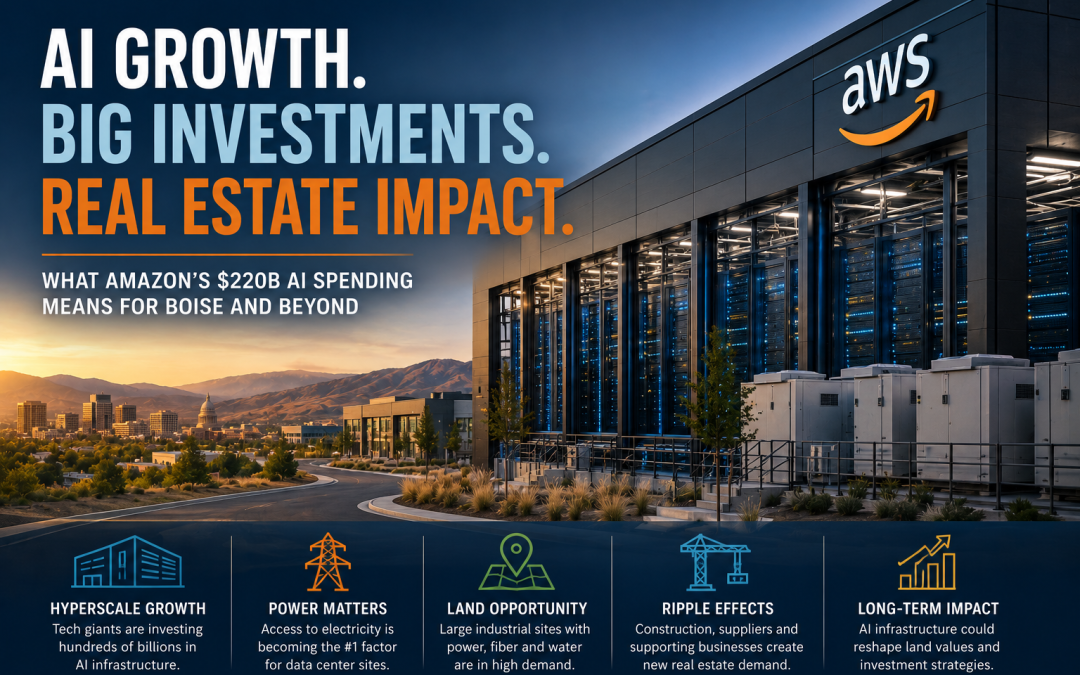
Amazon’s AI Data Center Spending Boom Could Reshape Commercial Real Estate Far Beyond Tech Hubs
Artificial intelligence may live in the cloud, but the infrastructure behind it is very physical.
It requires land, enormous buildings, electrical substations, transmission capacity, cooling systems, fiber connections and billions of dollars in construction.
Amazon’s latest spending plans show just how large that physical buildout is becoming. And while Boise isn’t one of the country’s major hyperscale data center markets today, the trend has implications for Boise commercial real estate, power-intensive development, industrial land and infrastructure planning across Idaho.
According to reporting by Randyl Drummer of CoStar News, Amazon is increasing its investment in AI and cloud infrastructure after Amazon Web Services posted strong sales growth. The original CoStar News article details Amazon’s latest earnings, capital spending and data center strategy.
AI Is Turning Into a Massive Real Estate and Infrastructure Business
Amazon’s numbers help put the scale of the AI boom into perspective.
Amazon Web Services reported quarterly sales of $42.2 billion, up 37% from a year earlier. Overall Amazon revenue topped $200 billion, increasing 20%.
That growth is giving Amazon confidence to spend even more.
The company increased its estimated annual spending to approximately $220 billion, up from its previous $200 billion projection, with artificial intelligence representing a major focus.
Amazon also reported $54.3 billion of capital spending during the latest quarter, much of it connected to AI infrastructure. That figure was roughly two-thirds higher than the comparable period a year earlier.
CEO Andy Jassy has an enormous long-term ambition for AWS. During the company’s earnings call, he suggested the cloud business could eventually become a trillion-dollar annual revenue operation.
If anything close to that happens, considerably more infrastructure will be required.
That’s where commercial real estate enters the story.
AI doesn’t simply require better software.
It requires more data centers.
And data centers require real estate.
The New Site-Selection Question: Can You Deliver the Power?
For traditional Boise development, we often talk about familiar site-selection factors: location, access, zoning, visibility, traffic counts, labor and utilities.
Data centers change that formula.
For hyperscale projects, access to electricity can become one of the most important site-selection factors.
A developer might control hundreds of acres of perfectly located industrial land, but if the required electrical capacity can’t be delivered within an acceptable timeframe, the site may not work.
That changes how certain land should be evaluated.
The most valuable future data center sites may not necessarily be closest to a major downtown. Instead, they may be locations where developers can assemble large parcels and secure power, fiber and water or alternative cooling infrastructure.
This is one reason AI development could eventually create opportunities in places that historically weren’t considered major technology markets.
Real estate is only part of the equation.
Infrastructure is the real constraint.
Hundreds of Billions Are Chasing AI Infrastructure
Amazon isn’t alone.
Microsoft, Meta and other major technology companies are committing extraordinary amounts of capital to artificial intelligence.
CoStar reported that Meta raised its projected AI-related spending to $145 billion for the year. Microsoft has also continued investing heavily in hyperscale campuses supporting its Azure cloud platform.
Investors are increasingly asking whether these expenditures will generate adequate returns.
Amazon’s latest results provided some encouragement.
AWS growth accelerated, and Amazon’s investment in Anthropic—the company behind Claude—also contributed to the financial picture. Amazon reported quarterly profit of $62.6 billion.
But there’s another side to the spending boom.
Amazon reported negative free cash flow of $7.6 billion as investment in property and equipment climbed sharply.
The company is also using debt markets to help fund expansion. Since June, Amazon has disclosed plans involving $25 billion in bonds along with a $17.5 billion credit facility through Citibank, according to CoStar’s reporting.
That’s a reminder of how capital-intensive the AI race has become.
These aren’t ordinary technology investments.
They are among the largest infrastructure programs being undertaken by private companies.
What This Could Mean for Boise Commercial Real Estate
Boise doesn’t need to become the next Northern Virginia data center corridor for this trend to matter locally.
There are several potential effects worth watching.
First is industrial land.
Large technology infrastructure projects can change the value equation for land that has access to substantial utility infrastructure.
Second is power availability.
As Idaho continues attracting manufacturing, industrial users and technology companies, competition for electrical capacity could become increasingly important.
Third is construction demand.
Data centers require contractors, engineers, electricians, mechanical specialists, equipment suppliers and a large ecosystem of supporting businesses.
That activity can create secondary demand for industrial, flex and office space even outside the data center campus itself.
Finally, there is the broader issue of economic development.
Communities looking to attract AI infrastructure will need to think carefully about land-use policy, electrical infrastructure, tax incentives, water resources and the actual employment benefits these projects produce.
A massive capital investment doesn’t necessarily translate into a massive permanent workforce.
That makes the economic-development calculation different from a conventional manufacturing facility.
Data Centers Could Change How Investors Look at Land
From an investment perspective, one of the most interesting effects of the AI boom could be the repricing of certain industrial and development sites.
Historically, commercial land values have often been driven by location, entitlements and surrounding growth.
Those factors still matter.
But infrastructure capacity may become increasingly important.
Imagine two similar industrial parcels.
One has a clear path to substantial electrical capacity and fiber connectivity.
The other doesn’t.
Those properties might look almost identical on a traditional commercial real estate map, yet their potential value to a data center developer could be dramatically different.
For Idaho landowners, that means understanding utility infrastructure could become an increasingly important part of due diligence.
The question isn’t simply:
“Is power available?”
It is:
“How much power is available, how quickly can it be delivered, and what will it cost to bring it to this site?”
Those are very different questions.
Local Insight: Idaho Should Watch the Infrastructure Before the Buildings
From my perspective, the biggest Boise commercial real estate takeaway isn’t whether Amazon will announce a giant Treasure Valley data center tomorrow.
The bigger question is whether Idaho’s infrastructure could support the next generation of power-intensive development.
That’s what I would watch.
Data center announcements usually happen after years of utility planning, land assembly, engineering and infrastructure discussions.
By the time the buildings appear, many of the important real estate decisions have already been made.
For investors and developers, that means following power infrastructure can sometimes provide more insight than simply following commercial listings.
Where are transmission upgrades happening?
Where is additional generating capacity planned?
Which industrial areas have substantial power nearby?
Where can large sites be assembled?
What areas have strong fiber connectivity?
And perhaps most importantly, where can new electrical demand realistically be served without creating unacceptable costs or delays?
Those questions could become increasingly important for Boise investment property and industrial land throughout southwest Idaho.
AI Growth Creates Opportunity — but Also Risk
There is another lesson in Amazon’s numbers that commercial real estate investors shouldn’t ignore.
Booms can create overbuilding.
Technology companies are currently racing to build capacity because AI demand is growing rapidly. But these projects are extraordinarily expensive, and some analysts are questioning whether every dollar invested will ultimately generate adequate returns.
Amazon itself acknowledged the near-term cash-flow pressure created by constructing many data centers before they begin producing revenue.
Commercial real estate has seen this pattern before.
Strong demand attracts capital. Capital creates new supply. Eventually the market has to determine whether demand can absorb everything that was built.
AI may ultimately justify today’s massive investment.
But investors shouldn’t assume every proposed data center, industrial park or AI-related development will succeed simply because the sector is growing.
Location, power, financing, technology and customer demand still matter.
The Physical Side of Artificial Intelligence Is Just Beginning
The AI story is usually told through software, chips and new applications.
Commercial real estate professionals should be watching the physical side.
Amazon’s planned $220 billion spending program demonstrates just how much real-world infrastructure is being built behind the digital economy.
That means more demand for land, electricity, fiber, construction and highly specialized buildings.
For Boise commercial real estate, the immediate opportunity may not be a wave of hyperscale campuses.
Instead, the bigger opportunity may be understanding how this infrastructure boom changes industrial site selection, utility planning and land values over the next decade.
Artificial intelligence might be digital.
Its real estate footprint is anything but.
Mike Gioioso (joy-OH-so) has for 16+ years been helping companies of all sizes buy, build, and lease perfect places for business in greater Boise, Idaho and beyond.
www.streetsmartidaho.com mike@streetsmartidaho.com 208-209-9166
Tags: #boisecommercialrealestate, #boisedevelopment, #idahocommercialrealestate, #datacentersidaho, #boisedatacenters, #artificialintelligencerealestate, #amazonwebservices, #industriallandboise, #boiseindustrialrealestate, #treasurevalleycommercialrealestate, #idahopowerinfrastructure, #aidatacenters, #boiseinvestmentproperty, #industrialdevelopmentidaho, #commercialrealestateinvestment