
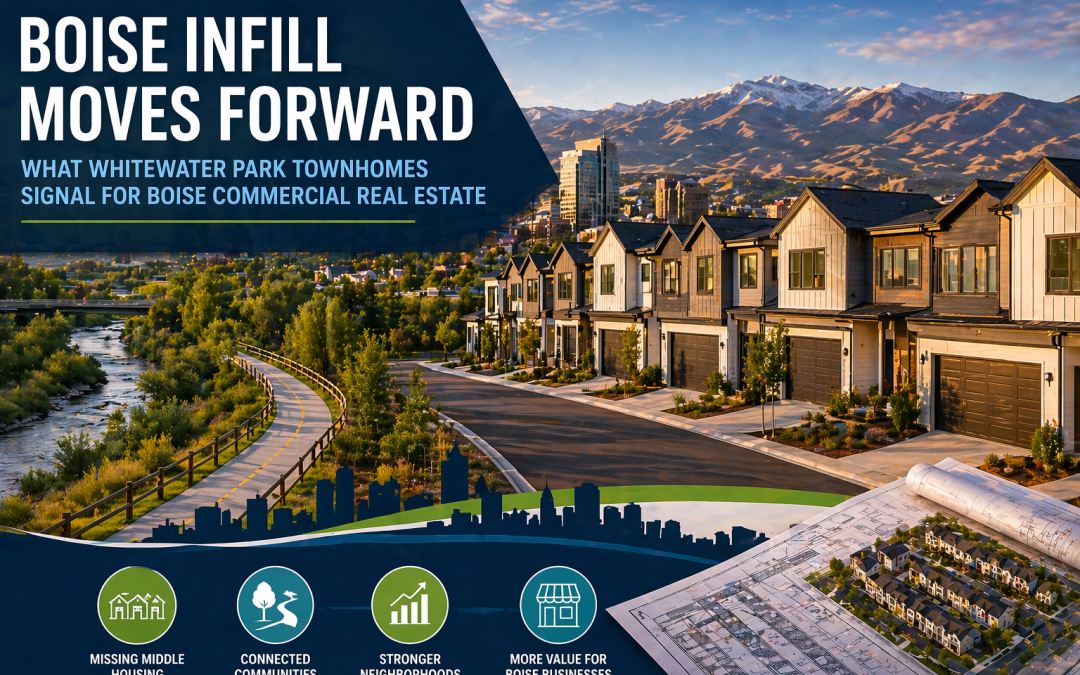
Boise Infill Moves Forward: What Whitewater Park Townhomes Signal for Boise Commercial Real Estate
Not all development battles are about if something gets built.
Sometimes, they’re about what kind of housing a city is willing to accept.
And in Boise, a recent decision near Whitewater Park Boulevard highlights a growing tension in the market—while also signaling where Boise commercial real estate and housing development are headed next.
A Key Infill Decision in a High-Demand Location
According to reporting by Idaho Press (read the original article here: https://www.idahopress.com/news/planning-zoning-makes-room-for-townhomes-on-whitewater-park-boulevard/article_0a68e7a8-9469-4228-b408-a7c1a8ec74b7.html), the Boise Planning and Zoning Commission approved a rezoning request to allow a new townhome development in north Boise.
Here’s what’s planned:
- 66 for-sale townhomes on roughly 3.5 acres
- Located near Whitewater Park Boulevard, close to the Greenbelt and Quinn’s Pond
- Units expected to range from two to three bedrooms
- Estimated pricing between $500,000 and $800,000
- Developed on land owned by the Boise Housing Authority
The approval came despite neighborhood opposition, with concerns focused on traffic, parking, and the loss of open space.
What’s Really Happening: The Rise of “Missing Middle” Housing
This project isn’t just about one site—it’s part of a broader shift in Boise’s housing strategy.
At the center of the conversation is something developers and planners call “missing middle” housing:
- Not apartments
- Not large single-family homes
- But something in between—like townhomes
Why does this matter?
Because Boise is running out of easy options.
- Land is limited in core areas
- Construction costs remain high
- Entry-level single-family homes are increasingly out of reach
Townhomes are becoming one of the few viable ways to:
👉 Add ownership opportunities
👉 Increase density without high-rise development
👉 Keep projects financially feasible
Why This Matters for Boise Commercial Real Estate
Even though this is a housing story, the ripple effects hit directly into Boise development and leasing strategy.
1. Infill Development Is Winning
Boise is clearly prioritizing:
- Development inside existing neighborhoods
- Projects near amenities like parks, trails, and transit
- Higher density in already built-out areas
For investors, this means:
👉 The most valuable land isn’t on the outskirts—it’s in infill locations like this one.
2. Density Drives Retail Demand
Sixty-six new for-sale units in a high-income area isn’t just housing—it’s future spending power.
That supports:
- Neighborhood retail
- Food and beverage concepts
- Service-based tenants
For retail leasing in Boise, more rooftops near lifestyle amenities = stronger tenant demand.
3. The Affordability Gap Isn’t Going Away
Let’s be honest—$500K to $800K isn’t “affordable” for most buyers.
But in today’s Boise market, it’s often:
👉 More attainable than detached homes in similar locations
This highlights a key reality:
- Developers are solving for relative affordability, not true affordability
- Pricing is still driven by land, labor, and entitlement costs
That has long-term implications for:
- Workforce housing
- Rental demand
- Multifamily development pipelines
4. Entitlement Risk Is Real
This project passed—but not easily.
Neighborhood opposition focused on:
- Traffic congestion
- Parking limitations
- Loss of open space and character
Even with approval, conditions were added requiring coordination with transportation agencies.
For developers, that reinforces:
👉 Entitlements in Boise are becoming more complex and community-driven
Time, risk, and cost are all increasing.
The Bigger Trend: Boise Is Evolving—Whether People Like It or Not
This decision reflects a broader shift happening across the Treasure Valley:
- Cities are pushing for more density
- Infill is replacing underutilized land
- Housing types are diversifying
And yes—there will be pushback.
But from a planning standpoint, Boise doesn’t have many alternatives if it wants to:
- Keep up with population growth
- Support local businesses
- Maintain economic momentum
My Take: This Is the New Normal for Boise Development
From a boots-on-the-ground Boise commercial real estate perspective, this project checks a lot of important boxes:
- Strong location near lifestyle amenities
- Ownership housing product (not just rentals)
- Efficient land use in a constrained area
Is it perfect? No.
But it represents where the market is going.
Here’s what I see coming next:
- More townhome and attached housing proposals
- Continued tension between growth and neighborhood character
- Increased focus on walkability and proximity to amenities
And for investors and developers:
👉 The winners will be the ones who can navigate both city policy and community expectations.
Final Thought
Boise isn’t the same market it was five years ago.
And projects like this prove it.
Growth is getting denser, more complex, and more debated—but it’s still moving forward.
The question isn’t whether Boise will evolve.
It’s how—and who adapts fastest.
Mike Gioioso (joy-OH-so) has for 16+ years been helping companies of all sizes buy, build, and lease perfect places for business in greater Boise, Idaho and beyond.
www.streetsmartidaho.com mike@streetsmartidaho.com 208-209-9166
Tags: #boisecommercialrealestate, #boisedevelopment, #boisehousingmarket, #infilldevelopmentboise, #missingmiddlehousing, #boisetownhomes, #whitewaterparkboise, #boiserealestatetrends, #retailleasingboise, #mixedusedevelopmentboise, #boisepopulationgrowth, #housingaffordabilityboise, #boisezoningchanges, #treasurevalleyrealestate