
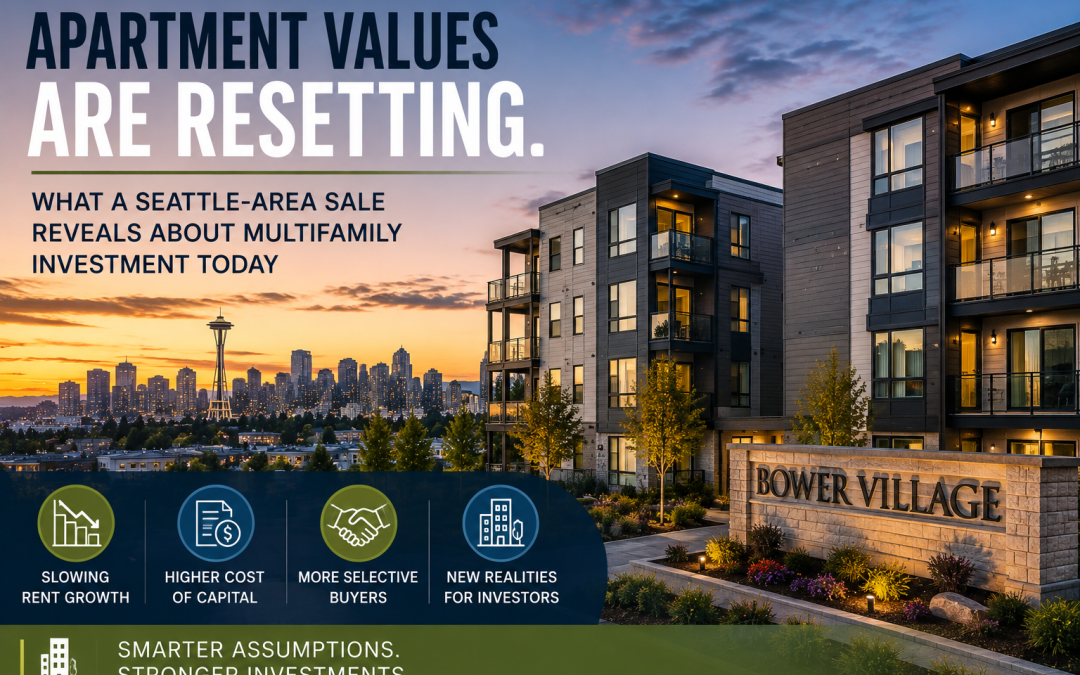
Apartment Values Are Resetting—What Boise Multifamily Investors Should Watch
Apartment buildings don’t have to lose tenants to lose value.
Sometimes the bigger change happens in the math.
A Seattle-area apartment complex recently sold for only slightly more than its previous purchase price seven years ago. The transaction is another example of how higher financing costs, slower rent growth and more cautious buyers can reshape multifamily valuations even when people still need places to live.
For Boise commercial real estate investors, that is an important trend to watch.
Boise and Seattle are different markets, but apartment investors everywhere are dealing with many of the same questions:
How fast can rents realistically grow?
What will financing cost?
How much should buyers pay today?
And what happens when an owner who purchased during a stronger market needs to sell?
According to reporting by Randyl Drummer of CoStar News, Oro Capital Advisors purchased the 198-unit Bower Village apartment community in Kent, Washington, for approximately $45 million.
You can read the original CoStar News article here:
https://product.costar.com/home/news/1039238115
The interesting part is what happened between the property’s two sales.
Seven Years of Ownership Produced Very Little Price Growth
Toronto-based Rise Properties Trust acquired Bower Village in 2019 for approximately $43.3 million.
Seven years later, the property sold for $45 million.
That’s less than a 4% increase in the headline sale price over the entire ownership period.
Of course, a property’s total investment return involves much more than the difference between its purchase and sale price. Rental income, capital improvements, financing, distributions and transaction expenses all matter.
But the sale still illustrates something important:
Time alone doesn’t guarantee appreciation.
Commercial real estate values ultimately depend on income and what investors are willing and able to pay for that income.
When interest rates increase, lenders become more cautious and rent growth slows, buyers generally need stronger returns to justify an acquisition.
That can put downward pressure on property values.
For Boise multifamily real estate, this is especially relevant after years of rapid rent and population growth encouraged aggressive investment assumptions.
The market doesn’t necessarily have to crash for valuations to reset.
Sometimes prices simply stop climbing.
Rent Growth Changes the Investment Equation
One of the most important numbers in the Seattle story isn’t the sale price.
It’s rent growth.
According to CoStar, average annual apartment rent growth in the Seattle region has slowed to approximately 1%, a major change from the double-digit annual increases experienced earlier in the decade.
That’s a big deal for apartment investors.
Imagine buying a property expecting rents to rise quickly.
Higher rents increase net operating income.
Higher net operating income can increase property value.
That makes renovations easier to justify and allows investors to underwrite future performance more aggressively.
Now change the assumption.
Instead of strong rent increases, rents barely move.
Expenses may still rise.
Insurance may cost more.
Property taxes may increase.
Maintenance costs may climb.
Payroll can become more expensive.
Suddenly, the investment looks very different.
This is why rent growth matters so much for Boise investment property.
A multifamily building isn’t valuable simply because apartments are occupied.
The relationship between revenue, expenses and the purchase price determines whether the investment works.
Buyers and Lenders Are Becoming More Selective
CoStar’s reporting indicates that apartment transactions around Seattle have slowed as both lenders and investors take a more cautious approach to pricing.
Some properties have also traded below their original asking prices.
That shouldn’t be surprising.
The era of extremely inexpensive debt created a powerful tailwind for commercial real estate.
When financing was cheap, investors could often pay higher prices while still achieving acceptable leveraged returns.
Higher interest rates reverse part of that equation.
Debt service increases.
Loan proceeds may decrease.
Debt-service coverage requirements become harder to satisfy.
Investors may need to contribute more equity.
And buyers generally need a higher property yield to compensate for the cost of capital.
That creates a gap between buyers and sellers.
Sellers may remember what properties were worth a few years ago.
Buyers are underwriting what the property is worth today.
Transactions slow until those expectations move closer together.
That dynamic is relevant across Boise commercial real estate, not just multifamily.
What This Means for Boise Multifamily
Boise experienced extraordinary apartment demand during the pandemic-era migration boom.
Population growth accelerated.
Rents increased.
Investors poured capital into the market.
Developers responded with new apartment construction throughout Boise, Meridian, Nampa and other Treasure Valley communities.
But every growth cycle eventually moves into another phase.
New supply gives renters more choices.
Rent growth moderates.
Concessions can appear.
Investors become more disciplined.
That doesn’t necessarily mean Boise multifamily has poor fundamentals.
The Treasure Valley continues to benefit from population growth, employment diversity and long-term housing demand.
But investors need to distinguish between housing demand and investment pricing.
Those aren’t the same thing.
An apartment property can be 95% occupied and still be overpriced.
Likewise, a property with temporary vacancy can be an excellent investment if purchased at the right basis.
Price matters.
New Apartment Supply Can Help Renters While Challenging Owners
Another factor Boise investors should watch is new construction.
More apartments can create healthy competition.
Renters receive more choices.
Developers introduce newer amenities.
Older properties may need to improve.
Rent growth can become more sustainable.
But new supply also changes the economics for existing owners.
A 1990s apartment community isn’t just competing against another 1990s property anymore.
It may be competing against a brand-new development offering modern fitness facilities, package rooms, coworking areas, upgraded appliances, dog parks and other amenities.
Older properties often respond in one of two ways.
They compete on price.
Or they reinvest.
That can create opportunity for value-add investors, but only when the purchase price leaves enough room to fund improvements and still earn an acceptable return.
Replacement Cost Still Matters
One factor that could support existing multifamily properties is the high cost of new development.
Land isn’t cheap.
Construction costs remain significant.
Financing new projects can be difficult.
Development fees and infrastructure requirements add additional costs.
If new apartments become too expensive to build, existing properties may gain a competitive advantage.
This creates an interesting tension in Boise development.
Too much new construction can pressure rents.
Too little construction can eventually tighten vacancy and push rents higher.
Investors should therefore watch the development pipeline just as carefully as current occupancy.
Today’s apartment vacancy tells you what the market looks like now.
The construction pipeline gives you clues about what it might look like two years from now.
The Opportunity May Be in the Reset
Lower valuations aren’t necessarily bad news for everyone.
They can create opportunities.
For years, many investors struggled to acquire multifamily properties because pricing was extremely aggressive.
A slower transaction market can change that.
Properties may sit on the market longer.
Sellers may become more flexible.
Assumptions may become more realistic.
Buyers with available equity may face less competition.
And investors who don’t depend on aggressive rent growth may find opportunities that didn’t exist during the market’s hottest period.
This is where patience can become valuable.
The best investment isn’t always the property with the highest projected rent growth.
Sometimes it’s the property purchased at a basis that allows the investment to work even if growth is modest.
Local Insight: Don’t Underwrite Yesterday’s Rent Growth
The Seattle transaction offers a simple lesson for Boise multifamily investors:
Don’t assume the next five years will look like the last five.
Boise’s long-term growth story can remain positive while apartment investment returns become more difficult.
Both things can be true.
Population can grow while cap rates rise.
Occupancy can remain healthy while values decline.
Rents can increase while expenses increase faster.
That’s why underwriting matters so much in today’s market.
I would pay close attention to:
- Actual in-place rents
- Realistic renewal increases
- Concessions
- Insurance costs
- Property taxes
- Maintenance expenses
- Upcoming capital improvements
- Current debt terms
- Competing apartment deliveries
- Replacement cost
Most importantly, I would stress-test the investment without relying on aggressive rent growth.
If the deal only works because rents need to jump every year, the investor is making a bet on the market.
If the deal works with modest assumptions, the property has more room for error.
For Boise commercial real estate, that may ultimately be one of the healthier outcomes of this market reset.
Buyers are being forced to focus again on fundamentals.
And in real estate, fundamentals eventually matter more than momentum.
Mike Gioioso (joy-OH-so) has for 16+ years been helping companies of all sizes buy, build, and lease perfect places for business in greater Boise, Idaho and beyond.
www.streetsmartidaho.com mike@streetsmartidaho.com 208-209-9166
Tags: #boisecommercialrealestate, #boisemultifamily, #boiseapartmentmarket, #boisemultifamilyinvestment, #boiseinvestmentproperty, #treasurevalleycommercialrealestate, #idahomultifamilyrealestate, #apartmentinvestment, #multifamilyvaluations, #boisedevelopment, #apartmentrentgrowth, #meridianapartments, #nampaapartments, #treasurevalleyapartments, #multifamilyfinancing