
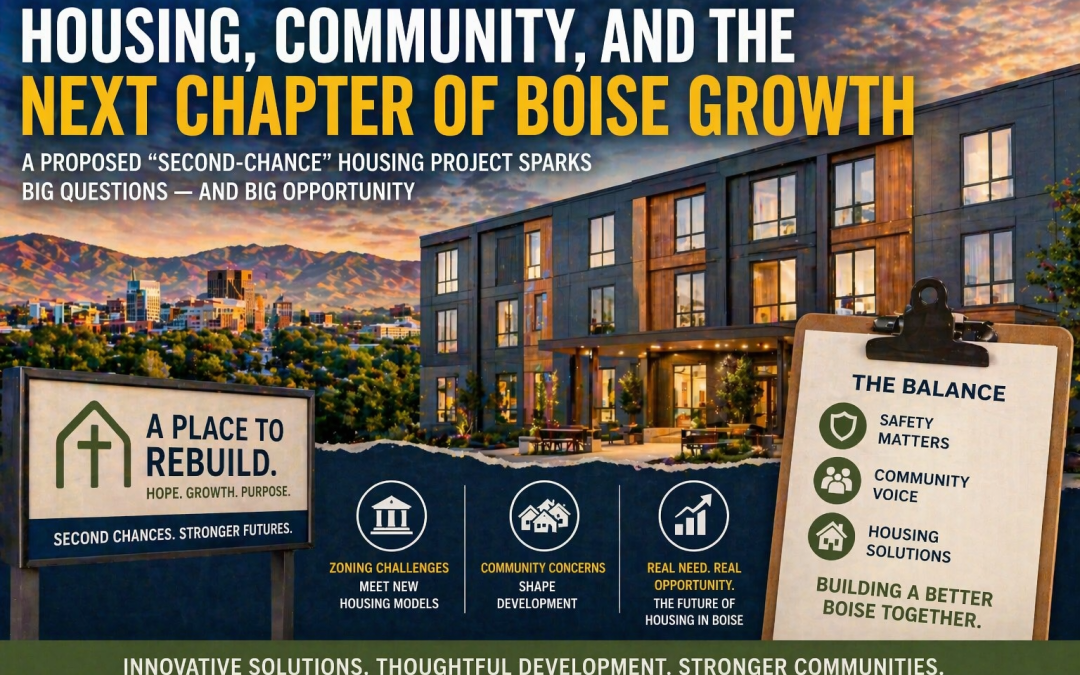
Boise’s “Second-Chance” Housing Proposal Highlights a Growing CRE Challenge — And Opportunity
Some of the most complex real estate decisions aren’t about land or buildings.
They’re about who the space is for—and whether the community is ready for it.
That tension is playing out right now in Boise, where a proposed housing concept is forcing a deeper conversation about zoning, affordability, and neighborhood compatibility.
According to reporting by the Idaho Press (read the original article here: https://www.idahopress.com/news/decision-on-second-chance-dorm-for-boise-men-deferred-by-city/article_9172b912-7bd3-4362-a793-4f9d24441195.html), city officials have delayed a decision on a proposed 100-unit “second-chance” dorm-style housing project on the West Bench, citing unanswered questions and community concerns.
For anyone involved in Boise commercial real estate, this isn’t just a single project—it’s a window into a much bigger issue: how cities handle nontraditional housing models in a tightening market.
What’s Being Proposed — And Why It’s Different
The project, led by a local church, would transform underutilized land into a dorm-style housing community for men focused on personal and professional growth.
Here’s what makes it unique:
- Roughly 100 individual rooms rented separately
- Residents required to participate in job training and financial education
- Access to mentors and career guidance
- Structured environment with expectations around accountability and progress
This isn’t positioned as:
- A traditional apartment complex
- A halfway house
- Or a formal rehabilitation center
Instead, it sits somewhere in between—a hybrid housing model that doesn’t fit neatly into existing zoning categories.
And that’s where the friction begins.
Why This Matters for Boise Commercial Real Estate
This proposal brings up several key issues that are becoming increasingly important across Boise development.
1. Zoning Is Struggling to Keep Up With New Housing Models
One of the biggest challenges highlighted here:
There isn’t a clear zoning category for this type of project.
That creates uncertainty for:
- Developers trying to bring innovative solutions
- Cities trying to regulate fairly
- Neighborhoods trying to understand impact
As housing demand evolves, we’re likely to see more:
- Co-living concepts
- Workforce housing hybrids
- Program-based residential communities
Boise—and many cities—are still catching up.
2. Community Pushback Is a Real Development Factor
Even when projects aim to address real needs, public perception can shape outcomes.
In this case, concerns raised include:
- Safety
- Resident backgrounds
- Neighborhood fit
Whether those concerns are accurate or not, they matter in the approval process.
For developers and investors, this reinforces a key reality:
Entitlement risk isn’t just regulatory—it’s emotional and political.
3. Demand for “Second-Chance” and Workforce Housing Is Growing
One of the most important undercurrents in this story:
There is a real need for transitional and attainable housing options.
This includes:
- Individuals re-entering the workforce
- People priced out of traditional apartments
- Residents needing structured support environments
From a market perspective:
- This is a growing demand segment
- Supply is limited
- Solutions are often difficult to entitle and execute
That creates both challenge and opportunity in Boise’s housing landscape.
Local Market Impact: What to Watch
As this project moves through the approval process, here are a few signals to monitor:
- Will Boise begin adapting zoning for nontraditional housing?
- Do similar proposals start emerging across the Treasure Valley?
- How much weight will community opposition carry in future decisions?
This isn’t likely to be the last project of its kind.
My Take: The Market Is Asking for New Solutions—But the System Isn’t Ready Yet
From a boots-on-the-ground perspective, this is one of the more telling stories in Boise commercial real estate right now.
Why?
Because it highlights a gap between:
- What the market needs (more flexible, affordable housing options)
- What the system allows (traditional zoning categories and expectations)
Projects like this are trying to bridge that gap—but they’re doing it in a framework that wasn’t designed for them.
That creates friction.
But it also creates opportunity—for:
- Developers willing to innovate
- Cities willing to adapt
- Investors who understand where demand is heading
Because as Boise continues to grow, the question won’t just be how much housing gets built.
It’ll be what kind of housing actually gets approved.
Mike Gioioso (joy-OH-so) has for 16+ years been helping companies of all sizes buy, build, and lease perfect places for business in greater Boise, Idaho and beyond.
www.streetsmartidaho.com mike@streetsmartidaho.com 208-209-9166
Tags: #boisecommercialrealestate, #boisehousingmarket, #boisedevelopment, #workforcehousingboise, #affordablehousingboise, #colivingboise, #dormstylehousing, #boisezoningissues, #housingdevelopmentboise, #treasurevalleyhousing, #boiserealestatetrends, #mixedusedevelopmentboise, #landuseboise, #boiseinvestmentproperty, #housingsupplyboise