
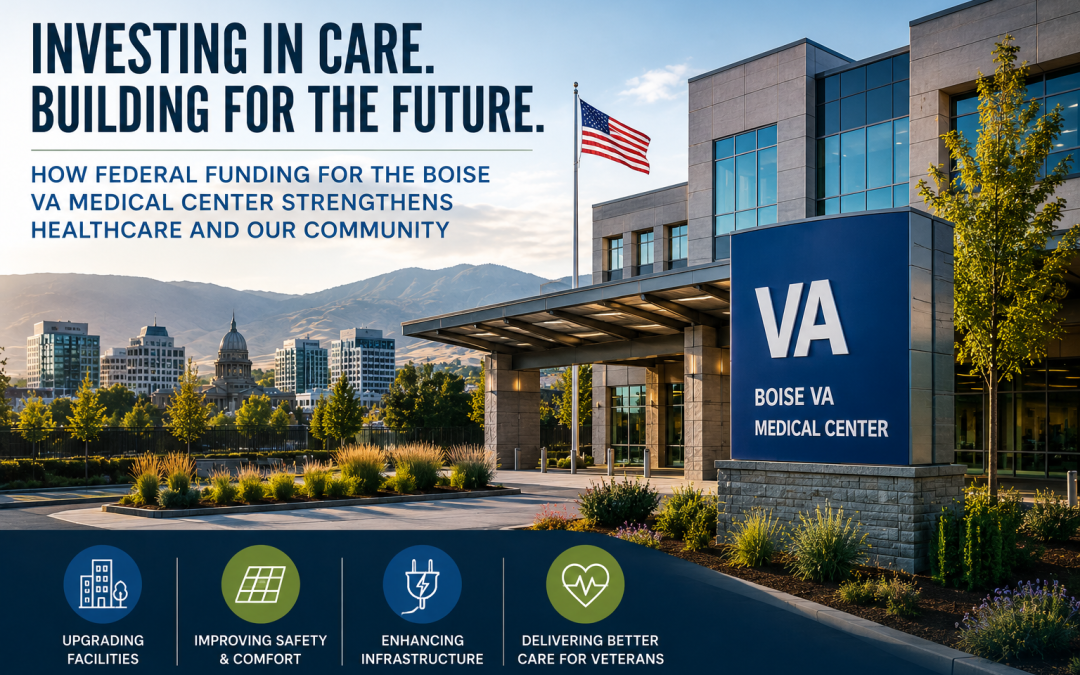
Boise VA Investment Highlights Growing Demand for Modern Medical Real Estate
Healthcare buildings have a difficult job.
They need to operate for decades while medical technology, electrical demands, safety standards and patient expectations continue to change.
That means maintaining an older healthcare property isn’t simply about fixing what breaks. Owners increasingly need to modernize buildings so they can support the next generation of medical care.
A new round of federal funding for the Boise Veterans Affairs Medical Center provides a local example—and offers some useful lessons for Boise commercial real estate investors, medical tenants, landlords and developers.
According to reporting by IBR Staff in the Idaho Business Review, the Boise VA Medical Center received additional federal maintenance funding during the third quarter of 2026. The exact amount allocated to the Boise facility was not disclosed.
The original Idaho Business Review article can be read here:
The Boise projects are relatively straightforward, but the larger story is about something commercial property owners across the Treasure Valley are dealing with:
Buildings have to keep evolving.
Medical Buildings Require Continuous Investment
The latest Boise VA funding is expected to support building and space improvements, flooring replacement and an evaluation of the facility’s electrical systems.
Those may not sound like major development projects.
But anyone who has worked with medical real estate knows that infrastructure can determine whether a building remains functional and competitive.
Healthcare users can have demanding requirements.
Medical equipment may require additional electrical capacity.
Flooring may need to meet specific durability and sanitation standards.
Backup power can be critical.
HVAC requirements may be more complex.
Technology infrastructure continues expanding.
Accessibility and life-safety systems must also keep pace with changing requirements.
For Boise medical office real estate, this creates an important distinction between a building that simply has available space and a building that can actually support a healthcare tenant.
The difference can be expensive.
Electrical Capacity Is Becoming More Important
One detail in the VA announcement particularly stands out from a commercial real estate perspective: the planned electrical system study.
Power is becoming a bigger issue across several property types.
We often hear about electrical capacity in connection with data centers, semiconductor manufacturing and advanced industrial facilities.
Healthcare belongs in that conversation too.
Medical buildings increasingly depend on sophisticated equipment, digital records, imaging technology, communications systems and other electrical infrastructure.
An older property might have a good location and attractive lease rate but still require substantial upgrades before a medical user can occupy it.
That can change the economics of a deal quickly.
Imagine comparing two office buildings.
One has a lower asking rent but requires significant electrical, HVAC and accessibility improvements.
The other costs more per square foot but already has much of the necessary infrastructure.
The supposedly expensive building may actually be the cheaper option after tenant improvements are considered.
That is why understanding a property’s infrastructure early in the leasing process can be so important.
Billions Are Going Into Existing Healthcare Facilities
The Boise improvements are part of a much larger federal effort.
According to the Idaho Business Review report, the federal government allocated approximately $4.8 billion for VA facilities nationwide during fiscal 2026.
Third-quarter commitments cited in the report included approximately $915 million for repairs and infrastructure improvements at medical facilities.
Another $229 million was directed toward maintenance and modernization efforts, including infrastructure associated with future electronic health record improvements.
Approximately $11 million was allocated toward elevators, electrical equipment and boiler systems.
The federal government has also been expanding the VA healthcare network, with 38 additional healthcare locations opened around the country, according to information cited by IBR.
From a real estate standpoint, the takeaway isn’t simply that the government is spending money.
It is where the money is going.
A significant amount is being invested in existing buildings.
That’s important because the future of commercial real estate isn’t only about new construction.
In many markets, including Boise, some of the biggest opportunities may come from improving the buildings we already have.
What This Means for Boise Medical Real Estate
The Treasure Valley continues to grow, and healthcare demand tends to grow with population.
More residents eventually mean more primary care, dental, specialty medicine, physical therapy, behavioral health, imaging and other healthcare services.
That creates opportunities for Boise development, but not every healthcare user needs—or can afford—a brand-new building.
Existing office and retail properties can sometimes be converted for medical use.
That is where things get interesting for investors and landlords.
A traditional office building in the right location might have potential as medical space.
A former retail suite could potentially accommodate an outpatient healthcare provider.
An older medical property could become more competitive through targeted improvements.
But these conversions require careful analysis.
Parking ratios matter.
Accessibility matters.
Electrical capacity matters.
Plumbing can matter significantly.
HVAC configuration matters.
Floor loading and equipment needs may matter.
Patient access and visibility can also influence site selection.
For landlords considering medical tenants, understanding these requirements before negotiating a lease can prevent expensive surprises later.
Healthcare Can Support Surrounding Commercial Real Estate
Medical investment also has effects beyond the healthcare property itself.
Healthcare facilities create employment.
Employees buy lunch and coffee.
Patients combine appointments with other errands.
Medical providers attract pharmacies and complementary healthcare businesses.
Larger facilities can generate demand for nearby restaurants, convenience retail and professional services.
That makes healthcare an important component of the broader Boise commercial real estate ecosystem.
It can be particularly valuable because healthcare demand doesn’t necessarily follow the same cycle as traditional office or discretionary retail demand.
People still need medical services when economic conditions slow.
That doesn’t make every medical property recession-proof, but it can provide a different demand profile than many other commercial uses.
For developers planning mixed-use and neighborhood commercial projects, proximity to healthcare can therefore be a meaningful demand driver.
Local Insight: The Cheapest Building Isn’t Always the Best Deal
The Boise VA improvements highlight something I see repeatedly in commercial real estate:
Building infrastructure matters more than the asking rent alone.
A tenant can negotiate an attractive rental rate and still end up with an expensive location if the building needs major upgrades.
For medical tenants, that risk can be even greater.
Electrical systems, HVAC, plumbing, accessibility and specialized buildout requirements can quickly become major pieces of the total occupancy cost.
That is why landlords should understand what their properties can realistically support.
It is also why tenants should evaluate infrastructure early—before getting too far into lease negotiations.
For Boise commercial real estate investors, there may also be opportunity here.
Older buildings in strong locations aren’t necessarily obsolete.
Sometimes they simply need the right investment.
A property with upgraded power, modern mechanical systems, improved accessibility and flexible floor plans can potentially compete for a much broader group of tenants.
The Boise VA Medical Center is a very different type of property from a privately owned medical office building.
But the basic lesson is similar.
Real estate has to evolve with the people and technology using it.
As the Treasure Valley continues growing, properties capable of adapting to healthcare’s changing requirements could become increasingly valuable.
Mike Gioioso (joy-OH-so) has for 16+ years been helping companies of all sizes buy, build, and lease perfect places for business in greater Boise, Idaho and beyond.
www.streetsmartidaho.com mike@streetsmartidaho.com 208-209-9166
Tags: #boisecommercialrealestate, #boisemedicalrealestate, #boisehealthcarerealestate, #boisedevelopment, #boiserealestate, #medicalofficeboise, #healthcaredevelopmentboise, #treasurevalleycommercialrealestate, #idahocommercialrealestate, #medicalofficebuildings, #healthcareinfrastructure, #boiseinvestmentproperty, #commercialpropertyrenovation, #adaptivereuseboise, #electricalinfrastructure, #treasurevalleydevelopment, #medicalofficeleasing, #boisehealthcaredevelopment