
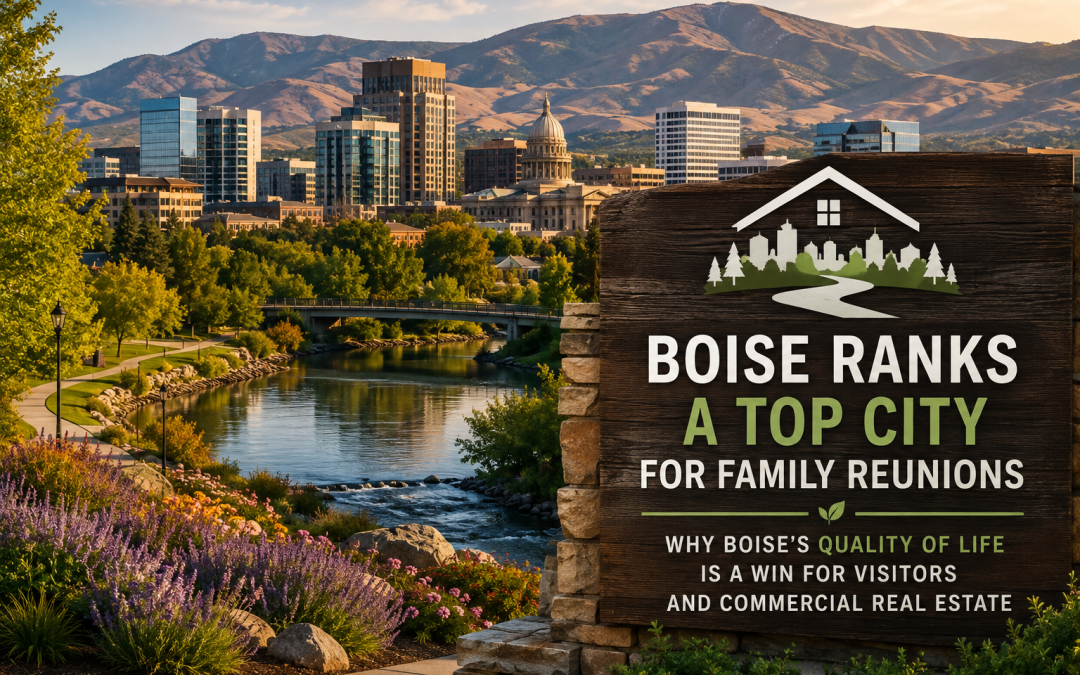
Boise’s Visitor Appeal Is Growing—and Commercial Real Estate Could Benefit
Boise just earned another national ranking, but the bigger story may not be the ranking itself.
It is what people increasingly value about the city.
Boise combines a walkable downtown, parks, relatively easy airport access, restaurants, recreation, and attractions without many of the logistical headaches associated with larger metros.
Those qualities helped Boise rank among the country’s best destinations for family reunions. They are also qualities that can support Boise commercial real estate, particularly hotels, restaurants, entertainment concepts, retail, event venues, and mixed-use development.
According to reporting from Idaho Business Review staff, Boise ranked sixth nationally in a study evaluating major U.S. cities as destinations for multigenerational family gatherings.
You can read the original Idaho Business Review article.
The ranking may sound like a travel story. From a commercial real estate perspective, however, it points toward something larger: Boise is becoming a place where people don’t just want to live—they increasingly have reasons to visit.
Boise’s Quality of Life Is Becoming an Economic Asset
The study was produced by Mixbook and compared 100 of the largest U.S. cities using 13 factors connected to group travel and accessibility.
Boise received an overall score of 62.3, with strengths that included walkability, parks, proximity to the airport, and access to historic attractions.
New Orleans finished first nationally, followed by Tucson, Colorado Springs, Wichita and Charleston. Boise came next at No. 6.
What makes Boise’s position interesting is the combination of amenities rather than any single attraction.
A visitor can fly into Boise Airport and reach Downtown Boise relatively quickly. Once downtown, restaurants, parks, hotels, entertainment, cultural attractions and outdoor spaces are concentrated within a relatively manageable area.
That convenience has value.
For residents, it contributes to quality of life.
For visitors, it makes Boise easier to experience.
For businesses and commercial property owners, it can translate into additional customer traffic.
Visitors create demand beyond hotels
When someone comes to Boise for a reunion, wedding, youth sports tournament, graduation, conference or family event, their spending spreads across multiple commercial real estate categories.
They may stay in a hotel or short-term rental.
They eat at restaurants.
They buy coffee.
They visit breweries, shops and entertainment venues.
They rent cars, purchase groceries and use local services.
They may also travel beyond downtown to Meridian, Eagle, Garden City or other parts of the Treasure Valley.
That means growth in visitation can support demand across Boise retail real estate, hospitality properties, restaurant space and entertainment-oriented commercial development.
One family reunion will not change a market.
Thousands of additional visitors over time can.
Walkability Could Become More Valuable for Boise Development
One of the most interesting parts of the ranking is Boise’s performance around walkability and access to amenities.
Commercial real estate has traditionally placed enormous value on vehicle counts, parking and visibility. Those factors still matter greatly in the Treasure Valley.
But there is another type of location becoming increasingly valuable: places where multiple activities can happen within a relatively small area.
Downtown Boise is the clearest example.
Someone staying downtown can potentially walk from a hotel to breakfast, attend an event, visit Julia Davis Park, shop, eat dinner and find entertainment without spending much of the day driving between destinations.
That concentration of activity can make commercial space more productive.
A restaurant does not have to depend entirely on nearby residents if office workers, tourists, hotel guests, convention attendees and event traffic are also walking past the front door.
The same is true for retailers and entertainment businesses.
This is one reason mixed-use environments can be powerful. Residential, office, hospitality, entertainment and retail uses can create customers for one another.
For Boise development, creating more places where people can comfortably move between multiple businesses could become an increasingly important competitive advantage.
Airport Access Gives Boise Another Advantage
Boise Airport may also deserve more attention in commercial real estate discussions.
Visitors do not necessarily judge accessibility based only on the number of airline routes available. They experience the entire trip.
How long does it take to reach the city after landing?
Is the destination difficult to navigate?
Are hotels near restaurants and activities?
Does a group need several cars to get everywhere?
Boise performs relatively well on many of these practical questions.
That matters for tourism, but it can also influence corporate travel, conventions, recruiting, sporting events and business expansion.
A company bringing employees or clients into Boise benefits from many of the same characteristics that make the city attractive for a family gathering.
This creates opportunities around hospitality and service businesses, particularly along corridors connecting Boise Airport, Downtown Boise and major employment centers.
What This Could Mean for Boise Commercial Real Estate
Boise’s ranking doesn’t suddenly mean every hospitality or retail project makes sense.
But it reinforces several trends commercial real estate investors and businesses should watch.
Hotels and hospitality: A broader visitor base can strengthen hotel demand beyond traditional business travel.
Restaurants: Group travel creates demand for restaurants capable of handling larger parties and providing memorable experiences.
Entertainment: Visitors increasingly want something to do rather than simply somewhere to shop. Family entertainment, recreation, cultural uses and experiential concepts could benefit.
Event space: Weddings, reunions, corporate gatherings and celebrations require flexible venues, creating opportunities for properties that can accommodate groups.
Downtown retail: Visitor traffic can supplement the spending generated by downtown residents and employees.
Mixed-use development: Projects combining restaurants, entertainment, hotels, residential uses and public spaces can capture multiple types of traffic.
The opportunity extends beyond Downtown Boise.
As Meridian and other Treasure Valley communities develop stronger entertainment districts, mixed-use centers and hospitality offerings, they can potentially capture more visitor spending as well.
Local Insight: Boise Is Selling an Experience, Not Just Growth
For years, much of the Boise real estate story has focused on population growth.
More people moved here. More houses were built. More businesses followed.
That remains important.
But I think the next phase of Boise commercial real estate will increasingly depend on another question:
What makes people want to spend time here?
That question matters because the strongest commercial districts are rarely just collections of buildings.
They are places people intentionally visit.
Parks matter.
Restaurants matter.
Walkability matters.
Entertainment matters.
Public spaces matter.
Hotels and transportation connections matter.
And when those pieces work together, they can create economic activity that extends well beyond the people who live nearby.
That is particularly important as retail continues evolving.
Many products can now be purchased online. Experiences cannot.
You cannot download dinner with your family, walk through a park online, attend a wedding through an e-commerce platform or recreate a night downtown with two-day shipping.
That gives experience-oriented commercial real estate a different kind of value.
For landlords, it may mean looking more closely at tenants that generate activity rather than simply occupy space.
For developers, it means thinking about how people move between buildings and uses rather than evaluating each parcel independently.
For retailers and restaurants considering retail leasing in Boise, it means understanding the difference between residential population and total customer traffic.
And for investors, properties located within districts where people have multiple reasons to visit may become increasingly difficult to replicate.
Boise ranking sixth nationally for family reunions is a fun headline.
The more meaningful takeaway is that many of the characteristics behind that ranking—accessibility, parks, walkability, amenities and convenience—are the same ingredients that can make a commercial district successful.
If Boise continues improving those qualities as the Treasure Valley grows, the economic benefit could reach well beyond tourism.
It could help shape where restaurants open, where hotels are built, which retail districts thrive, and what kinds of commercial developments succeed next.
Mike Gioioso (joy-OH-so) has for 16+ years been helping companies of all sizes buy, build, and lease perfect places for business in greater Boise, Idaho and beyond.
www.streetsmartidaho.com mike@streetsmartidaho.com 208-209-9166
Tags: #boisecommercialrealestate, #boiserealestate, #boisedevelopment, #boiseretailrealestate, #retailleasingboise, #downtownboise, #boisetourism, #boisehospitality, #treasurevalleycommercialrealestate, #idahocommercialrealestate, #boiseinvestmentproperty, #boiserestaurants, #boisehotels, #mixedusedevelopmentboise, #downtownboisedevelopment