
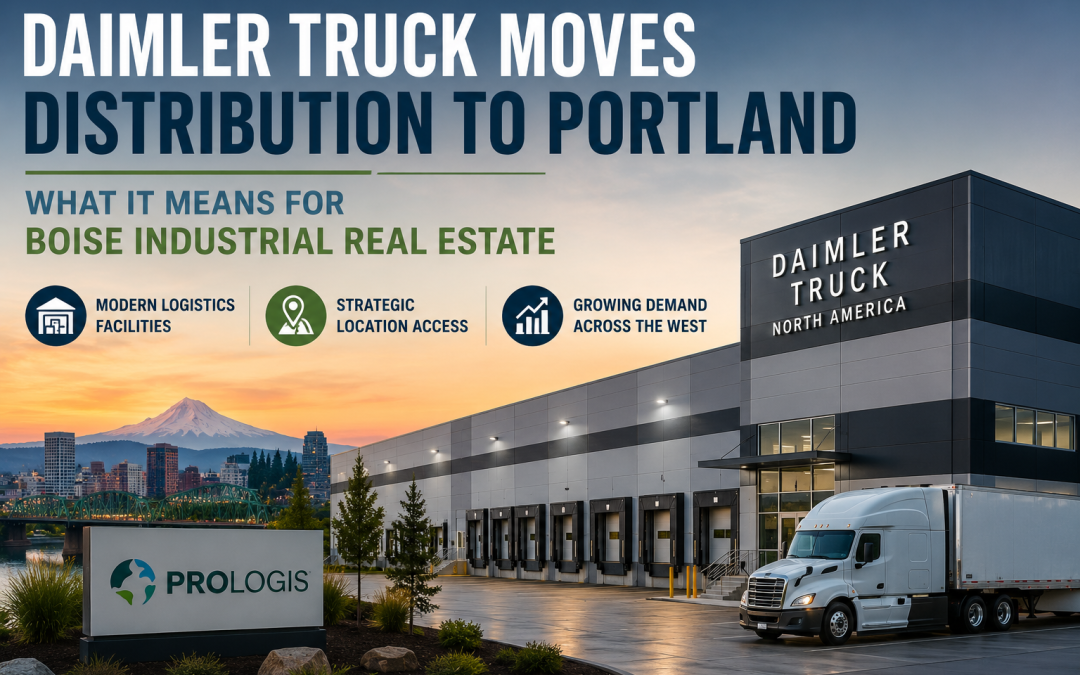
Daimler Truck’s Portland Warehouse Move Offers Lessons for Boise Industrial Real Estate
A major West Coast manufacturer is closing one operation in Portland while expanding another.
That may sound contradictory, but it highlights an important shift taking place across industrial real estate: companies are becoming more selective about what happens inside each building and where that building needs to be located.
Daimler Truck North America is preparing to consolidate more of its West Coast parts distribution into a new warehouse being developed by Prologis in Portland, Oregon. At the same time, the company is relocating manufacturing work away from Portland.
According to reporting by Randyl Drummer of CoStar News, the moves are part of a larger effort by Daimler Truck to restructure its production and distribution network. You can read the original CoStar News article for the source reporting.
For those watching Boise commercial real estate, there is a bigger takeaway here. Modern industrial demand is increasingly being driven by logistics efficiency, transportation access, building specifications, and the ability to serve growing regional populations.
Distribution Is Following West Coast Growth
Daimler Truck plans to occupy Prologis Broadmoor, a new 271,828-square-foot industrial building under construction in northeast Portland.
The company previously announced plans to reorganize its parts network after seeing significant growth in West Coast parts sales, particularly in the Pacific Northwest.
As part of that strategy, its Reno distribution operation is expected to shift to Portland, while its Phoenix operation will move to Las Vegas.
That is an important example of how companies think about industrial real estate.
A warehouse isn’t valuable simply because it has four walls, loading docks, and enough square footage.
Its location needs to make the entire distribution network work better.
That means companies are analyzing interstate access, transportation costs, delivery times, customer locations, labor, population growth, and the ability to serve multiple markets from one facility.
For Boise industrial real estate, that matters.
The Treasure Valley sits along Interstate 84 between major Pacific Northwest and Mountain West markets. As southern Idaho’s population and business base continue to expand, Boise, Meridian, Nampa, and Caldwell can play a larger role in regional distribution strategies.
Not every company needs a massive regional distribution center here. But more companies may need smaller warehouses, last-mile facilities, flex industrial buildings, service centers, and regional inventory locations to serve Idaho customers efficiently.
Modern Industrial Buildings Are Raising the Bar
The physical specifications of Daimler Truck’s new facility are also worth noting.
Prologis Broadmoor is designed with 36-foot clear heights, along with infrastructure that can support electric vehicles and solar energy.
The property also provides access to Interstates 5 and 205.
Those features show where institutional industrial development is heading.
Today’s large distribution users increasingly want buildings that can accommodate taller racking systems, more efficient material handling, modern trucking operations, increased electrical demand, automation, and future energy requirements.
That creates an important divide in industrial real estate.
Older warehouses can still perform very well, especially in tight infill locations. But some older buildings cannot easily provide the clear height, truck circulation, power capacity, loading configuration, or yard space required by modern logistics users.
We see versions of that same issue in Boise commercial real estate.
An older industrial property may have an excellent location but limited functionality. Meanwhile, a newer building farther from Boise’s urban core might provide better loading, higher ceilings, more parking, larger truck courts, and more efficient layouts.
For tenants, the cheapest rent per square foot doesn’t always create the lowest operating cost.
A slightly more expensive building can sometimes save money through better logistics, storage density, labor efficiency, and transportation access.
Manufacturing and Distribution Are Becoming Separate Real Estate Decisions
One of the most interesting parts of Daimler Truck’s restructuring is what it isn’t keeping in Portland.
The company plans to end production at its Swan Island manufacturing facility, affecting hundreds of positions, while moving that work to North Carolina and South Carolina.
At the same time, its North American headquarters will remain in Portland, and the company recently opened a new engineering facility there.
So within one metro area, Daimler Truck is essentially making three different real estate decisions:
- Manufacturing is being moved elsewhere.
- Parts distribution is expanding.
- Corporate and engineering functions are staying.
That is a good reminder that “industrial demand” isn’t one category.
Manufacturing, distribution, assembly, research, warehousing, service, and corporate operations all have different site-selection requirements.
That distinction matters when evaluating Boise development opportunities.
A site that works extremely well for a distribution center may not work for advanced manufacturing. A flex building that attracts contractors and service companies may not meet the requirements of a large warehouse user.
Developers and landlords should understand exactly which users they are building for rather than simply labeling everything “industrial.”
What This Could Mean for Boise Industrial Development
Boise and the Treasure Valley don’t compete directly with Portland for every industrial tenant.
But regional decisions like Daimler Truck’s can tell us what larger companies are prioritizing.
Transportation remains critical.
So does access to customers.
And increasingly, building design matters almost as much as location.
For Boise-area developers and investors, several trends are worth watching:
Higher clear heights. Newer logistics users often want to maximize cubic storage capacity, not simply floor area.
More power. Automation, manufacturing equipment, electric fleets, and other technologies are increasing electrical requirements.
Better truck circulation. Trailer storage, turning radiuses, dock configuration, and yard depth can make or break an industrial property.
Interstate access. Properties near I-84 and major north-south connections have a natural advantage for regional distribution.
Flexible building design. Industrial demand changes. Buildings that can accommodate several types and sizes of users may have stronger long-term leasing prospects.
These considerations are particularly relevant along the I-84 corridor through Boise, Meridian, Nampa, and Caldwell.
Another Trend: Redeveloping Underused Land
There is also a land-use story behind the Portland project.
Prologis developed the facility on the site of the former Broadmoor Golf Course, which closed in 2020 after operating for decades.
The developer also restored wetlands on roughly 45 acres around the industrial project.
That is an interesting example of how land uses can change as cities grow.
Large parcels inside established metropolitan areas are increasingly difficult to assemble. As land becomes more valuable, properties originally developed for golf courses, agriculture, low-density commercial uses, or other land-intensive purposes can eventually become redevelopment candidates.
Boise and the Treasure Valley are facing similar pressures.
As population growth pushes development outward, well-located parcels near transportation corridors become increasingly valuable.
That doesn’t mean every golf course or low-density property should become warehouses. It does mean property owners and developers need to continually evaluate whether existing land uses still represent the highest and best use of a site.
Local Insight: Follow the Logistics, Not Just the Population
Boise’s population growth gets plenty of attention.
But industrial investors should look beyond population numbers.
The more important question is what that population growth does to the movement of goods.
Every new household needs groceries, furniture, building materials, vehicles, medical supplies, packages, restaurant products, and thousands of other goods.
Those products have to move through warehouses and distribution networks somewhere.
As the Treasure Valley grows, the economics of placing inventory closer to Idaho customers can improve.
That can create demand for everything from large distribution buildings to smaller last-mile and service-oriented industrial properties.
For investors, I would pay particular attention to industrial land with strong I-84 access and areas where residential growth is creating new concentrations of customers and businesses.
For developers, building specifications will matter more as sophisticated regional and national tenants enter the market.
And for industrial tenants, site selection should be based on total operating efficiency — not simply asking which building has the lowest lease rate.
My Take
The Daimler Truck move shows why industrial real estate remains one of the most interesting parts of the commercial property market.
Companies are constantly redesigning their supply chains.
Manufacturing can move one direction while distribution moves another. Corporate offices can remain in place while warehouses consolidate. One facility can close while another larger, more modern property opens nearby.
Those decisions create both winners and losers in commercial real estate.
For Boise industrial real estate, the opportunity is positioning properties for the uses that are growing rather than designing them around yesterday’s requirements.
The Treasure Valley has several advantages: strong population growth, Interstate 84, available development land, and a location between major Western markets.
But capturing future industrial demand will require the right buildings in the right places.
As companies become more sophisticated about their logistics networks, Boise developers and property owners should be doing the same.
Mike Gioioso (joy-OH-so) has for 16+ years been helping companies of all sizes buy, build, and lease perfect places for business in greater Boise, Idaho and beyond.
www.streetsmartidaho.com mike@streetsmartidaho.com 208-209-9166
Tags: #boiseindustrialrealestate, #boisecommercialrealestate, #boiseindustrialdevelopment, #boisewarehousespace, #boiseindustrialproperty, #boiselogisticsrealestate, #boisedistributioncenters, #boisewarehousedevelopment, #boiseindustrialleasing, #boiseinvestmentproperty, #idahocommercialrealestate, #idahoindustrialrealestate, #idahowarehousespace, #idahologistics