
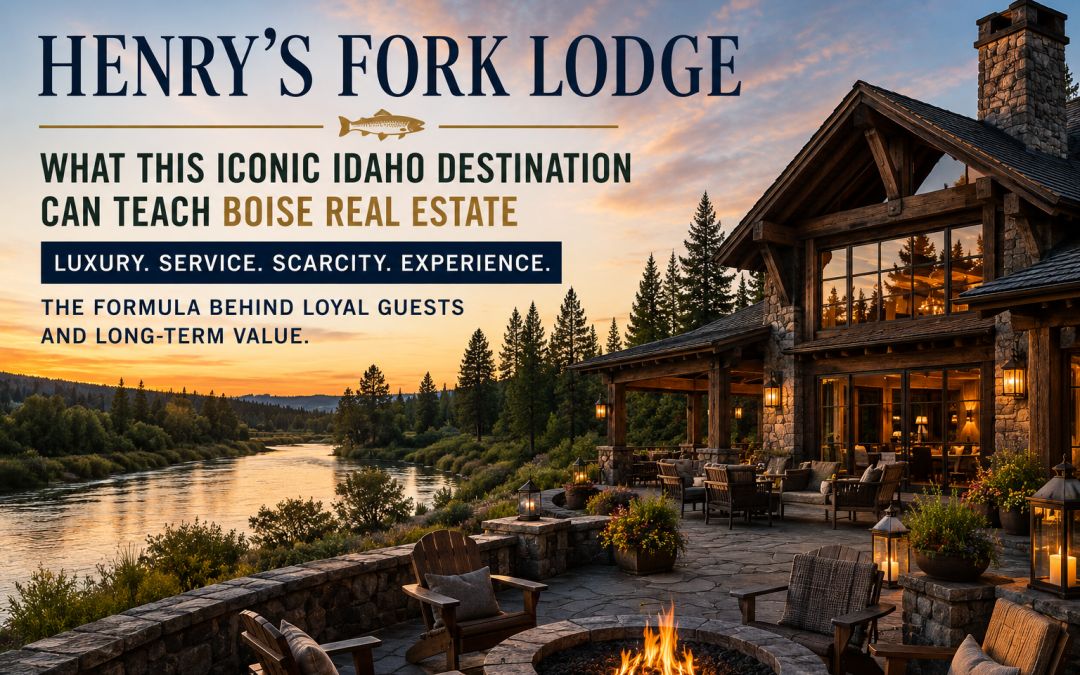
What Henry’s Fork Lodge Can Teach Boise Hospitality and Commercial Real Estate
The most valuable part of a hospitality property isn’t always the building.
Sometimes it’s the experience people can’t easily get anywhere else.
Henry’s Fork Lodge in Island Park has spent more than three decades proving that point. The small seasonal property has created enough demand that some guests reserve stays years ahead, offering an interesting case study for anyone involved in Boise commercial real estate, hospitality development, tourism, or investment property.
According to reporting by Heide Brandes in the Idaho Business Review, owner Nelson Ishiyama has operated Henry’s Fork Lodge since opening it in 1990. The lodge combines world-class fly fishing with unusually high levels of service for a remote seasonal property. The full story is available from the Idaho Business Review.
For commercial real estate professionals, the story is about more than fishing. It demonstrates how location, design, operations, staffing, and scarcity can combine to create a property that competes on experience rather than price.
Scarcity Can Be a Powerful Real Estate Advantage
Henry’s Fork Lodge operates differently from a traditional hotel.
It has only 14 rooms and operates roughly from late May through mid-October. Yet demand is strong enough that repeat visitors account for much of its business, with reservations reportedly extending as far as 2028.
Normally, a hotel investor wants more rooms.
More rooms create more potential revenue.
But there is another side to that equation. Limited inventory can become part of a property’s appeal when customers strongly value the experience.
Henry’s Fork Lodge has something extremely difficult to reproduce: direct access to one of the country’s most recognized fly-fishing destinations.
The property sits above the Henry’s Fork of the Snake River, surrounded by a natural environment that gives the lodge an enormous competitive advantage.
That matters in commercial real estate because location doesn’t always mean traffic counts and highway visibility.
For a retailer, location might mean being at the busiest intersection.
For industrial real estate, it could mean interstate access.
For an office tenant, it could mean proximity to employees.
And for hospitality, location can mean access to an experience.
The best properties understand what makes their location difficult to duplicate and build the business around that advantage.
The Building Creates the Setting — Service Creates the Value
The lodge itself was designed to reinforce the experience.
Ishiyama worked with noted architect Joseph Esherick to avoid the standard hotel layout of rooms arranged in a simple line. Instead, the property was designed as a collection of structures that feels more like a small village.
The architecture eventually gained national recognition, including coverage in Architectural Digest.
But a great building alone doesn’t create loyal customers.
The operating model may be even more important.
The lodge employs roughly 16 people while serving only a few dozen guests at full capacity. Before each season, Ishiyama brings in an experienced luxury-hospitality consultant for staff training.
That’s an unusually high service commitment for such a small operation.
Employee retention also appears to be a major advantage. Several key staff members have returned for many seasons, including longtime reservation, management, and culinary employees.
From a Boise commercial real estate perspective, there’s an important lesson here:
Real estate creates the platform, but the operator creates the performance.
Two restaurants can occupy nearly identical spaces and produce completely different sales.
Two hotels can have comparable rooms and completely different occupancy.
Two retailers can operate at the same intersection with very different results.
The building matters.
The tenant or operator often matters more.
That is why landlords and developers should evaluate more than financial statements when choosing tenants. Strong operators with good systems, experienced management, and loyal employees can create enormous long-term value for a property.
Experience Is Becoming Part of the Real Estate Product
Henry’s Fork Lodge isn’t simply selling lodging.
It is selling a carefully controlled experience.
Most guests reportedly come specifically to fish and typically use guides during their stays. Meals are structured around fishing schedules rather than forcing guests to interrupt the reason they traveled there.
The food program is intentionally elevated, with changing dinner selections and a dedicated culinary team.
The goal appears simple: remove friction from the guest’s trip.
That’s becoming increasingly relevant to commercial real estate.
Consumers have more choices than ever about where they shop, eat, stay, work, and spend their free time. Physical locations therefore need to provide something that can’t easily be replaced by an online transaction.
We already see that happening in retail leasing in Boise.
Successful shopping centers increasingly combine restaurants, fitness, entertainment, personal services, medical uses, and community gathering places.
Hotels are becoming more experiential.
Restaurants are investing more heavily in atmosphere.
Even office buildings are competing through amenities and employee experience.
The physical property isn’t just where the transaction happens anymore.
Increasingly, the property is part of the product.
Corporate Retreats Add Another Revenue Stream
Henry’s Fork Lodge has also developed an interesting corporate customer base.
According to the Idaho Business Review, the property typically hosts several larger company groups during a season, with past corporate guests including Bank of America and Wells Fargo.
That diversification matters.
A destination property built entirely around individual leisure travelers can be vulnerable to changing consumer behavior.
Corporate retreats create another source of demand.
And the appeal is understandable.
Instead of another conference room or traditional golf outing, companies can bring clients or employees somewhere memorable and difficult to replicate.
That trend could create opportunities throughout Idaho.
The state already has strong outdoor and destination assets around McCall, Sun Valley, Stanley, Coeur d’Alene, Island Park, and other recreational markets.
As companies place more emphasis on team building, executive retreats, client entertainment, and employee experiences, distinctive hospitality properties may have opportunities to capture corporate spending that traditionally went to conventional hotels and conference facilities.
What This Means for Boise Development
Boise isn’t Island Park.
But the underlying development principle translates surprisingly well.
The Treasure Valley is attracting more residents, businesses, visitors, and investment. That creates opportunities for developers — but it also creates the risk of producing properties that look exactly like everything else.
Another generic retail building isn’t automatically valuable because Boise is growing.
Another hotel isn’t automatically successful because tourism is increasing.
Another restaurant space isn’t automatically attractive because population numbers look good.
Successful Boise development increasingly requires differentiation.
That could come from architecture.
It could come from location.
It could come from outdoor space, walkability, views, amenities, tenant mix, programming, or access to recreation.
The question developers should be asking isn’t simply:
What can we build here?
It should also be:
Why would someone choose this property instead of the alternatives?
Henry’s Fork Lodge has an unusually strong answer to that question.
Conservation Can Also Protect Real Estate Value
There’s another part of the Henry’s Fork story that commercial real estate investors shouldn’t overlook.
The natural environment surrounding the lodge isn’t simply scenery.
It’s an economic asset.
Ishiyama has participated in conservation efforts intended to protect the Island Park area from development that could negatively affect the landscape and river.
That creates an interesting relationship between conservation and real estate value.
Commercial development often focuses on what can be added to a property.
But sometimes value depends on protecting what already surrounds it.
We’ve seen similar issues across Idaho.
Views, open space, rivers, foothills, trail systems, farmland, and recreational access can all influence property values.
For Boise-area developers, thoughtful growth doesn’t necessarily mean maximizing every square foot.
In some cases, preserving open space or natural features can increase the long-term value of the surrounding development.
Local Insight: Boise’s Next Opportunity May Be Experience-Driven Real Estate
One of the trends I continue to watch in Boise commercial real estate is the growing importance of experience.
Boise doesn’t need to copy Henry’s Fork Lodge.
It needs developers and operators who understand the same principle.
People will pay a premium for something memorable.
That could mean a boutique hotel with a strong Idaho identity.
It could mean a mixed-use development designed around restaurants and outdoor gathering spaces.
It could mean a destination retail concept.
It could mean an executive retreat outside Boise.
Or it could mean a redevelopment project that preserves an older building and turns its history into part of the experience.
The common denominator is differentiation.
Generic properties compete heavily on price.
Distinctive properties have more ways to compete.
That distinction can affect rent, occupancy, customer loyalty, and ultimately investment value.
My Take
Henry’s Fork Lodge is a good reminder that successful commercial real estate doesn’t always require scale.
Fourteen rooms can create an exceptional business when the location, building, operator, service, and customer experience all reinforce one another.
That’s particularly relevant as Boise and the Treasure Valley continue growing.
Growth creates opportunities, but it can also encourage developers to focus too heavily on simply adding more square footage.
More isn’t necessarily better.
The strongest projects often have a clear identity and a specific reason for existing.
For Boise investors and developers, I think that becomes increasingly important as the market matures.
Whether you’re developing a hotel, retail center, restaurant building, mixed-use project, or another type of Boise investment property, the question shouldn’t just be whether demand exists.
Ask what makes your project difficult to replace.
Henry’s Fork Lodge has been answering that question successfully for more than three decades.
Mike Gioioso (joy-OH-so) has for 16+ years been helping companies of all sizes buy, build, and lease perfect places for business in greater Boise, Idaho and beyond.
www.streetsmartidaho.com mike@streetsmartidaho.com 208-209-9166
Tags: #boisecommercialrealestate, #boiserealestate, #boisedevelopment, #boisehospitalityrealestate, #boisehoteldevelopment, #boisehotelrealestate, #boisehospitalitydevelopment, #boiseinvestmentproperty, #boiserealestateinvestment, #idahocommercialrealestate, #idahorealestatedevelopment, #idahohospitality, #idahohoteldevelopment, #idaholuxuryhotels, #idahotourism