
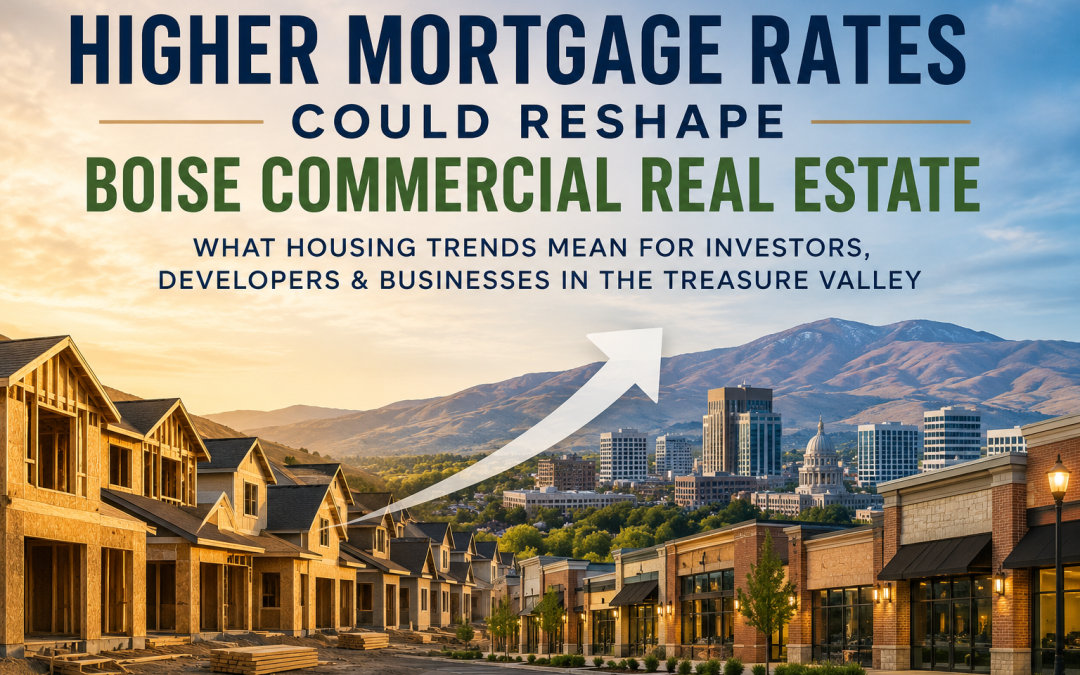
Higher Mortgage Rates Could Reshape Boise Commercial Real Estate Demand
The housing market just sent another mixed signal.
New-home sales moved higher in June, but buyers are still dealing with mortgage rates well above 6%. At the same time, builders appear to be giving up some ground on pricing.
For Boise commercial real estate, this matters for more than homebuilders.
Housing affordability can influence where people move, how quickly new neighborhoods grow, how much consumers spend, and where retailers, restaurants, medical providers, and other businesses choose to open.
According to reporting by Dan Burns of Reuters, published by the Idaho Business Review, U.S. new-home sales increased in June even as borrowing costs remained a major obstacle for buyers.
The original Idaho Business Review article is available here:
https://idahobusinessreview.com/2026/07/24/us-new-home-sales-rise-june-high-mortgage-rates/
Home Sales Improved, But Affordability Is Still the Bigger Story
U.S. sales of newly built single-family homes increased 1.6% in June, reaching a seasonally adjusted annual rate of 628,000 homes.
That was stronger than the 610,000-unit pace economists surveyed by Reuters had expected.
But zoom out, and the market still looks soft.
New-home sales were 5.6% below June of the previous year, showing that one better month does not necessarily mean the housing market has entered a strong recovery.
Pricing also moved in the buyer’s direction. The median price of a newly built home fell 2.7% from a year earlier to $398,300.
That combination is important.
Builders may be finding ways to attract buyers through lower prices, incentives, rate buydowns, or other concessions. But financing costs remain difficult enough to keep many households on the sidelines.
The biggest obstacle is still the cost of money.
Freddie Mac reported that the national average rate for a 30-year fixed mortgage had climbed to 6.58%, while the Mortgage Bankers Association measured its comparable contract rate at 6.69%.
Those were the highest levels in roughly 11 months.
For buyers, the difference between a mortgage rate in the 4% range and one in the mid-6% range can translate into hundreds of dollars in additional monthly housing expense.
That changes behavior.
And when household behavior changes, commercial real estate eventually feels it too.
Why Housing Conditions Matter to Boise Commercial Real Estate
The connection between residential housing and commercial property is especially important in a growth market like the Treasure Valley.
Retailers do not expand because houses exist. They expand because enough households live nearby, have sufficient disposable income, and generate reliable traffic.
The same principle applies to restaurants, daycare operators, dentists, medical clinics, gyms, salons, grocery stores, banks, and many other tenants.
That means housing affordability can influence retail leasing in Boise, Meridian, Nampa, Caldwell, Kuna, Star, and Eagle.
If higher mortgage rates slow home sales or delay new residential construction, some developing commercial corridors may take longer to reach the population density businesses want.
On the other hand, if builders respond with lower prices and incentives that keep homes moving, new rooftops can continue supporting commercial development.
That makes residential absorption an important metric for anyone evaluating land or commercial projects on the edges of the Boise metro.
The renter population could remain stronger for longer
There is another side to this story.
When would-be homeowners cannot qualify for a mortgage or decide monthly ownership costs are too high, many continue renting.
For Boise-area investors, that can support apartment demand even if the for-sale housing market remains sluggish.
It can also affect where consumers spend money.
A household that postpones buying a home may have a very different budget than one taking on a new mortgage, moving expenses, landscaping costs, furniture purchases, and home improvements.
That spending shift can eventually show up in retail sales and tenant performance.
Interest Rates Are Still a Boise Development Story
The impact of higher rates does not stop with residential buyers.
Commercial developers and investors are borrowing in the same broader capital environment.
When Treasury yields rise, borrowing costs across real estate can face additional pressure. That affects construction financing, permanent loans, refinancing, and investment returns.
For Boise development, that creates a tougher equation.
A project that penciled at lower borrowing costs may need higher rents, lower land costs, more equity, reduced construction expenses, or a different exit value to generate the same return today.
This is especially relevant for speculative development.
A build-to-suit project with a committed tenant can still make sense because future income is more predictable. A speculative retail, office, industrial, or mixed-use project has another layer of risk if the developer must borrow at today’s rates without guaranteed occupancy.
That could encourage more discipline around new construction throughout the Treasure Valley.
For existing landlords, that is not necessarily bad news.
If financing costs prevent marginal projects from being built, existing well-located commercial properties face less competition from new supply.
What Investors and Businesses Should Watch
The June housing numbers are useful, but one month of national sales data should not drive a Boise real estate decision.
The larger trend matters more.
For Boise commercial real estate investors and business owners, I would watch several things closely:
- Mortgage rates: A meaningful decline could unlock more homebuyers and accelerate residential absorption.
- Builder incentives: Discounts and rate buydowns can keep subdivisions moving even when headline mortgage rates remain elevated.
- Residential permits and starts: Slower construction today can change the timing of future retail and service demand.
- Treasure Valley population growth: Continued household formation can partially offset national housing weakness.
- Consumer spending: High housing costs can leave households with less money for restaurants, services, entertainment, and discretionary retail.
- Commercial borrowing costs: Higher financing expenses can reduce development feasibility and affect investment property values.
For businesses considering expansion, this is also a reminder that not every fast-growing Boise-area corridor will mature at the same speed.
The number of planned rooftops matters.
The number of occupied rooftops matters more.
Local Insight: Follow the Rooftops, But Follow Affordability Too
For years, one of the simplest commercial real estate strategies in the Treasure Valley has been to follow residential growth.
That strategy still makes sense, but I think it needs another layer now.
Follow the affordable rooftops.
A subdivision can look impressive on a development map, but businesses ultimately depend on occupied homes and customers with money left to spend.
That is why I would pay close attention to the difference between announced residential development and actual home absorption when evaluating emerging Boise-area commercial sites.
For retail tenants, it may mean being more selective about when to enter a developing trade area.
For landlords, it means understanding how housing costs affect the customers supporting your tenants.
For developers, it means being realistic about how quickly planned communities will translate into demand for commercial space.
And for investors, higher rates may create opportunities to buy existing properties that would be expensive or difficult to reproduce under today’s construction and financing environment.
The June housing numbers do not suggest the U.S. housing market is collapsing. They also do not suggest affordability problems have disappeared.
Instead, they show a market trying to move forward while expensive financing keeps applying the brakes.
For Boise real estate, that tension is worth watching. Housing, population growth, consumer spending, development costs, and commercial leasing are interconnected. What happens in the residential market can eventually influence everything from neighborhood retail demand to land values and investment property pricing across the Treasure Valley.
Mike Gioioso (joy-OH-so) has for 16+ years been helping companies of all sizes buy, build, and lease perfect places for business in greater Boise, Idaho and beyond.
www.streetsmartidaho.com mike@streetsmartidaho.com 208-209-9166
Tags: #boisecommercialrealestate, #boiserealestate, #boisedevelopment, #boisehousingmarket, #treasurevalleyrealestate, #idahocommercialrealestate, #retailleasingboise, #boiseinvestmentproperty, #meridiandevelopment, #nampadevelopment, #caldwellrealestate, #treasurevalleydevelopment, #mortgagerates, #housingaffordability, #commercialrealestateinvestment