
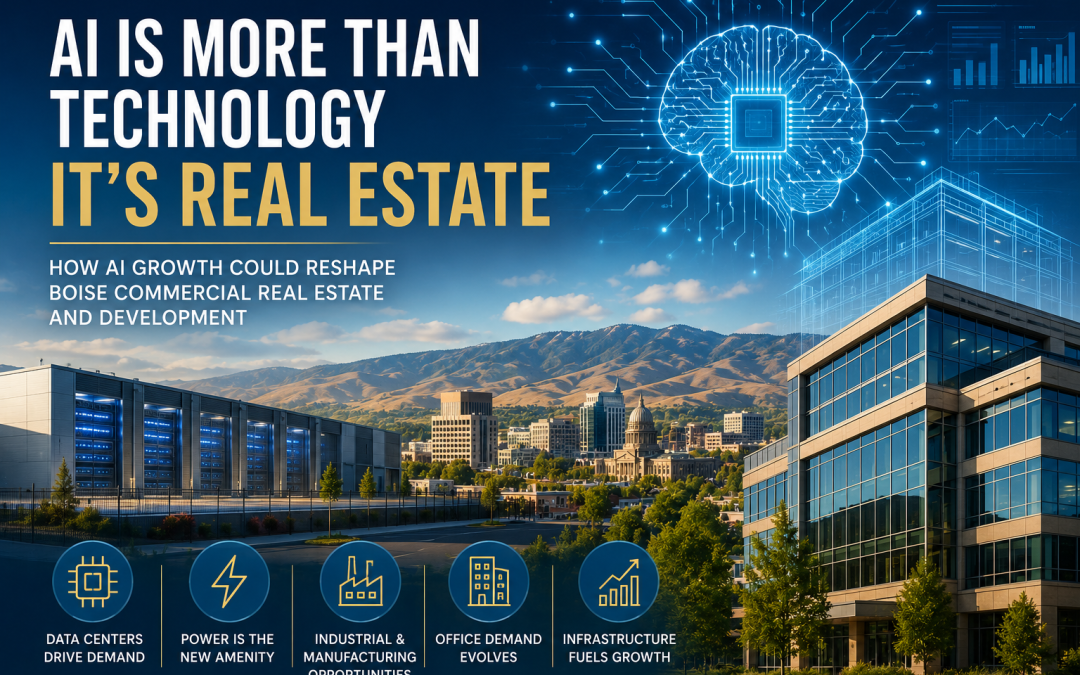
AI Growth Could Reshape Boise Commercial Real Estate in Ways Beyond the Office Market
Artificial intelligence may feel like a technology story.
For commercial real estate, it is quickly becoming a land, power, infrastructure and workforce story too.
As AI adoption grows, the technology could influence where companies locate, how much office space they need, which industrial properties become valuable and where billions of dollars of infrastructure investment eventually flows.
That makes public acceptance of AI worth watching from a Boise commercial real estate perspective.
According to reporting by IBR Staff in the Idaho Business Review, a recent HarrisX survey of more than 2,000 U.S. voters found that 56% had a favorable view of the potential benefits of artificial intelligence, while 36% expressed an unfavorable view.
The survey was commissioned by Build American AI, an advocacy organization connected to the technology industry, so that sponsorship is important context when interpreting the findings.
The original Idaho Business Review article can be read here:
https://idahobusinessreview.com/2026/07/23/americans-favorable-views-ai-benefits-concerns/
The bigger commercial real estate question isn’t whether Americans like AI.
It’s what happens to the built environment if AI investment continues accelerating.
AI Could Create an Entire New Layer of Real Estate Demand
One interesting finding from the survey was that 71% of respondents viewed AI as potentially representing the beginning of another industrial revolution.
Whether that comparison ultimately proves accurate remains to be seen.
But from a commercial real estate standpoint, AI already requires significant physical infrastructure.
Software may live on a screen, but the systems behind it require real estate.
Data centers need land.
Servers need buildings.
Buildings need enormous amounts of electricity.
Electrical systems require substations, transmission capacity and other infrastructure.
Those facilities also need fiber connectivity, cooling equipment, backup systems, security and access to specialized workers and contractors.
Then there are the businesses supporting the broader technology ecosystem.
That can create opportunities for industrial facilities, advanced manufacturing, semiconductor suppliers, engineering companies, construction firms and professional services.
This is where the connection to Idaho commercial real estate becomes much more tangible.
Idaho already has an important semiconductor industry, led in large part by Micron’s presence in Boise. The state also has significant energy resources, available land and growing interest in technology-related development.
If AI continues driving investment in computing and domestic manufacturing, some of that capital could eventually translate into additional demand for Idaho real estate.
The Office Market Could Feel AI Differently
AI’s effect on office space may be more complicated.
The traditional relationship between economic growth and office demand has generally been straightforward:
A company grows.
It hires more people.
Those employees need desks.
The company leases more office space.
AI could weaken that relationship.
If businesses can increase productivity without adding employees at the same rate, revenue growth may no longer translate as directly into additional office demand.
That could matter for Boise office real estate over the long term.
It doesn’t necessarily mean offices disappear.
Instead, companies may become more selective.
Businesses could prioritize better locations, modern buildings, flexible layouts and high-quality amenities while using less space per dollar of revenue.
That could widen the gap between desirable office properties and buildings that struggle to differentiate themselves.
For Boise landlords, reinvestment may therefore become increasingly important.
The future office tenant may care less about simply having enough desks and more about whether the workplace helps recruit employees, encourage collaboration and accomplish things workers cannot easily do remotely.
Industrial and Infrastructure May Be the Bigger Opportunity
Another notable survey finding involved domestic manufacturing.
According to the poll, 60% of respondents believed AI could contribute to increased U.S. industrial production.
That connection deserves attention from commercial real estate investors.
AI isn’t developing in isolation.
It is increasingly connected to semiconductors, robotics, automation, advanced manufacturing, energy infrastructure and logistics.
Those industries require physical space.
For Boise industrial real estate, that could create opportunities beyond giant technology campuses.
Think about the surrounding ecosystem.
Suppliers may need warehouses.
Equipment companies may need flex space.
Contractors may need yards and industrial buildings.
Engineering businesses may need office and laboratory facilities.
Manufacturers may need buildings with unusually high electrical capacity.
Service companies may locate near major technology employers.
This is often how a major economic investment spreads through a commercial real estate market.
The headline project attracts attention, but dozens of smaller businesses can create the broader leasing and development activity.
Power Could Become a Real Estate Amenity
For decades, commercial real estate listings have focused on familiar characteristics:
Location.
Traffic counts.
Visibility.
Parking.
Ceiling height.
Loading.
Population.
Those factors aren’t going away.
But for certain technology and industrial users, another feature may become increasingly important:
available electrical power.
A piece of industrial land can look perfect on a map and still be unsuitable for a power-intensive user if the necessary electrical infrastructure isn’t available.
That means developers evaluating future Boise development opportunities may need to understand utility capacity much earlier in the process.
The same could apply to data centers, semiconductor suppliers, advanced manufacturers and other technology-related businesses.
In some cases, the value of industrial land could become increasingly tied to infrastructure that isn’t immediately visible from the property line.
That represents an important shift for site selection.
What This Means for Boise Investors and Developers
AI could affect different commercial real estate sectors in very different ways.
For office investors, productivity improvements could mean watching employment growth more carefully instead of assuming economic expansion automatically creates additional space demand.
For industrial developers, technology investment could create opportunities around advanced manufacturing, suppliers, flex buildings and infrastructure-heavy users.
For landowners, access to electricity, fiber, water and transportation could become even more important.
For retailers, AI may influence everything from inventory management to site selection and customer analytics, potentially changing how companies evaluate retail leasing in Boise.
And for developers, understanding the businesses surrounding major technology investments may be just as important as chasing the major projects themselves.
The commercial real estate opportunity may not always be the giant data center.
Sometimes it is the contractor, supplier, restaurant, medical provider or service business that arrives because hundreds of new workers and millions of dollars of investment entered the market.
Local Insight: Follow the Infrastructure
Public enthusiasm about AI can change.
Technology trends can change even faster.
That’s why I wouldn’t look at one survey and conclude that AI will automatically create a commercial real estate boom.
But the capital being invested in computing infrastructure, semiconductors, power generation and advanced manufacturing deserves attention.
From a Boise commercial real estate perspective, I think one of the most useful questions is simple:
What physical infrastructure does the next economy require?
If AI continues expanding, its real estate footprint could show up in unexpected places.
It could mean fewer traditional desks in some office buildings.
It could mean greater demand for power-intensive industrial sites.
It could strengthen demand around semiconductor manufacturing.
It could create opportunities for contractors, suppliers and service companies.
And it could make infrastructure capacity an increasingly important factor in land values and development decisions.
Boise doesn’t need to become Silicon Valley for these trends to matter.
Idaho already participates in the technology economy.
The commercial real estate opportunity will be understanding where that economy touches the ground.
Mike Gioioso (joy-OH-so) has for 16+ years been helping companies of all sizes buy, build, and lease perfect places for business in greater Boise, Idaho and beyond.
www.streetsmartidaho.com mike@streetsmartidaho.com 208-209-9166
Tags: #boisecommercialrealestate, #artificialintelligence, #boiserealestate, #boisedevelopment, #idahocommercialrealestate, #boiseindustrialrealestate, #boiseofficemarket, #aidatacenters, #datacenterdevelopment, #micronboise, #semiconductormanufacturing, #advancedmanufacturingidaho, #technologyrealestate, #idahoeconomicdevelopment, #industrialdevelopment, #treasurevalleycommercialrealestate, #retailleasingboise, #boiseinvestmentproperty, #technologyinfrastructure, #idahodatacenters