
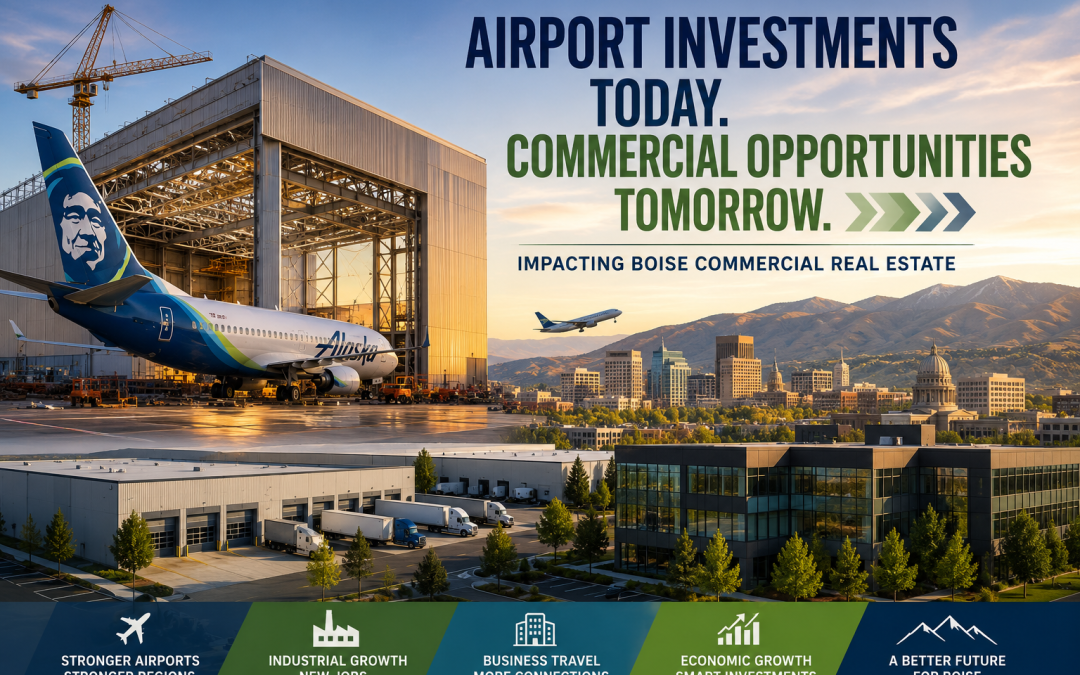
How Major Airport Investments Could Create Long-Term Opportunities for Boise Commercial Real Estate
Large transportation investments rarely benefit only the airport where construction takes place.
When airlines commit millions of dollars to expanding maintenance operations, they’re also investing in long-term passenger growth, regional employment, business travel, and supply chain capacity. Those changes often ripple across neighboring markets—including Boise.
According to reporting by Randyl Drummer in CoStar News, Alaska Airlines has begun construction on a major aircraft maintenance complex at Portland International Airport. You can read the original CoStar News article here: https://product.costar.com/home/news/1792212529. This article is based on that reporting while exploring what these investments could mean for Boise commercial real estate, industrial development, office demand, and future economic growth throughout the Treasure Valley.
Airport Infrastructure Often Signals Bigger Economic Growth
Commercial aviation plays a much larger role in regional economies than many people realize.
Airports support tourism, business travel, manufacturing, logistics, corporate expansion, and workforce mobility. When airlines invest heavily in permanent facilities, they typically expect long-term growth—not just higher passenger counts next year.
Alaska Airlines recently began construction on a $150 million maintenance facility at Portland International Airport. The project is expected to open during the second quarter of 2028.
The expansion will include:
- A 125,000-square-foot aircraft maintenance hangar
- Approximately 60,000 square feet of offices, maintenance shops, and support space
- Capacity to service multiple narrow-body and widebody aircraft simultaneously
- More than 100 permanent jobs once operations begin
The project follows another recent Alaska Airlines investment at Portland International Airport: an $18 million expansion and renovation of its airport lounge.
Together, these projects demonstrate that the airline sees Portland as one of its most important long-term operating hubs.
Why Airlines Invest in Maintenance Facilities
Maintenance hangars may not attract headlines like new passenger terminals, but they’re among the most important assets an airline can build.
Aircraft require constant inspections, repairs, upgrades, and scheduled maintenance. Expanding maintenance capacity helps airlines:
- Reduce operational delays
- Improve fleet reliability
- Support larger route networks
- Create skilled aviation jobs
- Increase long-term operational flexibility
The new Portland facility will also support both Alaska Airlines and Hawaiian Airlines following Alaska’s acquisition of Hawaiian, giving the combined airline additional maintenance capacity across its growing network.
For commercial real estate professionals, projects like this represent confidence in future business activity rather than short-term demand.
Business Travel Continues Supporting Commercial Real Estate
According to CoStar’s market analysis, Portland continues benefiting from consistent weekday travel driven by tourism and major employers, including Intel and companies involved in the Pacific Northwest semiconductor industry.
That business activity supports demand for numerous commercial property types, including:
- Hotels
- Office space
- Industrial facilities
- Airport-related logistics
- Retail serving travelers and employees
Every new job created around an airport generates additional spending throughout the surrounding economy.
Restaurants, hotels, suppliers, transportation providers, contractors, and professional service firms all benefit when aviation activity expands.
What This Could Mean for Boise Commercial Real Estate
Although this investment is taking place in Oregon, the implications extend beyond Portland.
Boise continues strengthening its role as one of the fastest-growing business markets in the Northwest. As companies expand throughout the region, stronger transportation networks become increasingly valuable.
Several trends could eventually benefit Boise commercial real estate:
Continued Industrial Growth
Boise’s industrial market already benefits from manufacturing, logistics, food production, and Micron’s semiconductor expansion.
Regional transportation investments often improve supply chain efficiency across multiple Northwest markets.
More Business Travel
Companies operating throughout Idaho frequently rely on airline connections through major hubs like Portland and Seattle.
As airline infrastructure improves, business travel becomes more efficient, supporting corporate expansion and attracting outside investment.
Increased Demand for Airport-Related Development
As Boise Airport continues growing, additional opportunities may emerge for:
- Industrial development
- Distribution facilities
- Aviation-related businesses
- Hotels
- Office projects
- Flex space serving transportation companies
Airport districts often evolve into major commercial employment centers over time.
Boise’s Competitive Position Continues Improving
One reason investors continue watching Boise is its ability to benefit from broader regional growth without experiencing many of the higher operating costs found in larger West Coast cities.
Companies expanding across the Pacific Northwest frequently evaluate multiple markets for future operations.
As transportation infrastructure improves throughout the region, Boise becomes even more attractive because it offers:
- Lower business costs
- Strong population growth
- Expanding workforce
- Business-friendly policies
- Continued commercial development opportunities
These advantages help support long-term demand across office, industrial, retail, and mixed-use projects.
Local Insight
Large aviation projects rarely stand alone.
They often signal where companies expect future economic activity to concentrate over the next decade.
For Boise developers, investors, landlords, and business owners, watching major transportation investments across the Pacific Northwest provides valuable insight into future demand trends. While Portland receives today’s construction activity, Boise continues positioning itself to capture businesses seeking a growing market with lower costs and expanding regional connections.
As transportation, manufacturing, and business travel continue evolving across the Northwest, Boise commercial real estate appears well positioned to benefit from those long-term economic shifts.
Mike Gioioso (joy-OH-so) has for 16+ years been helping companies of all sizes buy, build, and lease perfect places for business in greater Boise, Idaho and beyond.
www.streetsmartidaho.com
mike@streetsmartidaho.com
208-209-9166
Tags: #boisecommercialrealestate, #boisedevelopment, #boiseairport, #alaskaairlines, #portlandinternationalairport, #industrialrealestate, #aviationindustry, #airportdevelopment, #commercialpropertyinvestment, #industrialdevelopment, #logisticsrealestate, #officedevelopment, #treasurevalleygrowth, #economicdevelopment, #commercialrealestatetrends, #transportationinfrastructure