
How AI Could Change Boise Commercial Real Estate—and Why Local Businesses Should Pay Attention Now
Artificial intelligence isn’t just a technology story anymore.
It is becoming a business strategy story—and eventually, a commercial real estate story.
Companies are beginning to use AI to analyze information, automate repetitive work, improve customer service, forecast demand, and make decisions faster. Those changes could influence everything from how businesses operate to how much space they need and where they choose to locate.
According to reporting by Steve Lombard in the Idaho Business Review, Boise-based buildAidaho is helping Idaho companies develop strategies for using data and artificial intelligence without losing sight of the people actually running those businesses.
You can read the original Idaho Business Review article here: https://idahobusinessreview.com/2026/07/17/buildaidaho-idaho-businesses-leverage-ai-advancements/
For those of us watching Boise commercial real estate, the bigger takeaway is worth considering.
AI probably won’t change real estate because a computer suddenly starts choosing buildings.
It will change real estate because the companies occupying those buildings are changing.
Idaho Businesses Are Moving From AI Curiosity to AI Strategy
Boise-based buildAidaho, led by Paige Giese, works with companies seeking to improve how they use data and AI.
Giese brings a background in corporate data science and has focused the business on helping Idaho companies develop practical technology strategies.
She is also working with Jet Hansen, a principal solutions architect at Intuit who serves on the executive board of the Idaho Technology Council.
Their approach is less about chasing the newest AI product and more about figuring out what businesses actually need.
That’s an important distinction.
The market is being flooded with AI tools promising to automate nearly everything.
But installing software doesn’t automatically make a business more productive.
Companies first need to understand their workflows, their customers, their data, and the problems they’re trying to solve.
For Boise businesses, that could become an important competitive advantage.
Why Better Data Matters to Commercial Real Estate
Commercial real estate has always been a data business.
We analyze rents.
We track vacancy.
We compare sales.
We study demographics.
We evaluate traffic counts.
We look at population growth, construction pipelines, tenant demand, absorption, and investment returns.
AI has the potential to make much of that analysis faster.
Imagine combining property information, demographic trends, lease data, traffic patterns, business formation, construction activity, and consumer behavior into systems capable of identifying patterns humans might otherwise miss.
That doesn’t eliminate the broker, developer, property manager, or investor.
It changes what they can do.
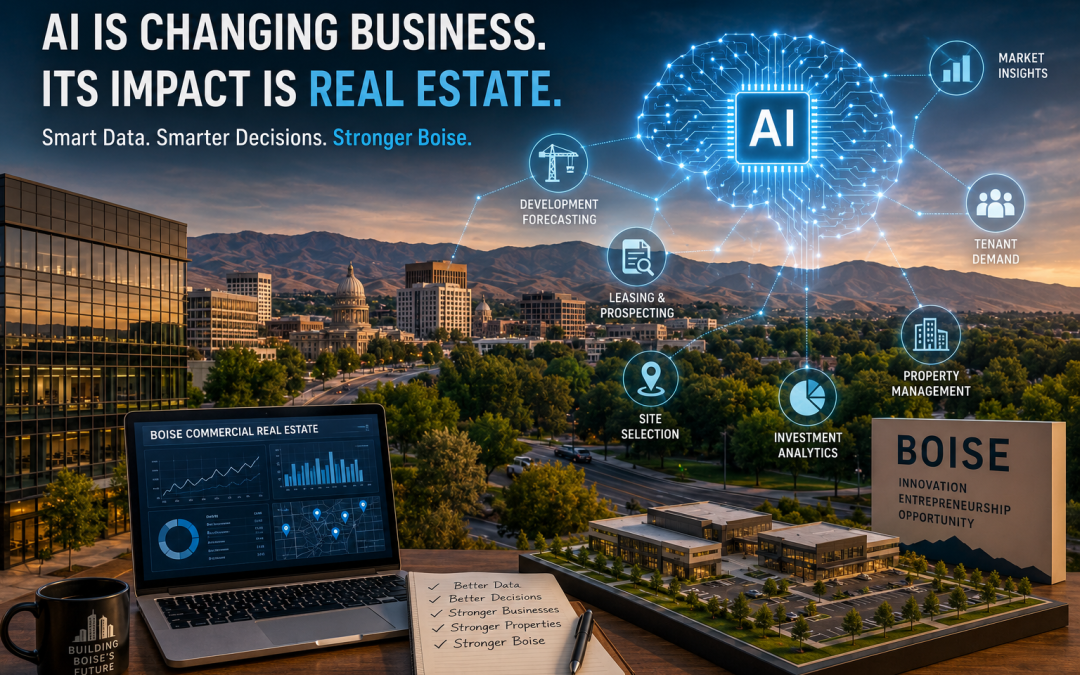
For Boise commercial real estate, AI could eventually improve several parts of the business:
- Property and tenant prospecting
- Site-selection analysis
- Lease and document review
- Market research
- Investment underwriting
- Property management
- Marketing and lead generation
- Development forecasting
- Customer relationship management
The companies that learn how to use these tools effectively may be able to move faster than competitors.
But speed isn’t the same thing as accuracy.
And that’s where the human element remains important.
AI Is Only as Useful as the Information Behind It
One of the most important ideas raised by Giese is the need for businesses to build a strong data foundation.
That may sound technical, but the concept is simple.
Bad information produces bad decisions.
A commercial real estate company could have access to an incredibly powerful AI system, but if its lease records are incomplete, property information is outdated, contacts are duplicated, and transaction data is poorly organized, the technology won’t magically fix everything.
In some cases, it could make the problem worse by producing incorrect answers faster.
This is especially relevant to commercial real estate.
Brokerage companies often have years—or decades—of valuable information sitting across CRMs, spreadsheets, email accounts, lease files, property databases, marketing platforms, and individual brokers’ contact lists.
Organizing that information may eventually become one of the industry’s biggest competitive advantages.
A firm with clean, structured data can potentially use AI far more effectively than one starting with scattered information.
AI Could Change What Tenants Need From Their Real Estate
The impact could go beyond brokerage.
As companies become more efficient, their real estate needs may change too.
Some businesses could need fewer administrative workstations.
Others could require more collaborative space.
Technology companies may place greater importance on electrical capacity and connectivity.
Advanced manufacturing companies could need specialized facilities.
Data-intensive businesses may prioritize fiber infrastructure and redundant power.
Smaller companies could potentially compete with larger organizations because AI allows a small team to accomplish more.
That creates an interesting question for office leasing in Boise:
What happens when a company that once needed 40 employees to produce a certain amount of work can accomplish something similar with 25 employees supported by better technology?
The answer doesn’t necessarily mean less office demand.
It could mean different office demand.
Companies may spend more per employee on better environments while occupying less space overall.
We could see more emphasis on conference rooms, collaborative areas, client-facing environments, flexible layouts, and high-quality amenities.
That reinforces a trend already occurring in many office markets: quality can matter more than quantity.
Smaller Businesses May Gain the Most
One of the most interesting possibilities is what AI could do for small companies.
Large corporations already have marketing departments, analysts, researchers, software developers, accounting teams, and administrative staff.
A small company may have one person handling several of those responsibilities.
AI can potentially narrow that gap.
A five-person company may be able to create marketing materials, analyze customer data, automate administrative tasks, improve sales follow-up, and conduct research that once required a much larger staff.
That could encourage more entrepreneurship across the Treasure Valley.
And more successful small businesses eventually means more demand for commercial space.
Today’s home-based startup could become tomorrow’s office tenant.
Today’s online retailer could eventually need a warehouse.
Today’s food entrepreneur could eventually need a production facility and storefront.
Today’s small technology company could eventually occupy an entire office floor.
For landlords involved in retail leasing Boise, office leasing, or small industrial properties, watching the local startup ecosystem may become increasingly important.
Micron, Meta and Boise’s Technology Economy Raise the Stakes
AI adoption is particularly relevant because the Treasure Valley isn’t operating in isolation.
Large technology and infrastructure investments are already changing the region.
Micron’s semiconductor expansion is perhaps the most visible example.
Major technology and data infrastructure projects can create an ecosystem around them.
Suppliers arrive.
Engineering firms expand.
Contractors grow.
Technology companies hire.
Professional service businesses follow.
Employees create additional demand for housing, restaurants, retail, healthcare, and entertainment.
That creates secondary demand throughout Boise commercial real estate.
The Idaho Business Review article also notes that local technology leaders are seeing startup activity rather than simply contraction.
If AI lowers some of the barriers required to launch and operate a business, Boise could potentially see more small companies entering the market.
That would be important for landlords because startups typically don’t begin by leasing enormous headquarters.
They start with small offices, flex space, coworking environments, storefronts, and modest industrial units.
Those businesses can eventually grow into larger tenants.
Local Insight: AI Won’t Replace Relationships
Commercial real estate is an interesting industry for AI because so much of the business depends on information—but deals still depend heavily on people.
AI can analyze hundreds of properties.
It can summarize leases.
It can organize prospect lists.
It can identify patterns in market data.
It can help create marketing campaigns.
It may eventually predict which companies are likely to expand or relocate.
But it can’t walk a property with a business owner and fully understand why one location simply feels better than another.
It can’t negotiate every complicated landlord-tenant relationship.
It doesn’t have decades of relationships with property owners.
And it doesn’t personally carry the consequences of a multimillion-dollar investment decision.
That’s why I believe the biggest winners won’t necessarily be companies trying to replace people with AI.
They will be companies using AI to make experienced people better.
A broker who understands the market and uses powerful technology should have an advantage over someone relying only on technology—or someone refusing to use it at all.
Developers and Investors Should Watch Tenant Productivity
There is another commercial real estate implication that deserves attention.
AI could improve the productivity of tenants.
A more productive business can potentially generate higher revenue from the same physical footprint.
That matters to landlords.
Retailers that use technology to improve marketing and inventory management may generate stronger sales.
Professional firms that automate administrative work may improve profitability.
Manufacturers that optimize production could increase output.
Property managers using predictive maintenance could reduce operating expenses.
Developers using better forecasting tools could make more informed construction decisions.
If these improvements strengthen tenant businesses, they could ultimately strengthen commercial properties.
The value of a building is closely tied to the financial health of the businesses occupying it.
Technology that makes those businesses stronger can indirectly make commercial real estate stronger too.
The Biggest Mistake May Be Using AI Without a Clear Problem
One of the strongest points in the Idaho Business Review article is also one of the simplest.
Businesses shouldn’t adopt AI just because everyone is talking about AI.
They should identify a real problem first.
For a commercial real estate company, that problem might be:
“We spend too much time researching prospective tenants.”
Or:
“Our property information is scattered across multiple systems.”
Or:
“We don’t follow up with leads consistently.”
Or:
“It takes too long to analyze new investment opportunities.”
Once the problem is clear, technology can be evaluated against it.
That’s much more useful than buying the latest AI platform and then trying to invent a reason to use it.
What Boise Commercial Real Estate Should Watch Next
Artificial intelligence is going to continue moving into nearly every part of business.
The question isn’t whether Boise companies will use it.
The more important question is which companies will learn to use it effectively.
For commercial real estate, that could influence tenant growth, office requirements, industrial demand, brokerage productivity, development decisions, property management, and investment analysis.
But the fundamentals won’t disappear.
Good properties still need good locations.
Retailers still need customers.
Industrial users still need infrastructure.
Investors still need acceptable returns.
And businesses still need talented people.
AI simply gives those people another tool.
For Boise landlords, investors, developers, brokers, and tenants, the opportunity isn’t to chase every new technology.
It’s to figure out where technology can make an already good business better.
That may ultimately be one of the most important competitive advantages in the next chapter of Boise commercial real estate.
Mike Gioioso (joy-OH-so) has for 16+ years been helping companies of all sizes buy, build, and lease perfect places for business in greater Boise, Idaho and beyond.
www.streetsmartidaho.com mike@streetsmartidaho.com 208-209-9166
Tags: #boisecommercialrealestate, #artificialintelligence, #aiincommercialrealestate, #boisetechnology, #boisedevelopment, #idahotechnology, #treasurevalleybusiness, #buildaidaho, #idahotechnologycouncil, #micronboise, #boiseofficemarket, #officeleasingboise, #industrialrealestateboise, #retailleasingboise, #commercialpropertyinvestment, #aiautomation