
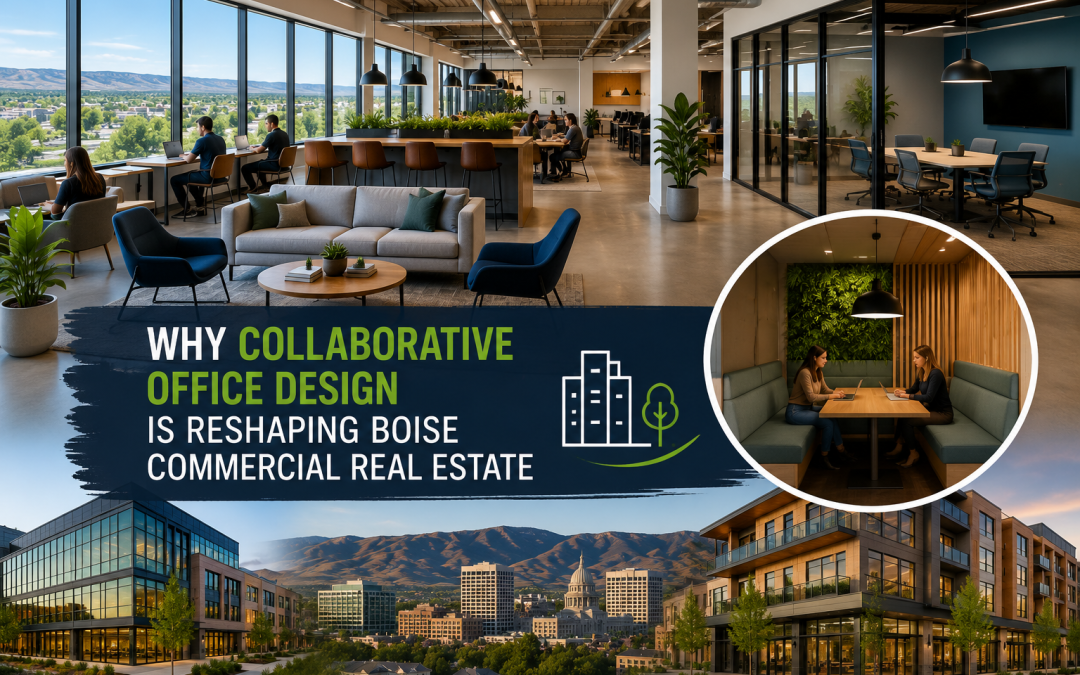
Why Collaborative Office Design Is Reshaping Boise Commercial Real Estate
Office buildings are no longer judged only by their location or square footage. Today, many companies are looking for workplaces that help employees communicate, solve problems faster, and adapt to changing ways of working.
According to reporting by Steve Lombard in the Idaho Business Review, Boise architect Eamonn Parke says collaborative workspaces are becoming an increasingly important part of both commercial and residential design. You can read the original Idaho Business Review article here: https://idahobusinessreview.com/2026/07/10/boise-architects-collaborative-office-residential-spaces/. This article is based on that reporting while exploring what this design trend could mean for Boise commercial real estate, office leasing, and future development across the Treasure Valley.
Office Design Is Moving Beyond the Traditional Conference Room
For decades, offices were built around private offices, cubicles, and conference rooms.
Today’s workplaces look very different.
Companies increasingly want offices that support multiple ways of working throughout the day. Instead of relying on one large meeting room, newer office layouts often include:
- Small breakout rooms for focused discussions
- Open collaboration areas for project teams
- Flexible seating arrangements
- Technology-enabled meeting spaces
- Quiet rooms for individual work
- Comfortable lounge areas that encourage informal conversations
Rather than creating one-size-fits-all offices, businesses are designing spaces that allow employees to choose the environment that best fits the task at hand.
Boise Is Seeing More Flexible Workspace Options
While collaborative office design has been common in larger metropolitan markets for years, Boise continues to see steady growth in flexible workplace options.
Two examples highlighted in the Idaho Business Review include:
- Trailhead, a downtown Boise nonprofit coworking and entrepreneurial hub that connects startups, innovators, and small businesses.
- Kiln in Meridian, which offers flexible office suites, coworking memberships, conference rooms, podcast studios, wellness amenities, and collaborative gathering spaces.
These types of work environments appeal to:
- Startups
- Remote teams
- Small businesses
- Consultants
- Expanding companies
- Satellite corporate offices
As Boise continues attracting entrepreneurs and technology companies, demand for flexible office environments is likely to remain strong.
Why This Matters for Boise Commercial Real Estate
The shift toward collaborative workspaces affects much more than office interiors.
It influences how landlords renovate buildings, how developers design new projects, and how tenants evaluate potential office space.
Businesses today often ask questions like:
- Can this office support hybrid work?
- Are there spaces for collaboration and private work?
- Does the layout help recruit and retain employees?
- Can the space adapt as the company grows?
Buildings that offer flexible floor plans, abundant natural light, modern technology infrastructure, and shared amenities may have an advantage when competing for tenants.
For landlords, investing in updated common areas and collaborative environments can improve leasing opportunities without necessarily expanding the building’s footprint.
Collaboration Is Expanding Beyond Office Buildings
One of the more interesting trends is that collaborative design is no longer limited to commercial offices.
According to Parke, schools are incorporating more flexible learning environments that support both teamwork and independent study.
Residential design is evolving as well.
As remote and hybrid work remain common, many homeowners want dedicated workspaces that function as productive home offices while still blending into everyday living.
That shift creates opportunities for architects, builders, and developers to rethink how homes and mixed-use communities are designed.
The Growing Importance of User-Centered Design
The Idaho Business Review article also highlights research from workplace design company Haworth, which emphasizes creating environments that help people inform, think, connect, and accomplish work more effectively.
That philosophy reflects a broader trend throughout commercial real estate.
Modern office users increasingly evaluate a building based on the employee experience rather than simply rental rates.
Successful office projects now consider details such as:
- Furniture flexibility
- Acoustic comfort
- Technology integration
- Wellness amenities
- Natural lighting
- Adaptable floor plans
- Comfortable gathering areas
These features can improve workplace satisfaction while making office space more attractive in a competitive leasing market.
What This Could Mean for Boise Development
As Boise continues growing, collaborative office design may become an increasingly important differentiator for new commercial projects.
Developers planning office buildings, mixed-use developments, innovation districts, and business campuses have an opportunity to create environments that encourage creativity and interaction instead of simply providing workspace.
For companies relocating to the Treasure Valley, modern collaborative office environments can also support recruiting efforts by offering workplaces that employees genuinely enjoy using.
The office market is evolving from providing desks to creating experiences.
That shift could influence everything from office leasing in downtown Boise to suburban developments in Meridian, Eagle, and the broader Treasure Valley.
My Take
From my perspective in Boise commercial real estate, collaborative design is becoming a competitive advantage rather than just an architectural trend.
Office tenants today aren’t simply comparing lease rates—they’re comparing how well a space helps their employees perform. A thoughtfully designed office can improve productivity, support company culture, and make hiring easier in a competitive labor market.
I also think we’ll continue seeing more landlords renovate existing office buildings instead of constructing entirely new ones. Updating common areas, adding flexible meeting spaces, and improving shared amenities can help older properties compete with newer developments while giving tenants the adaptability they increasingly expect.
As Boise attracts more technology firms, professional services, healthcare companies, and entrepreneurs, buildings designed around collaboration are likely to become some of the market’s most desirable commercial assets.
Mike Gioioso (joy-OH-so) has for 16+ years been helping companies of all sizes buy, build, and lease perfect places for business in greater Boise, Idaho and beyond.
www.streetsmartidaho.com
mike@streetsmartidaho.com
208-209-9166
Tags: #boisecommercialrealestate, #boiseofficespace, #boisedevelopment, #officedesign, #collaborativeworkspace, #flexibleofficespace, #coworkingboise, #retailleasingboise, #commercialarchitecture, #officeleasingboise, #trailheadboise, #kilnmeridian, #mixedusedevelopment, #workplacedesign, #commercialproperty, #treasurevalleydevelopment, #hybridwork, #officetrends