Idaho’s Horse Economy Could Create Overlooked Opportunities for Boise Commercial Real Estate
Not every commercial real estate opportunity in Idaho involves apartments, warehouses, restaurants, or office buildings.
Some opportunities are sitting on acreage at the edge of the Treasure Valley.
Idaho’s large horse community supports veterinarians, feed stores, tack businesses, trainers, boarding facilities, arenas, agricultural suppliers, and other businesses that require very different real estate than a typical retail or office tenant.
A new statewide education effort from the University of Idaho offers an interesting look at the size and needs of this community—and why the Boise commercial real estate industry should pay attention to specialized agricultural and equine businesses.
According to reporting by IBR Staff in the Idaho Business Review, University of Idaho Extension recently launched a statewide horse-owner education initiative after a survey identified significant gaps in owners’ knowledge of horse health, nutrition, handling, and related topics.
The original Idaho Business Review article is available here:
The program itself is educational, not a real estate project.
But it highlights a broader part of Idaho’s economy that can be easy to overlook when discussing commercial development.
Idaho’s Horse Community Supports More Than Farms
University of Idaho Extension surveyed adult horse owners and enthusiasts across Idaho during 2025.
The 25-question assessment covered subjects including nutrition, vaccinations, hoof care, dental care, animal health, and safe handling. A total of 140 people responded.
The results showed substantial differences in knowledge depending on experience.
New horse owners and parents involved with 4-H horse activities generally scored around 30%, while experienced owners scored above 50%.
Health, nutrition, and handling emerged as some of the biggest areas where additional education was needed.
Extension educators Sawyer Fonnesbeck of Oneida County and Selena Davila of Lincoln County used those findings to develop workshops focused on practical subjects such as first aid, nutrition, and biosecurity.
Sessions have already been held in Burley, Rexburg, Malad, and Shoshone, while additional Idaho counties have expressed interest.
That growing interest provides a useful reminder:
Idaho has a substantial population of people actively involved with horses—and every horse represents an economic ecosystem extending well beyond the property where the animal lives.
Owners buy feed.
They hire veterinarians.
They purchase equipment.
They need trailers.
They use trainers and boarding facilities.
They buy fencing, tack, supplements, bedding, and other supplies.
Some participate in competitions and events.
Others own acreage specifically because they want horses.
That activity creates businesses, and businesses eventually create commercial real estate demand.
Treasure Valley Growth Could Increase Demand for Specialized Properties
This becomes particularly interesting around the Boise metro.
Growth in Boise, Meridian, Nampa, Caldwell, Kuna, Star, Eagle, and surrounding communities continues pushing development farther into areas that historically had more agricultural uses.
That creates an unusual commercial real estate dynamic.
As residential development expands outward, some agricultural land disappears.
At the same time, the growing population can increase the number of potential customers for equine services and other rural-oriented businesses.
That can make appropriately located properties increasingly important.
An equine veterinarian, for example, may have very different real estate requirements from a traditional medical tenant.
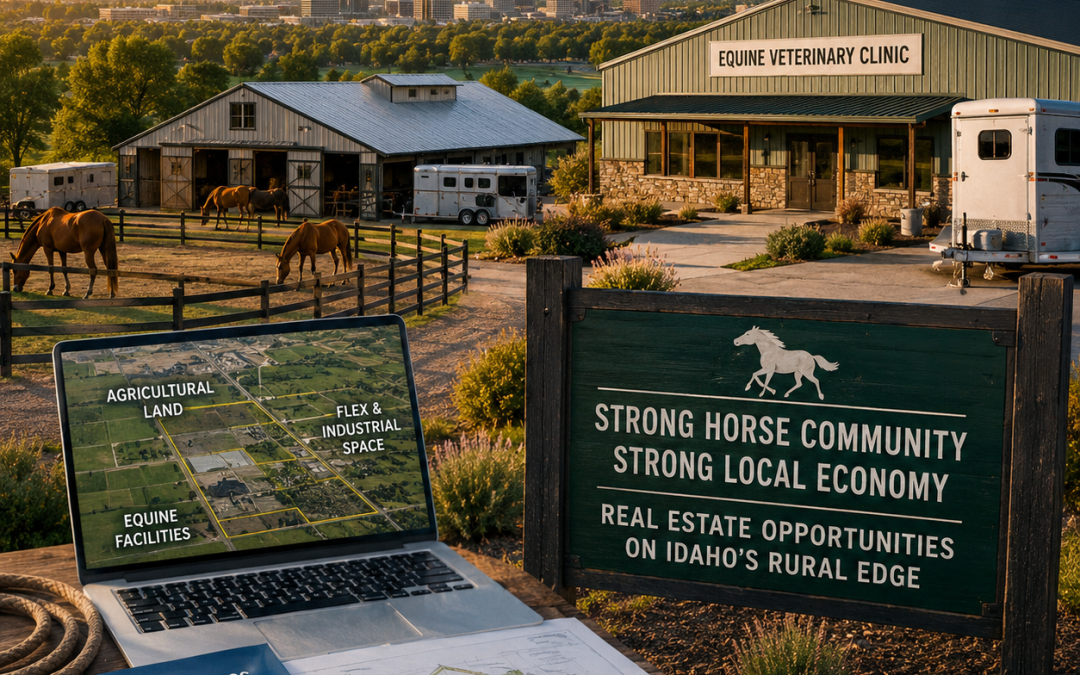
A horse boarding or training business may require acreage, barns, arenas, trailer access, fencing, water, and substantial separation from neighboring uses.
Feed and agricultural retailers may need a combination of retail space, warehouse storage, loading areas, and outdoor storage.
Farriers, tack businesses, trailer companies, fencing contractors, and other related businesses may fit particularly well into flex and industrial properties.
These uses rarely fit neatly into the conventional retail-office-industrial categories used to describe Boise commercial real estate.
But that does not make their demand less important.
Land Use Could Become the Bigger Issue
The long-term commercial real estate question may be less about whether Idaho has demand for equine businesses and more about where those businesses will be able to operate.
As the Treasure Valley grows, land near population centers becomes more valuable.
Agricultural parcels can transition into subdivisions, industrial projects, retail centers, schools, and other development.
That creates competition for land.
A property that works extremely well for horses today could eventually become more valuable for another use.
At the same time, moving equine businesses farther from population centers can make them less convenient for their customers.
This creates an interesting balancing act for Boise development.
Some commercial activities need acreage without needing prime commercial frontage.
Others require outdoor storage, animal facilities, trailer circulation, or uses that may not be compatible with dense residential development.
Investors looking at properties on the edges of the Boise metro should therefore consider more than the building currently sitting on the land.
Zoning, water, access, surrounding development, future land-use plans, and the ability to accommodate specialized users can all influence long-term value.
Education Can Strengthen the Businesses Behind the Industry
The University of Idaho Extension program also highlights something commercial property owners do not always consider.
Education can strengthen an industry.
The Extension workshops cover subjects such as horse first aid, nutrition, and biosecurity. A second program involving dentistry, handling, and tack fitting is reportedly being developed.
Biosecurity has become especially relevant because concerns surrounding equine herpesvirus have affected horse events.
Better-informed owners can potentially improve animal care and help strengthen the overall horse community.
That matters economically because healthy industries create demand for supporting businesses.
A strong equine community can support everything from veterinary clinics and feed suppliers to equipment dealers, trainers, event facilities, and agricultural contractors.
University of Idaho Extension’s survey methodology has even attracted attention outside Idaho. According to the Idaho Business Review, educators from other states have contacted the program’s organizers about using similar approaches.
The findings were also published in the June 2026 edition of the National Association of County Agricultural Agents journal.
Local Insight: Don’t Ignore Commercial Demand on Boise’s Rural Edge
When people discuss Boise commercial real estate, attention naturally goes toward major industrial projects, apartment development, new shopping centers, office vacancy, and high-profile land transactions.
But the Treasure Valley economy is broader than that.
The areas between urban Boise and rural Idaho can create opportunities for property types that do not fit into traditional commercial categories.
Equine businesses are a good example.
A five- or ten-acre property with an older building might not attract a traditional office or retail investor.
For the right veterinary, boarding, training, agricultural, or specialty business, however, that same property’s combination of acreage, access, existing improvements, and location could be difficult to replace.
That is where specialized knowledge matters.
Commercial real estate investors should understand not only what a property is today but also which businesses can realistically use it.
The continued expansion of the Treasure Valley may make well-positioned rural commercial and agricultural properties more interesting—not less.
Some will eventually become redevelopment opportunities.
Others could become increasingly valuable because comparable properties are disappearing.
What This Means for Boise Commercial Real Estate
The University of Idaho Extension initiative is ultimately about helping Idaho horse owners become more knowledgeable.
But it also shines a light on a part of the state’s economy that commercial real estate professionals should not overlook.
Idaho’s horse community supports businesses requiring land, buildings, storage, access, infrastructure, and specialized facilities.
As the Treasure Valley continues growing, the properties capable of serving those businesses may become harder to find.
For landlords and investors, that could create opportunities in specialized flex, agricultural, and rural commercial properties.
For tenants, it makes early site planning increasingly important.
For developers and municipalities, it raises questions about how agricultural and animal-related businesses fit alongside expanding residential and commercial development.
And for commercial real estate brokers, it is another reminder that some of the best opportunities are found by understanding how businesses actually operate, rather than simply putting every tenant into a standard property category.
Boise is growing outward.
As that happens, the line between urban commercial real estate and Idaho’s traditional agricultural economy will continue moving.
Understanding what happens along that line could uncover some of the Treasure Valley’s more overlooked real estate opportunities.
Mike Gioioso (joy-OH-so) has for 16+ years been helping companies of all sizes buy, build, and lease perfect places for business in greater Boise, Idaho and beyond.
www.streetsmartidaho.com mike@streetsmartidaho.com 208-209-9166
Tags: #boisecommercialrealestate, #idahocommercialrealestate, #treasurevalleycommercialrealestate, #boisedevelopment, #treasurevalleydevelopment, #idahohorseeconomy, #idahoequineindustry, #equinerealestate, #agriculturalrealestateidaho, #boiseagriculturalland, #treasurevalleyagriculturalland, #ruralcommercialrealestate, #boiseruraldevelopment