
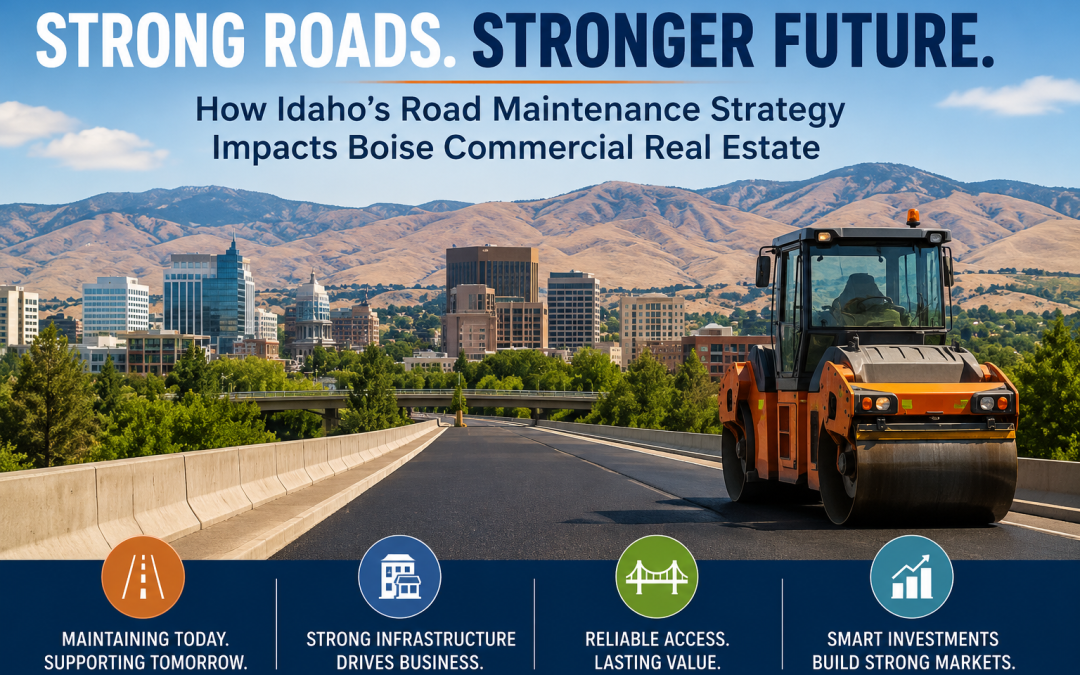
Why Idaho’s Road Maintenance Strategy Could Shape Boise Commercial Real Estate Growth
Transportation is one of the biggest factors influencing commercial real estate, but it’s not always the newest highways that matter most.
Sometimes, simply keeping existing roads and bridges in good condition has the greatest impact on businesses, property owners, and investors. Reliable transportation helps employees reach work, customers reach businesses, and goods move efficiently across the state.
According to reporting by the Idaho Business Review staff, based on an announcement from the Idaho Transportation Department (ITD), the agency is adjusting its seven-year investment program to place greater emphasis on maintaining Idaho’s existing transportation network as funding priorities evolve. You can read the original Idaho Business Review article here: https://idahobusinessreview.com/2026/06/26/idaho-roadway-maintenance-and-preservation-a-priority-for-itd/. This article is based on that reporting while exploring what these transportation priorities could mean for Boise commercial real estate, future development, retail leasing, industrial growth, and long-term investment across the Treasure Valley.
Idaho Is Prioritizing What Already Exists
Rather than accelerating large expansion projects, ITD is directing more resources toward preserving current roads and bridges.
The updated seven-year transportation investment program reflects today’s funding realities. According to the agency, maintaining safe, reliable infrastructure has become the highest priority while some future expansion projects move into an “Early Development” category until additional funding becomes available.
ITD Board Chairman Bill Moad also emphasized that community feedback will play an important role in determining final priorities. Public comments begin in July, with the finalized project list expected in September.
Key Takeaways
- Idaho is updating its seven-year transportation investment program.
- Existing roads and bridges will receive the highest funding priority.
- Some expansion projects are being advanced through planning but remain unfunded.
- Public comments will help shape final transportation priorities before projects are approved.
Why This Matters for Boise Commercial Real Estate
Transportation infrastructure directly affects commercial property values.
Retail centers depend on convenient customer access. Industrial buildings rely on dependable trucking routes. Office users want employees to commute efficiently. Multifamily developers also pay close attention to roadway improvements when evaluating future projects.
For the Boise commercial real estate market, maintaining existing transportation corridors may provide more immediate value than beginning several large expansion projects that cannot yet be fully funded.
Keeping major roads in good condition reduces disruptions for businesses already operating throughout Boise, Meridian, Nampa, Caldwell, Eagle, and the surrounding Treasure Valley.
Reliable infrastructure also provides confidence for companies considering relocation or expansion into Idaho.
Development Decisions May Become More Strategic
Developers often plan projects years before construction begins.
Even though some roadway expansion projects may be delayed, ITD indicated that planning and engineering work will continue whenever possible. That means projects can move forward more quickly if future funding becomes available.
For developers evaluating Boise development opportunities, this creates an important distinction.
Areas already served by strong transportation infrastructure may continue attracting commercial investment because existing access remains dependable. Projects requiring entirely new roadway capacity could take longer to move from planning into construction.
That may influence where new retail centers, industrial parks, office developments, and mixed-use projects are proposed over the next several years.
What Investors, Landlords, and Tenants Should Watch
Transportation planning often sends signals about future market activity.
Commercial property owners should pay attention to ITD’s final investment program this fall because roadway priorities can influence leasing demand, traffic patterns, and future land values.
Businesses considering new locations may also want to monitor transportation improvements that could affect customer accessibility or freight movement.
For companies involved in retail leasing Boise, logistics, manufacturing, or distribution, understanding future infrastructure investments can become an important part of long-term site selection.
My Take
From a commercial real estate perspective, Idaho’s decision reflects a practical approach.
Protecting existing infrastructure helps preserve the value of current commercial districts while keeping businesses operating efficiently. Although many people naturally focus on major highway expansions, maintaining dependable transportation networks often delivers immediate economic benefits that support leasing activity and business confidence.
As Idaho continues growing, maintaining today’s transportation system while preparing tomorrow’s expansion projects may ultimately provide a balanced strategy that supports both current businesses and future development opportunities.
Mike Gioioso (joy-OH-so) has for 16+ years been helping companies of all sizes buy, build, and lease perfect places for business in greater Boise, Idaho and beyond. www.streetsmartidaho.com mike@streetsmartidaho.com 208-209-9166
Tags: #boisecommercialrealestate, #boiserealestate, #boisedevelopment, #idahocommercialrealestate, #idahotransportationdepartment, #itd, #idahoinfrastructure, #roadinfrastructure, #transportationplanning, #commercialproperty, #commercialrealestateinvestment, #retailleasingboise, #industrialrealestate, #officedevelopment, #industrialdevelopment