
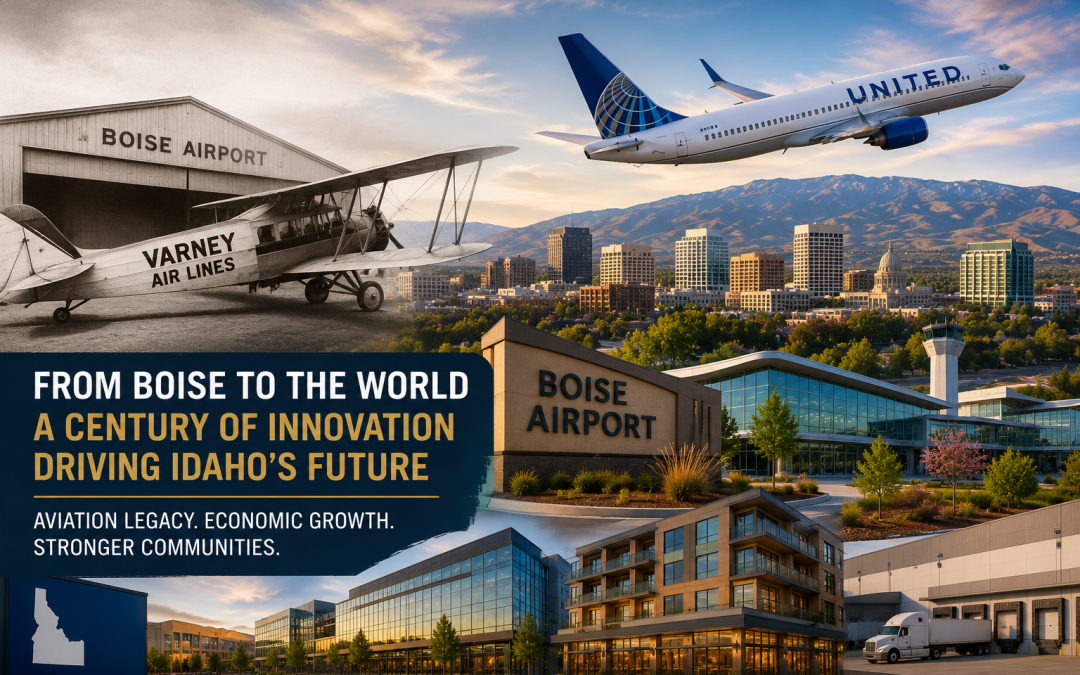
How United Airlines’ Boise Roots Highlight the City’s Long-Term Economic Potential
Boise has earned national attention in recent years for population growth, technology investment, and commercial development. But one of the city’s biggest business success stories actually began a century ago.
According to reporting by IBR Staff in the Idaho Business Review, a recent study by small-business lender OnDeck, using Brand Finance’s Top 500 Brands rankings, identified United Airlines as the most valuable brand founded in Idaho because of its origins as Varney Air Lines in Boise. You can read the original Idaho Business Review article here: https://idahobusinessreview.com/2026/07/10/united-airlines-most-valuable-brand-idaho/. This article is based on that reporting while exploring what Boise’s aviation history could mean for Boise commercial real estate, economic development, and future business growth.
Boise’s Aviation Legacy Still Matters Today
Many people associate Boise with outdoor recreation, technology companies, or Idaho agriculture.
Few realize the city also played an important role in American aviation.
The report explains that Varney Air Lines was founded in Boise in 1926 and operated the nation’s first privately contracted airmail flight on April 6 of that year. That milestone is also recognized as the beginning of what eventually became today’s Boise Airport.
Just five years later, Varney Air Lines became part of a consolidation that formed United Airlines, now one of the world’s largest airline companies.
While the airline has grown into a global brand, its history remains tied to Boise.
Key Facts
- Varney Air Lines was founded in Boise in 1926.
- The company operated the first privately contracted U.S. airmail flight.
- Boise Airport recently celebrated its 100th anniversary.
- Varney became part of United Airlines in 1931.
- United Airlines is now considered Idaho’s most valuable homegrown brand.
Why Brand History Can Influence Economic Growth
Corporate history may seem unrelated to commercial real estate, but it often helps shape how cities market themselves to investors and businesses.
Communities with recognizable business success stories tend to strengthen their reputation for entrepreneurship and innovation.
Boise has developed several competitive advantages over the past decade:
- A growing technology sector
- Expanding aerospace and aviation activity
- Strong population growth
- Continued industrial development
- Increasing national visibility among employers
Historic brands like United Airlines add another chapter to that story by reminding companies that Boise has supported business innovation for generations.
What This Means for Boise Commercial Real Estate
Economic identity matters when companies decide where to expand.
Businesses evaluating new markets often consider more than taxes or operating costs. They also look at workforce quality, transportation infrastructure, business climate, and long-term economic stability.
Boise continues strengthening many of those advantages.
As the metro area grows, demand may continue increasing across several commercial property sectors, including:
- Office space for expanding employers
- Industrial and logistics facilities near transportation corridors
- Retail centers serving growing neighborhoods
- Mixed-use developments attracting talent
- Hospitality properties supporting tourism and business travel
The continued expansion of Boise Airport also supports commercial development by improving regional connectivity for companies doing business throughout the western United States.
Boise’s Business Story Continues to Evolve
The OnDeck study also highlights how valuable brands have emerged from every corner of the country.
Retail companies accounted for the largest number of state-winning brands, including Walmart, Home Depot, Nike, and Publix.
Nationally, Apple ranked as the country’s most valuable brand, followed by Microsoft, Google, and Amazon.
While Idaho may not yet produce brands of that size, the state continues attracting entrepreneurs, manufacturers, technology firms, and growing service businesses that contribute to a diversified economy.
Those businesses create demand for commercial real estate long before they become household names.
My Take
As someone working in Boise commercial real estate, I think this story is about much more than airline history.
It shows that Boise has been part of America’s business innovation story for far longer than many people realize.
Today’s companies often choose locations that offer room to grow, access to talent, strong transportation networks, and a supportive business environment. Boise continues checking many of those boxes.
The city’s aviation legacy also reinforces the importance of Boise Airport as an economic engine. Every airport expansion, new airline route, logistics investment, or business relocation has the potential to create additional demand for office, industrial, retail, hospitality, and mixed-use development throughout the Treasure Valley.
As Boise continues growing, its past may become one of its greatest competitive advantages—demonstrating that world-class companies can begin here and build something much larger.
Mike Gioioso (joy-OH-so) has for 16+ years been helping companies of all sizes buy, build, and lease perfect places for business in greater Boise, Idaho and beyond.
www.streetsmartidaho.com
mike@streetsmartidaho.com
208-209-9166
Tags: #boisecommercialrealestate, #boisedevelopment, #boiseairport, #varneyairlines, #unitedairlines, #idahobusiness, #treasurevalleydevelopment, #economicdevelopment, #industrialrealestate, #officeleasingboise, #retailleasingboise, #commercialproperty, #mixedusedevelopment, #aviationindustry, #logisticsrealestate, #boiseinvestment, #idahoeconomy