
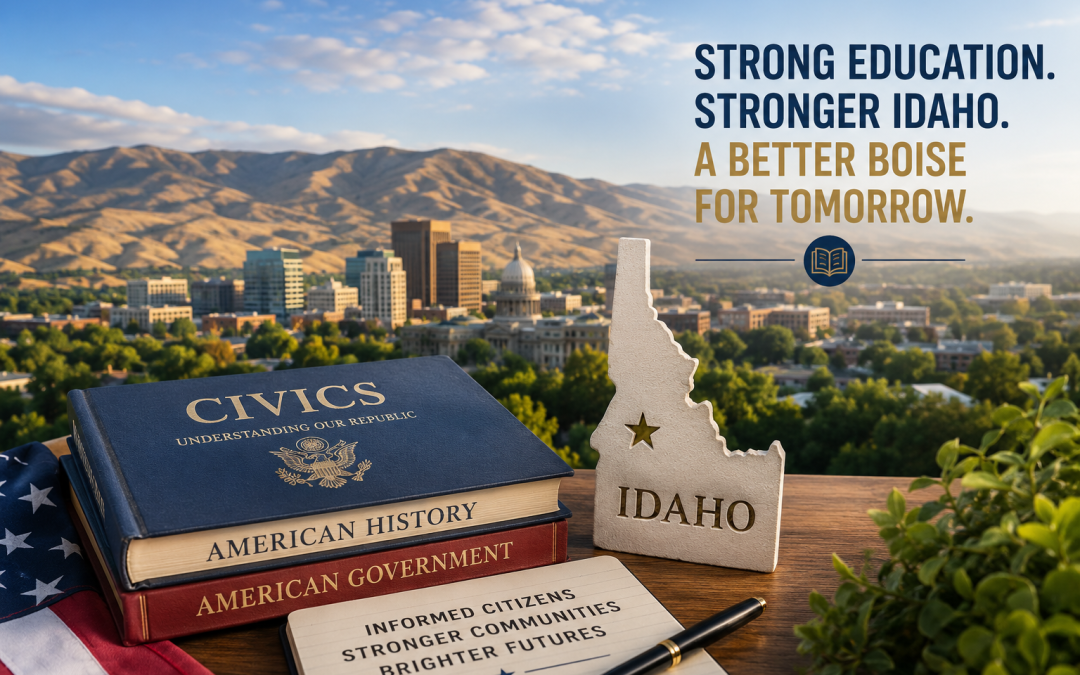
Idaho’s New Civics Requirements Could Shape Boise’s Future Workforce and Growth
Most education policy does not immediately look like a commercial real estate story. But when a fast-growing state changes what every public high school student must learn before graduation, the long-term effects can reach far beyond the classroom.
According to reporting by Steve Lombard in the Idaho Business Review, Idaho is strengthening its civics education requirements beginning with the 2026–27 school year. The changes increase required coursework in American history and government and eventually raise the bar students must meet on a civics assessment before graduating.
The original Idaho Business Review article is available here: https://idahobusinessreview.com/2026/08/03/idaho-requires-civics-education-for-high-school-graduation/
For the Boise commercial real estate market, the immediate impact may be limited. Longer term, however, education policy is part of the larger equation that determines workforce quality, community engagement, business recruitment, and ultimately where companies choose to invest.
Idaho Is Raising the Bar for Civics Education
Gov. Brad Little signed Senate Bill 1336 into law in April 2026, setting new statewide expectations for civics education.
Starting with the 2026–27 school year, Idaho public high school students will face expanded requirements that include a full year of American history and a full year of American government. A tougher civics assessment tied to graduation is expected to follow the next school year.
The legislation was supported by Rep. Barbara Ehardt of Idaho Falls, who has argued that students should leave school with a deeper understanding of America’s system of government and the responsibilities that come with citizenship.
Idaho Superintendent of Public Instruction Debbie Critchfield has also emphasized the importance of civics education. Her position goes beyond memorizing historical dates or government terminology. The broader goal is to develop students who can think critically, communicate effectively, and understand how they can participate in government and their communities.
A second measure, House Bill 712, adds another layer to the state’s effort.
The legislation creates an Idaho State Seal of Excellence for civics education. Schools can also earn a School of Civics Literacy designation when at least 75% of their students receive the state’s Civics Seal.
Taken together, the measures show that Idaho is treating civics as a larger part of preparing students for life after high school.
Why Education Policy Matters to Boise’s Business Climate
So what does any of this have to do with Boise development or commercial real estate?
More than it might appear.
Companies considering Boise, Meridian, Nampa, Caldwell, Eagle, or other Treasure Valley communities do not evaluate real estate in isolation. They look at the entire market.
That includes labor availability, schools, population growth, transportation, taxes, housing costs, infrastructure, quality of life, and the ability to recruit and retain employees.
Education is a major piece of that equation.
For employers, a strong workforce requires more than technical skills. Businesses also need employees who can communicate, evaluate information, solve problems, work with people who hold different opinions, and understand how institutions operate.
Those skills matter whether someone eventually works in construction, technology, healthcare, retail, finance, manufacturing, real estate, or public service.
That makes the debate over civics education relevant to Idaho’s broader economic development strategy.
A Growing Boise Needs an Engaged Workforce
The Treasure Valley has changed dramatically over the past decade.
Population growth has fueled new housing, shopping centers, industrial projects, medical facilities, restaurants, offices, schools, and infrastructure. That growth has created tremendous opportunities in Boise commercial real estate, but it has also created more complicated questions.
Where should new development occur?
How should roads and utilities be funded?
What should zoning allow?
How should cities balance housing needs with commercial growth?
What happens when residents, developers, businesses, and local governments disagree?
These questions are decided through public processes.
Planning and zoning commissions, city councils, school boards, county commissioners, highway districts, and state lawmakers all influence the environment in which businesses and commercial properties operate.
Understanding how those systems work can therefore have real economic value.
A population that better understands local government may be better prepared to participate in public hearings, evaluate development proposals, communicate with elected officials, and understand how public policy decisions are made.
For developers and property owners, that matters.
Local Control Will Make Implementation Important
One of the more significant aspects of Idaho’s approach is that the state establishes the standards while local districts and school boards retain responsibility for how those standards are taught.
That means implementation could look somewhat different across Idaho.
For the Boise metro area, the quality of implementation may ultimately matter more than the legislation itself.
Boise, Meridian, Kuna, Eagle, Star, Nampa, and Caldwell are experiencing different forms and speeds of growth. Their future workforce will increasingly come from students attending schools in these communities today.
From an economic development standpoint, the best outcome would be graduates who understand government while also developing practical skills in critical thinking, respectful disagreement, communication, and problem solving.
Those skills translate directly into the workplace.
The Workforce Connection for Commercial Real Estate
Commercial real estate follows jobs.
Retailers expand where households and spending are growing. Office users seek markets with skilled workers. Manufacturers and industrial companies evaluate labor pools before committing millions of dollars to facilities. Healthcare providers follow population and employment growth.
That means anything affecting Idaho’s future workforce deserves attention from investors and developers.
Education quality is also part of the story companies hear when evaluating a market.
A business considering a relocation to the Treasure Valley may compare Idaho with markets in Utah, Arizona, Colorado, Washington, Oregon, or Texas. Real estate costs matter, but so do schools and workforce development.
If Idaho can demonstrate that its education system produces graduates who are knowledgeable, engaged, thoughtful, and prepared to participate in their communities, that can become another piece of the state’s economic development story.
Local Insight: Think Beyond the Next Development Cycle
Commercial real estate tends to focus on relatively short-term indicators: vacancy, lease rates, cap rates, construction costs, interest rates, absorption, and population growth.
Those numbers are important.
But some of the biggest forces shaping a market develop over decades rather than quarters.
Education is one of them.
Today’s Idaho high school students will become tomorrow’s employees, entrepreneurs, business owners, tenants, homeowners, voters, developers, and community leaders.
That makes the state’s investment in education relevant to the future of Boise real estate even when there is no immediate effect on rents or property values.
For Boise developers and investors, the bigger takeaway is to watch the entire ecosystem supporting Treasure Valley growth. Roads, utilities, housing, schools, workforce development, and local government all influence whether growth remains sustainable.
A strong commercial real estate market ultimately depends on strong communities.
Idaho’s expanded civics requirements are one small piece of that much larger picture.
Mike Gioioso (joy-OH-so)
has for 16+ years been helping companies of all sizes buy, build, and lease perfect places for business in greater Boise, Idaho and beyond.
www.streetsmartidaho.com mike@streetsmartidaho.com 208-209-9166
Tags: #boisecommercialrealestate, #boiserealestate, #boisedevelopment, #idahocommercialrealestate, #idahoeconomicdevelopment, #boiseeconomicdevelopment, #treasurevalleygrowth, #treasurevalleycommercialrealestate, #boiseworkforcedevelopment, #idahoworkforcedevelopment, #idahoeducation, #idahocivicseducation, #boisebusinessclimate, #idahobusinessclimate, #boisepopulationgrowth