
Idaho’s Strong Nursing Pipeline Could Help Fuel Boise’s Growing Healthcare Real Estate Market
Healthcare real estate doesn’t grow simply because developers build more medical offices.
It grows because communities need more doctors, nurses, therapists, specialists and support staff to work inside those buildings.
That’s why new data showing strong nursing outcomes in Idaho deserves attention beyond the education industry. A healthy pipeline of licensed nurses is an important piece of the infrastructure needed to support Idaho’s growing population—and the healthcare facilities being developed to serve it.
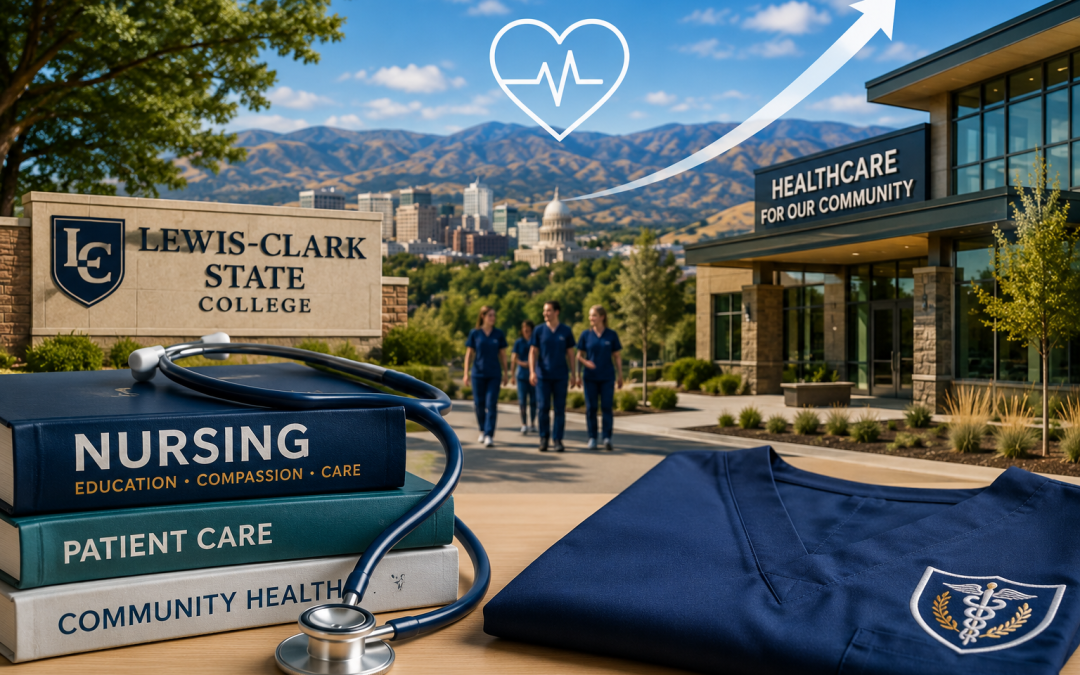
According to reporting from Idaho Business Review staff, Lewis-Clark State College recorded the strongest first-time nursing licensing exam performance among public Bachelor of Science in Nursing programs across Idaho, Washington and Oregon in 2025. The original Idaho Business Review article can be found here: https://idahobusinessreview.com/2026/08/11/lc-state-nursing-program-leads-public-bsn-pass-rates/
For Boise commercial real estate, the larger question is what Idaho’s healthcare workforce pipeline means for medical office demand and future development.
Idaho Is Producing Strong Nursing Results
Lewis-Clark State College, based in Lewiston, posted a 96.43% first-time pass rate on the NCLEX nursing licensing exam in 2025.
Eighty-four graduates took the exam.
More important, this wasn’t a one-year spike.
LC State recorded a 96.55% first-time pass rate in 2024 and 96.05% in 2023, demonstrating consistency across several graduating classes.
The results also fit into a stronger statewide picture.
Idaho’s first-time NCLEX pass rate reached 92.2%, according to data cited in the Idaho Business Review article. That placed Idaho ninth nationally and above the 89% national average.
Among other Idaho public institutions, Boise State University recorded an 85.53% first-time rate, while Idaho State University posted 83.87%.
North Idaho College, which offers an associate-level nursing program rather than a BSN, achieved a 96.25% first-time pass rate.
For Idaho employers, these numbers matter because passing the NCLEX is required before someone can practice as a licensed registered nurse.
That makes nursing education directly connected to workforce availability.
Healthcare Employment and Commercial Real Estate Go Together
What does a nursing exam have to do with Boise commercial real estate?
Quite a bit.
Healthcare facilities cannot expand without workers.
A developer can build a beautiful medical office building, surgery center or clinic, but the space doesn’t create value unless healthcare providers can hire enough people to operate it.
Nurses are especially important because they work throughout the healthcare system—from hospitals and urgent care centers to specialty practices, surgery centers, rehabilitation facilities and outpatient clinics.
As the Treasure Valley continues growing, demand for those services follows the population.
That can translate into demand for several types of commercial property:
- Medical office buildings
- Urgent care centers
- Physical therapy and rehabilitation clinics
- Outpatient surgery centers
- Specialty medical practices
- Senior care and assisted living facilities
- Behavioral health facilities
- Medical training and education space
This is one reason I continue to view healthcare as an important category within Boise commercial real estate.
It is connected to something more durable than a short-term retail trend.
People need healthcare regardless of where we are in the economic cycle.
Population Growth Is Changing Where Healthcare Space Is Needed
Healthcare real estate in the Treasure Valley isn’t only about Downtown Boise or properties next to major hospitals anymore.
The geography of demand is changing.
As residential development expands throughout Meridian, Nampa, Caldwell, Kuna, Star and Eagle, healthcare providers increasingly need locations closer to where their patients live.
That creates opportunities for neighborhood medical facilities.
A family may be willing to drive across the valley for major surgery or specialized treatment. They are less likely to want a long drive for routine physical therapy, dental care, primary care or recurring medical appointments.
Convenience matters.
That’s why medical users can become attractive tenants in newer retail and mixed-use developments.
A physical therapy practice, dentist, chiropractor, urgent care provider or medical specialist may compete for some of the same highly visible commercial locations that traditional retailers want.
For developers, that means healthcare should be considered early in the site-planning process rather than treated as an afterthought.
Parking, accessibility, signage, building depth, plumbing, power and tenant improvement costs can all affect whether a property works for medical use.
Healthcare Can Strengthen Boise Retail Centers
One of the more interesting changes in retail leasing Boise has been the increasing overlap between healthcare and traditional retail real estate.
Many outpatient healthcare providers want exactly what retailers want:
Visibility.
Easy parking.
Convenient access.
Strong demographics.
Locations close to residential neighborhoods.
That creates opportunities for shopping center landlords.
Medical and wellness tenants can diversify a property’s tenant mix while generating consistent customer traffic throughout the week.
They can also fill spaces that might otherwise be difficult for traditional retailers.
However, medical leasing requires careful underwriting.
Build-out costs can be significant. Plumbing and electrical requirements may be greater. Some users need specialized HVAC systems, backup power or unique accessibility improvements.
Lease terms need to reflect that investment.
For Boise landlords considering medical tenants, understanding those costs before signing a lease can prevent expensive surprises later.
Education Is Part of Idaho’s Development Infrastructure
We often talk about infrastructure in terms of roads, utilities, sewer capacity and transportation.
But workforce development is infrastructure too.
A fast-growing region cannot support unlimited business expansion if employers can’t find qualified workers.
That applies especially to healthcare.
Lewis-Clark State’s nursing program is also expanding the ways students can enter the profession. In addition to several BSN pathways, the school offers graduate-level nursing education and certificate programs.
It has also introduced a path allowing students who already hold bachelor’s degrees outside nursing to work toward a master’s degree while completing training needed for RN licensure.
Programs like these can help Idaho develop more healthcare professionals internally rather than depending entirely on recruiting workers from other states.
For Boise development, that matters over the long term.
A deeper healthcare workforce makes it easier for hospitals, medical groups and independent providers to expand.
Those expanding providers need real estate.
Local Insight: Medical Real Estate Is Ultimately a Workforce Story
When evaluating healthcare real estate, it’s easy to focus entirely on demographics.
How many people live within three miles?
What’s the household income?
How fast is the population growing?
Those numbers are important, but they’re only half of the equation.
The other side is workforce.
You can have tremendous patient demand, but if healthcare companies can’t recruit nurses and other qualified employees, expansion becomes difficult.
That’s why I think Idaho’s nursing pipeline is worth watching from a commercial real estate perspective.
The Treasure Valley continues adding households. Those residents need primary care, specialty medicine, rehabilitation, dental services, senior care and other healthcare services.
That should continue creating opportunities for Boise medical office space and healthcare-oriented development.
But successful projects will need more than population growth.
They’ll need access to workers, good locations, appropriate building infrastructure and lease economics that make expensive medical build-outs financially viable.
For investors and developers looking at Boise commercial property, healthcare remains one of the categories I would keep on the radar—particularly in fast-growing residential corridors where medical services haven’t yet caught up with the rooftops.
A strong pipeline of qualified healthcare workers gives Idaho another important piece of the foundation needed to support that growth.
Mike Gioioso (joy-OH-so) has for 16+ years been helping companies of all sizes buy, build, and lease perfect places for business in greater Boise, Idaho and beyond.
www.streetsmartidaho.com mike@streetsmartidaho.com 208-209-9166
Tags: #boisecommercialrealestate, #boiserealestate, #boisehealthcarerealestate, #boisemedicalrealestate, #boisemedicaloffice, #boisemedicalofficespace, #boisemedicalofficebuildings, #boisehealthcaredevelopment, #boisedevelopment, #idahocommercialrealestate, #idahohealthcarerealestate, #idahomedicaloffice, #treasurevalleycommercialrealestate, #treasurevalleyhealthcare, #treasurevalleymedicaloffice