
Idaho Specialty Food Success Shows How Local Producers Can Create Commercial Real Estate Demand
A small Idaho creamery just beat a field of roughly 1,200 products to earn national recognition for its cheese.
That’s a great food story. But from a commercial real estate perspective, it’s also a story about something Idaho does exceptionally well: turning agriculture into higher-value products and businesses.
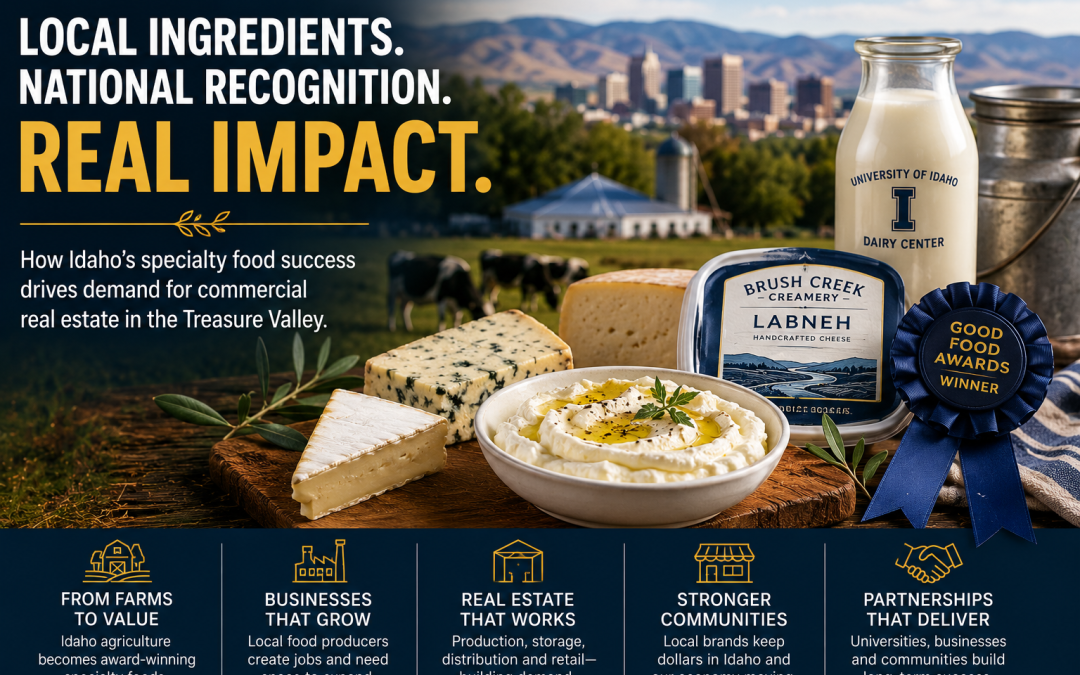
Brush Creek Creamery in Deary recently earned a top Good Food Award for its labneh, a creamy cheese traditionally made by removing whey from yogurt. The product is made using milk supplied through a long-standing relationship with the University of Idaho Dairy Center in Moscow.
According to a story provided by the University of Idaho and published by the Idaho Business Review, Brush Creek purchases about 357,000 pounds of milk annually from the university dairy and turns that supply into roughly 40,000 pounds of specialty cheese.
You can read the original Idaho Business Review article for the underlying reporting.
For those of us watching Boise commercial real estate and Idaho development, there’s a bigger economic story here.
Businesses like Brush Creek show how locally produced agricultural products can move through manufacturing, distribution and retail—and create demand for commercial space at every step.
Idaho Agriculture Is More Than Farming
Idaho’s agricultural industry is often discussed in terms of commodities.
Milk.
Potatoes.
Wheat.
Cattle.
But the real economic opportunity can come from what happens after those products leave the farm.
Brush Creek is a good example.
Instead of simply selling milk, the business transforms it into products including blue cheese, brie, feta, cheddar, smoked gouda, Havarti and its award-winning labneh.
That process adds value.
It also requires real estate.
Specialty food businesses can need production areas, cold storage, warehouse space, loading areas, commercial kitchens, aging rooms, offices and eventually retail locations.
That’s important when thinking about Boise industrial real estate and flex properties throughout the Treasure Valley.
The next growing industrial tenant isn’t necessarily a traditional manufacturer.
It might be a food company.
A Supply Partnership Became a Competitive Advantage
One of the more interesting parts of Brush Creek’s story is its relationship with the University of Idaho.
The partnership has reportedly lasted about eight years.
The University of Idaho dairy is primarily a research and educational facility, but it also supplies milk to several outside businesses.
Its herd includes Holsteins, Jerseys and crosses of the two breeds.
When Brush Creek needed milk with higher butterfat levels, the university added Jersey cows, which are known for producing richer milk.
That level of cooperation gave the creamery something extremely valuable:
A supplier willing to adapt to the needs of the customer.
Commercial real estate works in much the same way.
Growing companies rarely make location decisions based on rent alone.
They need infrastructure around them.
Employees.
Suppliers.
Transportation.
Utilities.
Customers.
Education.
Research.
Distribution.
When those pieces work together, a region becomes much more attractive to growing businesses.
That’s one reason universities and research institutions can play such an important role in economic development.
They don’t simply educate workers.
They can become part of the business ecosystem.
Small Producers Can Become Serious Space Users
Brush Creek’s real estate history is another part of the story worth watching.
The company traces its beginnings to cheesemaking in a family kitchen about 25 years ago.
Eventually, that operation outgrew the home.
In 2012, the business expanded into an approximately 8,200-square-foot historic brick building, which was renovated into a creamery.
That’s a familiar small-business progression.
Start at home.
Move into a small commercial space.
Add equipment.
Hire employees.
Increase production.
Need more storage.
Add distribution.
Eventually, the business can become a meaningful commercial real estate user.
For landlords and brokers involved in Boise commercial real estate, identifying companies before they reach the expansion stage can create significant opportunities.
A 1,500-square-foot local food company today might eventually need 10,000 square feet.
Then 25,000.
Then a distribution facility.
That’s why small-business growth matters to commercial property owners.
Food Manufacturing Has Unique Real Estate Requirements
Food companies can also be difficult tenants to relocate.
Once a business has invested heavily in a facility, moving isn’t always simple.
Food production may require specialized plumbing, drainage, refrigeration, electrical capacity, ventilation, sanitation systems and temperature-controlled environments.
Cheese adds another layer.
Some Brush Creek products are aged for as little as 60 days, while others can remain in controlled environments for years.
Brush Creek currently works with affiliated cheesemakers in Montana, where some products are aged in climate-controlled caves.
These operational requirements can make properly equipped buildings especially valuable.
For Boise industrial development, that presents both an opportunity and a challenge.
Most traditional warehouse buildings aren’t designed specifically for food production.
Developers considering food-oriented industrial projects need to understand requirements such as:
- Floor drains
- Wash-down areas
- Refrigeration
- Freezer capacity
- Food-grade surfaces
- Water availability
- Sewer capacity
- Loading and distribution access
- Backup power considerations
- Health and regulatory requirements
Those improvements can be expensive.
But they can also create highly specialized space that is difficult to reproduce.
From Production to Retail: The Real Estate Chain Gets Longer
Brush Creek’s cheese doesn’t stop at the creamery door.
Its products are sold through farmers markets, specialty stores, resorts and other retailers in Idaho and Washington. Distribution also extends into California.
That creates another layer of commercial real estate demand.
Production requires industrial space.
Distribution requires warehouses and logistics.
Wholesale relationships require retail space.
Direct-to-consumer sales can create opportunities for storefronts, tasting rooms and market concepts.
Restaurants create another potential customer.
One successful Idaho food producer can therefore touch several parts of the commercial property market.
That’s why locally produced food can be an interesting component of Boise retail development as well.
Consumers increasingly want businesses and products that give them something they can’t easily get everywhere else.
A shopping center filled entirely with national brands can be convenient.
But adding successful local operators can give the property identity.
That can be particularly valuable in mixed-use developments, downtown districts and destination retail environments.
National Recognition Can Accelerate Growth
Brush Creek’s labneh didn’t just win one award.
According to the University of Idaho story, its products have accumulated numerous honors over the years, including 12 American Cheese Society gold medals and multiple awards from the Intermountain Milk Producers Association.
Recognition like that can change the trajectory of a small company.
Awards can increase retailer interest.
They can generate media coverage.
They can strengthen distributor relationships.
They can create online demand.
And eventually, they can create a need for more production capacity.
Commercial real estate professionals should pay attention to those signals.
When a local manufacturer lands a major customer, receives national recognition, raises capital or expands distribution, its real estate requirements may be about to change.
That creates opportunities for brokers, developers and landlords who understand the business before the space requirement becomes obvious.
Local Insight: Boise Should Keep Building an Ecosystem for Food Businesses
My biggest takeaway isn’t really about cheese.
It’s about the infrastructure that allows small Idaho companies to become larger ones.
The Treasure Valley already sits within one of the country’s major agricultural states.
That gives Boise and surrounding communities an opportunity to capture more of the economic activity that happens between the farm and the consumer.
Instead of shipping commodities elsewhere to be processed, packaged and distributed, more of that work can potentially happen here.
That means jobs.
It also means demand for industrial buildings, flex space, commercial kitchens, cold storage, distribution facilities and retail storefronts.
For Boise commercial real estate investors, specialized food-production properties could become an interesting niche when they are located correctly and built around strong operators.
For developers, infrastructure matters tremendously. Water, sewer, power, loading and transportation can determine whether a food company can realistically occupy a site.
For landlords, flexibility matters. Growing companies may need additional space faster than expected.
And for economic development groups, connecting agricultural producers, universities, manufacturers, distributors and commercial property owners can help keep more business activity inside Idaho.
Brush Creek Creamery started with someone making cheese from excess milk.
Today its products are earning national awards and being distributed well beyond its hometown.
That’s exactly the kind of business evolution commercial real estate professionals should be watching.
Because behind almost every growing local brand is eventually a real estate question:
Where do we go next?
Source: University of Idaho story published by Idaho Business Review, Aug. 6, 2026. This article provides commentary and commercial real estate analysis based on that reporting and is not presented as independent reporting about Brush Creek Creamery or the University of Idaho.
Mike Gioioso (joy-OH-so)
has for 16+ years been helping companies of all sizes buy, build, and lease perfect places for business in greater Boise, Idaho and beyond.
www.streetsmartidaho.com mike@streetsmartidaho.com 208-209-9166
Tags: #boisecommercialrealestate, #boiserealestate, #boiseindustrialrealestate, #boiseindustrialdevelopment, #boisedevelopment, #boiseinvestmentproperty, #boiseflexspace, #boisewarehousespace, #boisefoodmanufacturing, #boisefoodproduction, #boisecommercialdevelopment, #boiseretailrealestate, #boiseretaildevelopment, #treasurevalleycommercialrealestate, #treasurevalleyindustrialrealestate