
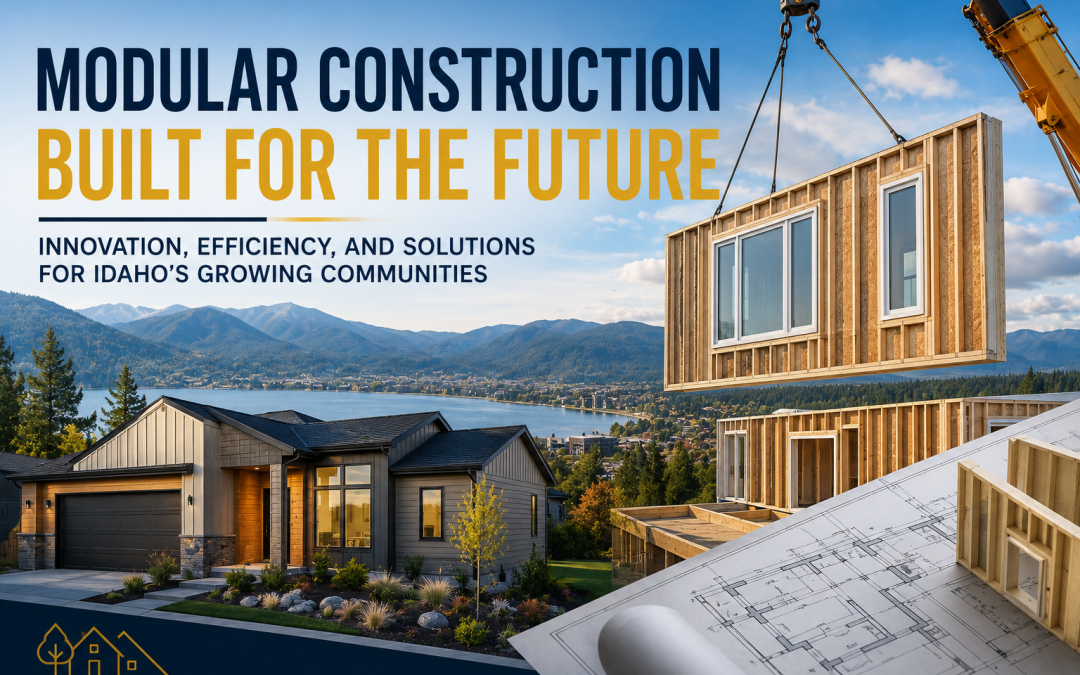
Modular Construction Gains Momentum as Idaho Builders Rethink How Homes Get Built
Idaho’s growth has created a simple problem with a complicated solution: We need more housing, but building it isn’t getting any easier.
Labor is expensive. Skilled construction workers can be difficult to find. Financing costs remain challenging. Materials cost more than they used to, and long construction schedules add another layer of risk for developers.
That is pushing some Idaho builders to rethink not just what gets built, but how it gets built.
According to reporting by IBR Staff in the Idaho Business Review, Coeur d’Alene-based Honor Built Homes recently received two 2026 BUILD Construction & Engineering Awards recognizing its work with prefab, panelized, modular, and other off-site construction methods. You can read the original Idaho Business Review article, “North Idaho builder Honor Built Homes wins two construction awards,” for the source reporting behind this discussion.
The awards are notable, but the larger commercial real estate story is the technology and construction model behind them.
Off-site construction could become increasingly important as Boise and other fast-growing Idaho markets search for ways to build more efficiently.
Idaho Builders Are Looking Beyond Traditional Construction
Honor Built Homes specializes in construction methods that shift significant portions of the building process away from the job site and into a controlled manufacturing setting.
Instead of completing nearly every stage of construction outdoors, portions of a house can be fabricated or assembled elsewhere and then transported to the development site.
That can include panelized walls and building components as well as larger modular sections.
The concept addresses several problems facing developers at the same time.
Weather becomes less disruptive.
Materials can potentially be used more efficiently.
Quality-control procedures can be more consistent.
And construction schedules can be shortened because some work can happen simultaneously rather than waiting for one trade to finish before another begins.
Honor Built Homes owner Katrina “Tina” Holtz told the Idaho Business Review that housing affordability, worker shortages, higher construction expenses, and longer development schedules are problems affecting communities nationwide.
Her company’s approach is based on using modern construction methods to address some of those pressures.
Honor Built Homes received recognition as an emerging construction innovator and for its work in off-site construction in the Mountain States region.
It is also the third consecutive year the company has received recognition through the BUILD awards.
But from a real estate standpoint, the bigger question isn’t who won an award.
It’s whether methods like these can solve enough real-world development problems to become a larger part of Idaho construction.
Why Off-Site Construction Matters for Boise Development
Construction time is money.
That may sound obvious, but it becomes especially important when interest rates and construction costs are elevated.
Imagine two otherwise similar development projects.
One takes 18 months to complete.
Another can be delivered several months sooner.
The faster project may reduce construction-loan interest, general conditions, weather exposure, carrying costs, and the amount of time the developer waits before generating income.
That can materially change the economics of a project.
For Boise development, this could become increasingly important.
Land throughout the Treasure Valley isn’t inexpensive anymore. Neither are labor, materials, utilities, infrastructure, impact fees, or financing.
Developers therefore have fewer places to find savings.
Reducing the construction timeline could become one of them.
The benefit isn’t necessarily about building cheaply.
It’s about building more efficiently.
That’s an important distinction.
A developer may still choose quality finishes, attractive architecture, durable materials, and thoughtful design while changing the process used to assemble the building.
That’s essentially the opportunity behind modular and panelized construction.
Labor Could Be the Bigger Long-Term Issue
Boise’s construction industry also faces a labor challenge.
Every new subdivision, apartment project, industrial building, retail center, road improvement, semiconductor facility, school, and public infrastructure project competes for workers.
When construction activity increases quickly, labor availability can become a bottleneck.
Traditional construction requires many specialized trades to arrive at the right job site at the right time.
One delay can affect everything behind it.
Off-site construction can change part of that equation by moving more work into a manufacturing-style environment.
Workers report to a consistent facility.
Tools and materials are already there.
Work isn’t as dependent on weather.
Production can become more standardized.
For developers, that creates the potential for greater predictability.
And predictability has value.
A project that finishes close to its projected delivery date is easier to finance, lease, sell, and manage than one experiencing repeated delays.
The Commercial Real Estate Opportunity Goes Beyond Housing
There is another angle Boise commercial real estate investors should watch.
If modular and panelized construction expand, the industry itself will need real estate.
Manufacturing buildings.
Assembly facilities.
Warehouses.
Outdoor storage.
Truck access.
Construction-material storage.
Distribution locations.
Land capable of accommodating larger industrial operations.
In other words, growth in off-site construction could create additional demand for Boise industrial real estate.
These businesses don’t necessarily operate like traditional home builders.
They can look more like manufacturers.
That means ceiling height, loading, power, yard space, truck circulation, zoning, and proximity to major transportation corridors can become important site-selection factors.
Areas around Nampa and Caldwell could be particularly interesting because larger industrial parcels and transportation access may provide advantages for manufacturing-oriented construction companies.
Parts of Meridian and Boise could also benefit depending on the size and type of operation.
That creates another connection between Idaho’s housing shortage and the commercial real estate market.
Solving a residential construction problem can create industrial property demand.
Local Insight: The Winning Technology Will Be the One That Improves the Math
I’ve watched plenty of construction ideas generate excitement over the years.
The real test is always the same:
Does it make the project work financially?
Developers aren’t going to adopt modular or off-site construction simply because it’s innovative.
It has to solve problems.
Can it shorten construction?
Can it reduce waste?
Can it make labor requirements more predictable?
Can it improve quality control?
Can it reduce weather delays?
Can lenders comfortably finance it?
Can architects and engineers design around it?
Can local jurisdictions permit and inspect it efficiently?
And ultimately, can the finished product compete with conventional construction?
If enough of those answers become yes, adoption can accelerate quickly.
For Boise commercial real estate and Boise development, I think this is worth watching closely.
The Treasure Valley continues to need housing, but the economics of producing that housing have become increasingly difficult.
Simply doing everything the same way and hoping construction becomes cheaper isn’t much of a strategy.
Builders and developers will continue looking for efficiencies.
Some will come from design.
Some will come from materials.
Some will come from financing.
And increasingly, some may come from moving part of the construction process away from the development site entirely.
For developers, faster and more predictable construction could improve project feasibility.
For investors, it could eventually create more efficient housing development opportunities.
For tenants and homebuyers, greater construction efficiency could help slow some of the cost pressures associated with creating new housing — although construction methods alone won’t solve Idaho’s affordability problem.
For industrial landlords and landowners, meanwhile, growth in modular construction could create an entirely different opportunity as these companies seek manufacturing and logistics facilities.
Honor Built Homes’ recognition is ultimately one small piece of a much larger trend.
Idaho isn’t going to stop growing because traditional construction has become expensive.
Instead, builders are going to keep searching for better ways to build.
And that could make the construction process itself one of the more interesting areas of innovation affecting Boise real estate over the next decade.
Mike Gioioso (joy-OH-so)
has for 16+ years been helping companies of all sizes buy, build, and lease perfect places for business in greater Boise, Idaho and beyond.
www.streetsmartidaho.com mike@streetsmartidaho.com 208-209-9166
Tags: #boisecommercialrealestate, #boiserealestate, #boisedevelopment, #boiseconstruction, #boisemodularconstruction, #boiseprefabconstruction, #boiseoffsiteconstruction, #boisehousingdevelopment, #boiseresidentialdevelopment, #boiseindustrialrealestate, #boiseindustrialdevelopment, #treasurevalleycommercialrealestate, #treasurevalleydevelopment, #treasurevalleyconstruction