
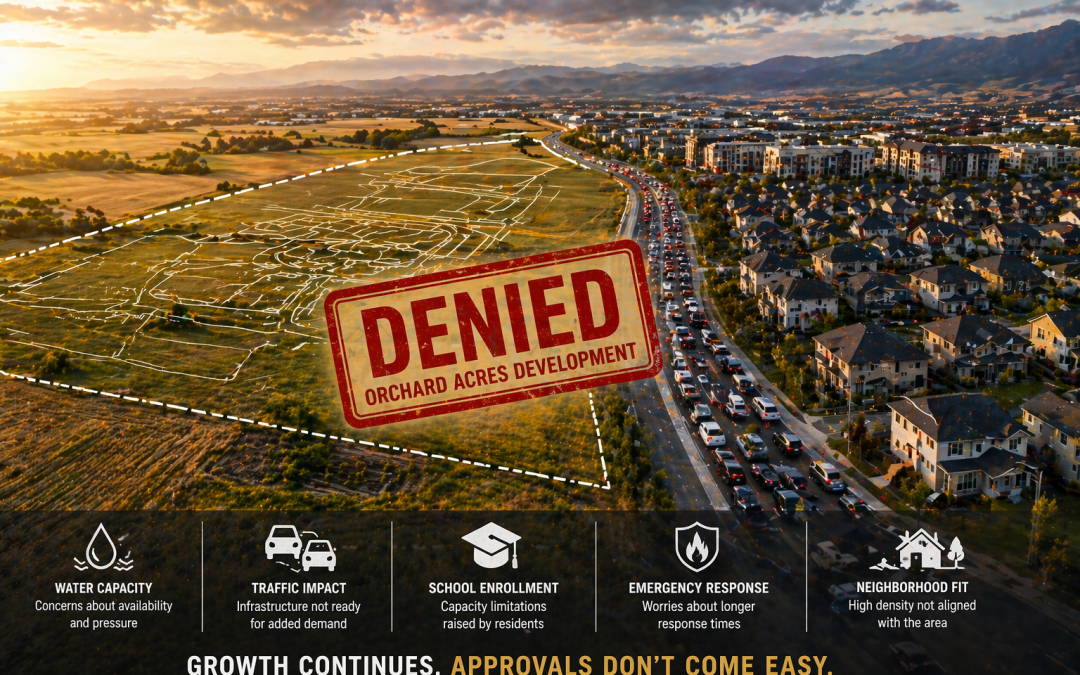
Nampa Says No to 276 Acres — What a Denied Development Means for Boise Commercial Real Estate
Growth in the Treasure Valley isn’t slowing down.
But this latest decision out of Nampa is a reminder that not all growth gets approved—especially when infrastructure and community concerns collide with large-scale development.
According to reporting by the Idaho Press (read the original article here: https://www.idahopress.com/news/local/nampa-city-council-denies-276-acre-housing-development/article_0e360ed9-33fd-487f-9a41-565b50538ced.html), the Nampa City Council voted to deny a proposed 276-acre master-planned community known as Orchard Acres.
On paper, this was a major housing project.
In reality, it became a case study in how development, infrastructure, and public sentiment intersect in today’s Boise commercial real estate environment.
What Happened: A Large Project Meets Local Resistance
The proposal included a long-term, mixed-use community with:
- Single-family homes and multifamily units
- Duplex-style housing
- Commercial components
- A multi-phase buildout expected to take well over a decade
But despite the scale—and the region’s ongoing housing shortage—the project didn’t move forward.
The council ultimately voted against annexation and zoning approvals after:
- A lengthy public hearing
- Concerns raised by residents and city officials
- Questions about infrastructure capacity
This wasn’t a quick decision. It followed earlier resistance at the planning level and culminated in a split council vote.
Why It Was Denied: Infrastructure and Density Took Center Stage
The reasons behind the denial are where the real insight lies.
Key concerns included:
- Water availability and pressure
- Traffic congestion and road capacity
- School enrollment limitations
- Emergency response times
- Compatibility with existing neighborhoods
Density became a central issue.
Some council members expressed concern that higher-density housing—particularly apartments—didn’t align with the surrounding area.
At the same time, residents voiced strong opposition, citing quality-of-life impacts and infrastructure strain.
Why It Matters: Approval Risk Is Rising in Growth Markets
For developers and investors, this decision highlights a growing reality:
Entitlement risk is increasing—even in high-growth areas like the Treasure Valley.
Boise and surrounding cities still need housing.
But getting projects approved is becoming more complex.
Here’s what this signals for Boise development:
1. Infrastructure Is Driving Decisions
Cities are taking a closer look at whether roads, water, and services can support new growth.
If the answer isn’t clear, approvals become harder.
2. Density Is a Sensitive Topic
Multifamily and higher-density housing remain critical—but not always politically easy.
Where and how density is introduced matters more than ever.
3. Public Sentiment Carries Weight
Community opposition can influence outcomes significantly.
Projects that don’t align with neighborhood expectations face an uphill battle.
4. Timeline Risk Is Real
This project was planned as a long-term buildout.
But even well-planned, phased developments aren’t guaranteed approval.
What This Means for Boise Commercial Real Estate
This decision doesn’t mean growth is stopping.
It means growth is becoming more selective.
For the Boise market:
- Developers need to engage earlier with cities and communities
- Investors should factor entitlement risk into underwriting
- Landowners may see longer timelines before projects move forward
- Cities will continue balancing growth with infrastructure capacity
At the same time, the underlying demand for housing hasn’t changed.
If anything, it’s increasing.
That creates a tension between need vs. feasibility—one of the defining challenges in today’s market.
My Take: This Is a Signal to Build Smarter, Not Slower
This isn’t a “no growth” story.
It’s a “better-planned growth” story.
Projects that succeed moving forward will likely:
- Align more closely with existing neighborhoods
- Address infrastructure concerns upfront
- Phase density in more strategically
- Communicate clearly with the public
In short, development in the Treasure Valley is entering a more disciplined phase.
Local Insight: Watch Where Approvals Are Still Moving
While some projects face resistance, others are moving forward—especially in areas where:
- Infrastructure is already in place
- Growth is expected and planned
- Community expectations align with development
For Boise commercial real estate professionals, this means opportunity still exists—but it’s becoming more location- and strategy-specific.
The Bottom Line
The denial of this 276-acre project isn’t just about one development.
It’s a signal about how the market is evolving:
- Growth is still happening
- Housing demand is still strong
- But approvals are no longer automatic
And for anyone involved in Boise commercial real estate, understanding that shift is critical to navigating the next phase of development in the Treasure Valley.
Mike Gioioso (joy-OH-so) has for 16+ years been helping companies of all sizes buy, build, and lease perfect places for business in greater Boise, Idaho and beyond.
www.streetsmartidaho.com mike@streetsmartidaho.com 208-209-9166
Tags: #boisecommercialrealestate, #boisedevelopment, #nampaidahodevelopment, #housingdevelopmentboise, #entitlementriskrealestate, #zoningapprovalidaho, #boisehousingshortage, #multifamilydevelopmentboise, #treasurevalleygrowth, #canyoncountydevelopment, #infrastructureconstraintsidaho, #boiserealestatetrends, #landdevelopmentboise, #commercialrealestateboiseidaho, #suburbangrowthboise