
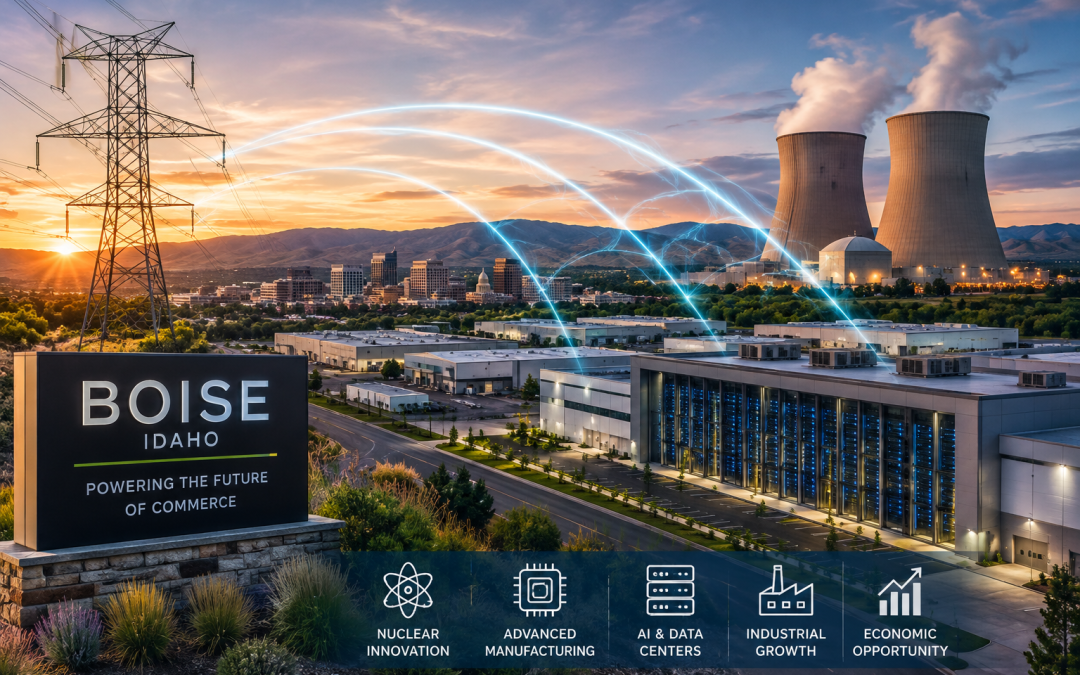
Why Nuclear Power’s Biggest Challenge Could Shape the Future of Boise Commercial Real Estate
America may need far more electricity than its current power system was designed to deliver.
Artificial intelligence, data centers, advanced manufacturing, semiconductor plants, and other power-intensive industries are driving a new conversation about where the country will get that electricity. Nuclear power is increasingly part of that discussion.
But there is a major difference between announcing a new reactor and actually financing and building one.
According to reporting by Evan Halper of The Washington Post, published by the Idaho Business Review, the federal government’s push to accelerate nuclear development has generated major announcements, loan programs, international partnerships, and new technology efforts. Yet many proposed large-scale projects still lack firm customers and committed private capital.
The original Idaho Business Review article can be read here: https://idahobusinessreview.com/2026/07/16/trump-administration-nuclear-power-japan-deals-stalled/
For Idaho, this story deserves attention for another reason.
The state is already becoming an important part of America’s technology and energy expansion. Between Micron’s massive Boise investment, Idaho National Laboratory’s nuclear research, and growing demand for AI infrastructure, access to reliable electricity could increasingly influence where future commercial real estate development happens.
The Real Estate Question Is Becoming a Power Question
For decades, commercial real estate development started with familiar questions.
How much land is available?
What does zoning allow?
Is there freeway access?
Where is the workforce?
Those questions still matter. But for some of the fastest-growing industries, another question is moving toward the top of the list:
How much power can we get—and when can we get it?
That matters because AI infrastructure and large data centers can require enormous amounts of electricity.
Energy Secretary Chris Wright has argued that large technology companies could become important customers for new nuclear projects because their data centers need dependable electricity around the clock. Long-term power purchase agreements from major technology companies could potentially help make expensive energy projects easier to finance.
That could have major implications for Boise commercial real estate and industrial development across Idaho.
A development site with strong electrical capacity may eventually command a very different level of interest than a similar property where major utility upgrades could take years.
In other words, future industrial site selection may increasingly be influenced by megawatts as much as square footage.
Nuclear Power Still Faces a Financing Problem
The opportunity is enormous, but so is the challenge.
The administration has promoted plans involving Westinghouse AP1000 reactors and potential international investment from countries including Japan. It has also announced billions of dollars in federal loan support intended to strengthen the nuclear supply chain and encourage additional reactor development.
The problem is turning those plans into projects.
According to the reporting, Japanese investment expected to support large AP1000 projects has not yet resulted in firm reactor orders. Utilities also remain cautious about taking on the financial risks associated with building large nuclear facilities.
History helps explain that hesitation.
The two AP1000 reactors completed at Georgia’s Vogtle nuclear plant experienced substantial cost increases and construction delays. Another AP1000 project in South Carolina was abandoned after billions of dollars had already been spent.
That history creates a difficult financing question.
Someone ultimately has to accept the risk if a multibillion-dollar reactor costs substantially more than expected.
Utilities may not want that exposure.
Technology companies may be willing to buy the electricity without owning the reactor.
Foreign investors want projects that offer acceptable returns.
That leaves policymakers trying to determine how much risk government should absorb to get the next generation of nuclear projects built.
For commercial real estate professionals, there is an important lesson here: demand alone does not guarantee development.
The same principle applies to real estate.
A market can desperately need housing, industrial buildings, data centers, or infrastructure. But projects only move forward when capital, construction costs, operating economics, and acceptable risk line up.
Idaho Could Have a Different Role in the Nuclear Expansion
This is where the national story becomes especially interesting for Idaho.
Large conventional nuclear reactors are only one part of the industry’s future.
Another strategy involves smaller and potentially more standardized reactor designs that could eventually be manufactured and deployed differently from traditional nuclear plants.
The federal government is supporting several of these technologies, and Idaho National Laboratory is playing an important role in that effort.
According to the article, multiple companies working at INL have recently reached criticality with experimental reactor designs. Criticality means the reactor has achieved a sustained, controlled nuclear chain reaction—an important technical milestone.
That does not mean those technologies are ready for widespread commercial deployment.
Developers still need to prove that smaller reactors can be licensed, manufactured, constructed, and operated at costs that make economic sense.
But Idaho’s participation places the state close to one of the most important energy experiments underway in the country.
And that could eventually have economic-development consequences beyond the laboratory itself.
Why AI and Data Centers Change the Equation
The explosion of artificial intelligence is changing electricity demand faster than many commercial property markets were prepared for.
Large AI data centers don’t simply need buildings.
They need land, fiber connectivity, cooling infrastructure, substations, transmission capacity, and tremendous amounts of reliable electricity.
That makes energy infrastructure increasingly connected to industrial real estate development.
For Boise and the Treasure Valley, several possible effects are worth watching:
- Industrial land near major electrical infrastructure could become increasingly valuable.
- Developers may need to evaluate utility capacity much earlier during site selection.
- Power-delivery timelines could become a major part of development feasibility.
- Advanced manufacturing and technology companies may favor markets capable of offering dependable long-term energy.
- New power infrastructure could open areas that previously were less competitive for major industrial development.
These trends will not be limited to enormous data centers.
If utilities must make major investments to serve large industrial customers, those improvements can sometimes influence the broader development potential of surrounding areas.
That makes energy infrastructure increasingly relevant to landowners, developers, brokers, and economic-development groups.
Micron Makes This Especially Relevant to Boise
Boise isn’t watching the technology boom from the sidelines.
Micron’s semiconductor expansion is already changing the scale of advanced manufacturing investment in the region.
Projects of that magnitude create ripple effects.
Suppliers need facilities.
Contractors need space.
Employees need housing.
Restaurants and retailers follow population and employment growth.
Hotels capture additional business travel.
Industrial users look for locations near major employment centers and transportation routes.
All of that contributes to demand across Boise commercial real estate.
But advanced manufacturing also requires enormous infrastructure investment.
As Idaho competes for additional semiconductor, AI, advanced manufacturing, and technology-related projects, reliable power could become one of the state’s most important economic-development assets.
Local Insight: Follow the Infrastructure
Commercial real estate professionals tend to focus on buildings.
Over the next decade, it may be just as important to follow the infrastructure underneath those buildings.
Power capacity, substations, transmission lines, fiber networks, water availability, and utility expansion plans could increasingly determine which development sites win and which ones wait.
That’s particularly important when evaluating industrial land.
A property might look perfect on paper—good zoning, freeway access, flat topography, and reasonable land pricing—but still struggle to attract certain users if the electrical infrastructure cannot support them.
Conversely, land positioned near major utility investments could become substantially more strategic.
For investors and developers looking at Boise development, that means utility due diligence deserves to move much earlier in the process.
Don’t just ask what can be built on a site.
Ask what can actually be powered there.
What Boise Commercial Real Estate Should Watch Next
The nuclear industry’s biggest challenge isn’t necessarily inventing another reactor.
It is proving that reactors can be financed and built at predictable costs.
If that happens, the implications could extend far beyond the energy industry.
Affordable and dependable electricity could help determine where America’s next generation of AI infrastructure, semiconductor plants, data centers, advanced manufacturing facilities, and industrial developments are located.
Idaho has an unusual position in that transition.
The state combines world-class nuclear research at Idaho National Laboratory with a growing technology and semiconductor economy centered around Boise.
Whether today’s nuclear announcements ultimately turn into commercially viable power plants remains uncertain.
But the underlying trend is much clearer:
Electricity is becoming a commercial real estate issue.
For Boise investors, developers, landlords, and tenants, understanding where new energy capacity is being created may eventually be just as important as understanding where the next highway interchange or major residential subdivision is being built.
Mike Gioioso (joy-OH-so) has for 16+ years been helping companies of all sizes buy, build, and lease perfect places for business in greater Boise, Idaho and beyond.
www.streetsmartidaho.com mike@streetsmartidaho.com 208-209-9166
Tags: #boisecommercialrealestate, #nuclearpoweridaho, #idahonationallaboratory, #boisedevelopment, #aidatacenters, #datacenterdevelopmentidaho, #boiseindustrialrealestate, #micronboise, #semiconductormanufacturingidaho, #industrialdevelopmentboise, #idahoenergyinfrastructure