
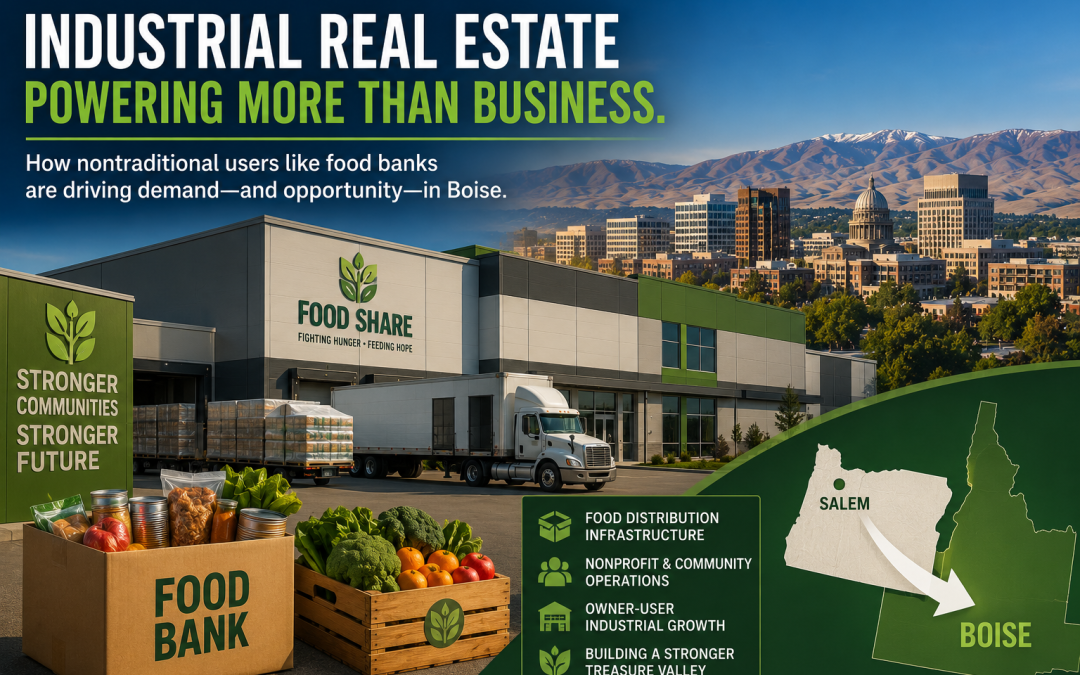
Oregon Food Bank’s Industrial Building Purchase Could Signal an Emerging Trend for Boise Industrial Real Estate
Industrial real estate is no longer being shaped only by manufacturers, logistics companies, and warehouse operators.
Nonprofits, healthcare systems, educational organizations, and community service providers are increasingly becoming major industrial space users — and that trend could eventually have important implications for Boise commercial real estate.
According to reporting and transaction data published by CoStar News in this article — “Food bank buys former tortilla production facility in Oregon to triple footprint” — Marion Polk Food Share acquired a large former food production facility in Salem, Oregon for approximately $12.4 million.
The transaction involved a 101,537-square-foot industrial property previously used for tortilla and tortilla chip production.
But the bigger story may not simply be the building sale itself.
The deal highlights how industrial real estate is becoming increasingly important infrastructure for organizations focused on food distribution, social services, healthcare support, and community operations.
Industrial Buildings Are Becoming Essential Community Infrastructure
The Salem facility reportedly will allow Marion Polk Food Share to triple its operational footprint as demand for food assistance continues rising.
The organization plans to renovate and expand the building to support both food bank operations and Meals on Wheels services beginning in 2027.
That may sound highly specific to Oregon, but similar pressures increasingly exist throughout many western growth markets — including Boise.
Population growth, rising living costs, and housing affordability challenges are increasing demand for:
- food distribution networks,
- nonprofit logistics operations,
- healthcare support infrastructure,
- and regional service hubs.
Many of those uses require industrial-style facilities with:
- warehouse space,
- refrigerated storage,
- loading capabilities,
- commercial kitchens,
- and transportation access.
As Boise continues growing, demand for these types of operational facilities could steadily increase.
Owner-User Industrial Activity Continues Rising
One of the more interesting details in the CoStar reporting involves the increase in owner-user industrial acquisitions occurring in the Salem market.
According to CoStar data referenced in the article, owner-users represented 54% of industrial sales volume over the past year — significantly higher than historical averages.
That trend matters for Boise industrial real estate as well.
Across many western markets, users increasingly prefer ownership rather than leasing when:
- interest rates stabilize,
- operational control becomes more important,
- specialized buildouts are expensive,
- or long-term occupancy needs become predictable.
For Boise industrial developers and investors, this creates an interesting dynamic.
While leasing demand remains strong in many sectors, more organizations may eventually seek:
- industrial condos,
- build-to-suit opportunities,
- adaptive reuse projects,
- and owner-occupied warehouse facilities.
That can alter industrial inventory availability over time.
Food Production and Distribution Facilities Remain Valuable
Another notable aspect of the Salem transaction is the reuse of a former food manufacturing property.
Facilities originally built for food production often contain specialized infrastructure that can be difficult and expensive to replicate, including:
- heavy utility capacity,
- commercial-grade ventilation,
- cold storage systems,
- floor drainage,
- food-safe processing areas,
- and logistics functionality.
As Boise development continues expanding, these types of specialized industrial buildings may become increasingly valuable.
The Treasure Valley already supports a significant food and agricultural economy tied to:
- food processing,
- cold storage,
- agricultural distribution,
- and regional transportation networks.
Properties capable of supporting food-related operations may continue seeing strong long-term demand.
Why This Matters for Boise Commercial Real Estate
The Salem acquisition highlights several broader trends Boise investors and developers may want to monitor closely:
- Nontraditional industrial users are expanding
- Owner-user demand remains strong
- Food distribution infrastructure is increasingly important
- Adaptive reuse industrial projects can create value
- Community service organizations are becoming major space users
For industrial landlords, this could eventually expand the tenant pool beyond traditional warehouse users.
For developers, it may create opportunities to reposition older industrial buildings for specialized operational uses.
For investors, the deal reinforces how industrial real estate increasingly functions as essential infrastructure rather than simply storage space.
My Take
One of the most important shifts happening in industrial real estate right now is that the sector is becoming far more diversified.
A decade ago, many industrial buildings were viewed mostly through the lens of manufacturing or freight distribution.
Today, industrial space supports:
- e-commerce,
- healthcare logistics,
- food systems,
- nonprofit operations,
- data infrastructure,
- and specialized service delivery networks.
That evolution matters for Boise commercial real estate because it broadens the long-term demand base for industrial properties across the Treasure Valley.
As Boise continues growing, industrial buildings may increasingly become some of the region’s most strategically important assets — even when the users are not traditional industrial companies.
Mike Gioioso (joy-OH-so) has for 16+ years been helping companies of all sizes buy, build, and lease perfect places for business in greater Boise, Idaho and beyond.
www.streetsmartidaho.com mike@streetsmartidaho.com 208-209-9166
Tags: #boisecommercialrealestate, #boiseindustrial, #industrialrealestate, #boisedevelopment, #warehousespace, #industrialleasing, #industrialdevelopment, #boiserealestate, #commercialrealestate, #idahocommercialrealestate, #treasurevalleyrealestate, #fooddistribution, #coldstorage, #logisticsrealestate, #warehousedevelopment