
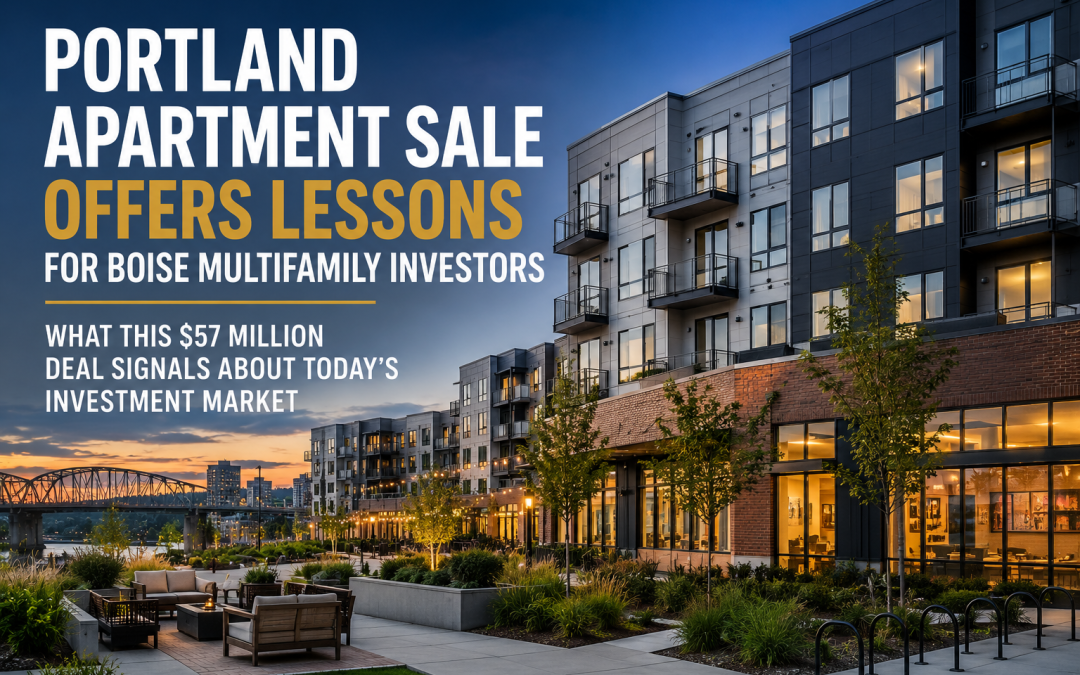
Portland’s $57 Million Apartment Sale Offers a Signal for Boise Multifamily Investors
A major apartment property in Portland just traded for slightly less than it sold for seven years ago.
That single detail says a lot about today’s multifamily investment market.
Apartment demand can remain healthy while higher borrowing costs and changing investor expectations put pressure on property values. That’s a combination worth watching closely in Boise commercial real estate as investors evaluate multifamily properties across the Treasure Valley.
According to reporting by Aaron Tamblyn with CoStar AI and CoStar Research, MG Properties acquired Tupelo Alley, a mixed-use apartment project in Portland, Oregon, for $57.2 million. The original CoStar News article provides the transaction details.
The sale provides a useful real-world example of how investors are pricing occupied multifamily properties in today’s capital environment.
Strong Occupancy Doesn’t Automatically Mean Higher Value
Tupelo Alley includes 188 apartments across three buildings at 3850 N. Mississippi Ave. in Portland.
The property also includes approximately 10,000 square feet of ground-floor retail, making it a mixed-use investment rather than a traditional apartment-only complex.
MG Properties purchased the property from Holland Partner Group for $57.2 million, which CoStar calculated at approximately $304,255 per apartment.
Perhaps the most interesting number is the occupancy.
The property was 94% leased when it sold.
That suggests this wasn’t simply a distressed, largely vacant apartment complex trading at a discount. The asset had substantial existing occupancy.
Yet the sale price was still slightly below its previous transaction.
CoStar reported that Tupelo Alley sold for $58 million in July 2019.
Seven years later, it changed hands for $57.2 million.
That’s roughly $800,000 less despite years of inflation, rent changes and rising construction costs.
For multifamily investors, that deserves attention.
The Cost of Capital Is Reshaping Apartment Values
The obvious question is: How can an apartment property remain well occupied but sell for less than it did years earlier?
The answer can often be found in the capital stack.
Commercial property values don’t depend only on rents and occupancy. They also depend on how investors finance an acquisition and what return they expect from their equity.
MG Properties secured approximately $36.96 million in Freddie Mac financing for the acquisition, according to CoStar.
That works out to roughly 65% of the $57.2 million purchase price.
The remaining capital would generally need to come from buyer equity or other sources.
That financing structure highlights something multifamily investors have been dealing with across the country: debt isn’t as cheap as it was during the ultra-low interest-rate environment.
When borrowing becomes more expensive, buyers generally can’t pay the same price for the same income stream unless rents or other property income increase enough to compensate.
That puts upward pressure on capitalization rates and downward pressure on values.
This is why commercial real estate investors shouldn’t automatically assume that a fully or nearly fully leased property is worth more today simply because rents have increased.
The financing environment matters enormously.
What Portland’s Sale Could Mean for Boise Multifamily
Portland and Boise are different markets, but investors often evaluate them using many of the same fundamentals.
Population growth.
Job creation.
Rent growth.
Vacancy.
Replacement cost.
Operating expenses.
Financing costs.
And ultimately, yield.
That makes this transaction relevant to Boise multifamily real estate.
Boise and the Treasure Valley experienced extraordinary apartment investment activity during the low-rate years. Rapid population growth, strong rent increases and inexpensive financing helped push multifamily values higher.
Today’s market requires a different approach.
Investors evaluating a Boise apartment property now need to pay particularly close attention to existing debt, current lending terms and the property’s ability to grow net operating income.
A property might have excellent occupancy and still face valuation pressure if the numbers don’t produce an acceptable return at today’s cost of capital.
That can create a gap between buyer and seller expectations.
Sellers may remember valuations from the peak years.
Buyers have to underwrite based on today’s financing.
That difference can slow transaction volume until one side adjusts.
Mixed-Use Adds Another Layer to the Investment
Tupelo Alley’s 10,000 square feet of retail space also makes the transaction interesting from a mixed-use perspective.
Ground-floor retail can strengthen an apartment project when the right businesses create amenities for residents and generate additional income for the owner.
But retail also adds another category of risk.
Investors must evaluate the retail tenants, lease expirations, rental rates, tenant improvement obligations and potential downtime in addition to the apartments.
The same applies to Boise development.
Mixed-use projects can work extremely well in the right location, especially in walkable neighborhoods and growing commercial corridors.
But simply putting retail underneath apartments doesn’t guarantee success.
The surrounding population, visibility, parking, access and tenant mix still matter.
Developers need enough residential density and commercial demand to support both pieces of the project.
That is particularly important when evaluating mixed-use development opportunities in Boise, Meridian and other parts of the Treasure Valley.
Local Insight: Watch the Basis, Not Just the Building
The most interesting part of this Portland transaction isn’t the $57.2 million headline.
It’s the basis.
A 94%-occupied apartment project traded for less than its 2019 sale price.
That is an important reminder for Boise commercial real estate investors.
A good property can still be a bad investment at the wrong price.
And a property facing challenges can become an excellent investment if the basis is low enough.
As transaction activity continues to adjust to today’s interest-rate environment, I think investors should spend less time asking, “What was this worth a few years ago?” and more time asking, “What return does this price produce today?”
For Boise multifamily investors, that means carefully underwriting realistic rents, concessions, operating expenses, property taxes, insurance, reserves and debt costs.
It also means understanding replacement cost.
Construction costs remain high, which can make existing apartment properties attractive compared with building new ones. If an investor can acquire a quality existing asset materially below the cost of developing a comparable project from the ground up, that can create an interesting long-term opportunity.
But the debt still has to work.
That’s why transactions like Tupelo Alley are useful benchmarks.
They show that even well-occupied multifamily properties aren’t immune to changing capital markets.
For Boise and the Treasure Valley, the next stage of the apartment investment cycle may be less about chasing rapid appreciation and more about buying at the right basis, managing operations well and holding quality real estate for the long term.
Mike Gioioso (joy-OH-so)
has for 16+ years been helping companies of all sizes buy, build, and lease perfect places for business in greater Boise, Idaho and beyond.
www.streetsmartidaho.com mike@streetsmartidaho.com 208-209-9166
Tags: #boisecommercialrealestate, #boiserealestate, #boisemultifamily, #boisemultifamilyrealestate, #boiseapartmentmarket, #boiseapartmentinvestment, #boiseapartments, #boisemultifamilyinvestment, #boiseinvestmentproperty, #boisecommercialproperty, #boisedevelopment, #treasurevalleycommercialrealestate, #treasurevalleymultifamily, #treasurevalleyapartmentmarket