
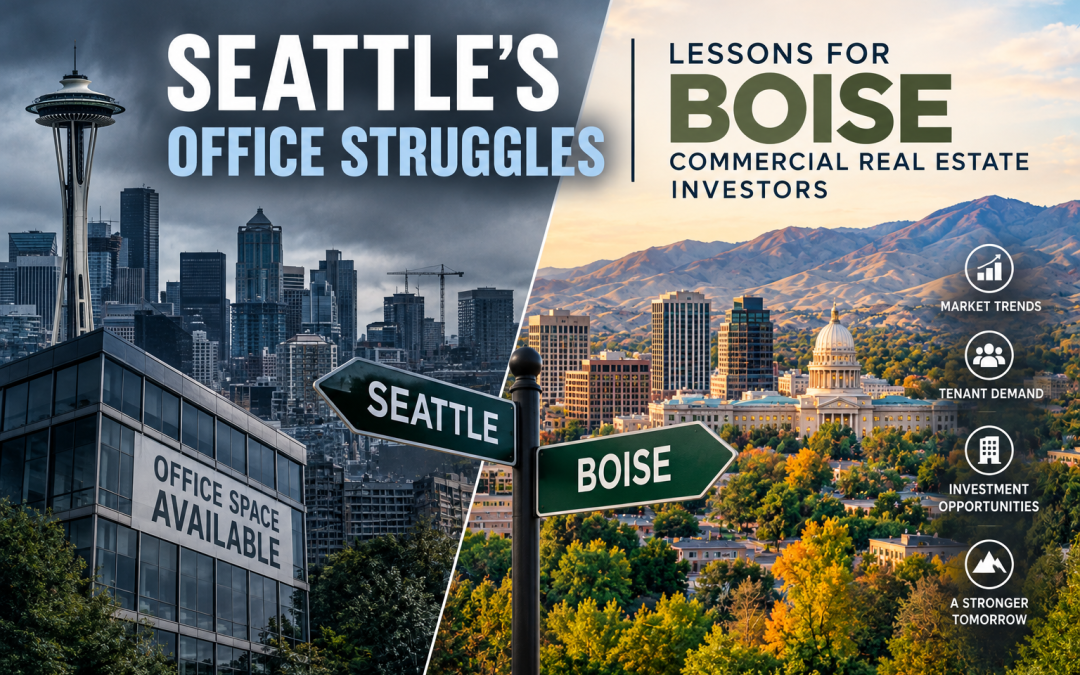
Cheap Office Buildings Aren’t Always Bargains: What Seattle’s Struggles Mean for Boise
Commercial real estate investors are trained to look for opportunities when other buyers retreat.
But today’s office market is testing that strategy.
An office building can sell for a fraction of its previous value and still be too expensive if tenants don’t want the space. That’s the problem facing investors in Seattle—and it carries an important lesson for Boise commercial real estate.
According to reporting by Katie Burke of CoStar News, Daniel Gallagher, president of Seattle real estate investment firm Nitze-Stagen, has become reluctant to pursue office acquisitions despite his firm’s history of making contrarian investments.
You can read the original CoStar News article here: https://product.costar.com/home/news/134111751
His concern isn’t simply that office values have fallen.
It’s that predicting future tenant demand has become extremely difficult.
When Lower Prices Don’t Automatically Mean Opportunity
Nitze-Stagen has experience finding value where other investors don’t.
The firm famously acquired an outdated Seattle warehouse in the 1990s, repositioned it and ultimately transformed the property into the complex that houses Starbucks’ corporate headquarters.
That history makes its current caution especially interesting.
Gallagher told CoStar that the combination of weak office demand, financing challenges and uncertainty around future occupancy has made it difficult to justify the risk of new office investments.
Seattle provides a dramatic example of the problem.
According to CoStar data cited in the article, downtown Seattle’s availability rate has hovered around 32%. Over the past five years, downtown tenants have vacated roughly 6 million more square feet than they have leased.
That creates a difficult investment equation.
A buyer may acquire an office building at what looks like an enormous discount.
But then what?
If the building needs millions of dollars in renovations, tenant improvements and leasing commissions—and still faces uncertain demand—the low purchase price may not matter very much.
That’s one of the biggest lessons in today’s commercial real estate market:
Price and value are not the same thing.
Tenants Have More Leverage When Space Is Everywhere
One example from the CoStar story illustrates the problem particularly well.
Nitze-Stagen had been working on the acquisition of a distressed Seattle office building. The strategy involved partnering with an incubator organization that could anchor the property, with additional space potentially occupied by startups connected to the program.
On paper, that could have created the leasing foundation necessary to make the investment work.
But the prospective tenant ultimately recognized that Seattle’s weak leasing environment gave it alternatives in better properties at attractive rents.
The deal fell apart.
That’s an important signal.
When tenants have a large selection of available space, landlords aren’t only competing on rent.
They’re competing on building quality, location, parking, amenities, tenant improvements and flexibility.
A Class B building priced below a Class A building may still struggle if the difference in rent isn’t large enough to compensate for the difference in quality.
This is where the idea of “flight to quality” becomes important.
In a soft office market, tenants can sometimes move up in building quality without dramatically increasing occupancy costs.
That can leave older or less competitive buildings squeezed from both directions.
Why This Matters for Boise Office Real Estate
Boise is not Seattle.
The size of the market, tenant base, development pipeline and office inventory are very different.
But the underlying investment lesson applies directly to Boise commercial real estate.
Investors evaluating Boise office buildings shouldn’t begin with:
“How far has the price fallen?”
The better question is:
“Who is going to occupy this building?”
That distinction matters.
An office property may look inexpensive based on price per square foot compared with its previous sale or replacement cost.
But investors need to understand the complete cost of getting the building stabilized.
That can include tenant improvements, leasing commissions, free rent, renovations, HVAC upgrades, common-area improvements and potentially significant carrying costs while space remains vacant.
A $100-per-square-foot acquisition can quickly become a much more expensive investment after another $50 or $75 per square foot is required to make the property competitive.
And even then, somebody still has to lease it.
Boise’s Best Office Opportunities May Be Very Specific
I don’t think the takeaway is that office real estate should simply be avoided.
Quite the opposite.
Periods of disruption can create excellent acquisition opportunities.
But the winning deals are likely to be highly property-specific.
In Boise, that could mean an office building with an existing long-term tenant.
It could mean medical office with a specialized buildout.
It could mean a smaller building attractive to an owner-user.
It could be a well-located property with covered parking, excellent access or proximity to growing residential areas.
Or it could be an older office property where the underlying land creates redevelopment potential.
Those characteristics can provide something investors desperately need right now:
a reason for the property to win.
Buying generic office space and assuming future leasing demand will eventually solve the problem is a much more difficult strategy.
The Owner-User Market Could Be Different
There is another segment of the Boise office market worth separating from traditional investment properties: owner-users.
A business buying a building for its own operations evaluates real estate differently than an investor buying space to lease to someone else.
The business may care about controlling its occupancy costs, building equity, securing a strategic location or customizing the property.
That can create opportunities in smaller Boise office properties even when institutional investors remain cautious about the broader asset class.
For example, an accounting firm, law office, medical practice or professional services company may see value in purchasing a building that a traditional investor considers difficult to lease.
That is why office market headlines don’t always tell the whole story.
Different buildings serve different buyers.
Adaptive Reuse Could Become More Important
The Seattle situation also raises another question that Boise developers and investors should be considering:
What happens to office buildings that no longer make sense as offices?
Not every property can be converted.
Office-to-residential conversions receive plenty of attention, but the physical realities can make them difficult. Floor plates, plumbing, windows, parking, zoning and construction costs all matter.
But residential isn’t the only alternative.
Depending on location and zoning, some older office properties may eventually support medical uses, education, government services, hospitality, mixed-use redevelopment or entirely new construction.
In certain cases, the most valuable part of an obsolete office building may eventually be the land underneath it.
That’s why investors need to look beyond today’s income statement.
A distressed property with multiple possible uses can be very different from a distressed property that only works as an office.
Local Insight: Don’t Buy the Discount—Buy the Solution
The most important lesson I take from Seattle’s office market is that a big discount isn’t an investment thesis.
There needs to be another reason to own the property.
For Boise commercial real estate investors, I would look closely at four things:
- Existing income: How strong are the current tenants, and when do their leases expire?
- Leasing costs: What will it actually cost to compete for new tenants?
- Property differentiation: Why would a tenant choose this building instead of another available option?
- Alternative value: Could the building support another use or redevelopment strategy if traditional office demand remains weak?
If those questions have strong answers, today’s office market could eventually produce some exceptional opportunities.
If they don’t, a low price alone won’t save the deal.
That’s especially important because office investments can look deceptively attractive on paper. A high going-in cap rate can quickly lose its appeal if tenants leave, rents decline or ownership has to spend heavily to backfill space.
The best opportunities may therefore look less like broad bets on “the office market” and more like very specific bets on individual properties.
A well-located Boise office building with durable tenants, flexible floor plans and redevelopment potential could be compelling at the right basis.
A building without those advantages could remain cheap for a reason.
Seattle’s experience is an extreme example, but it provides a useful warning for investors everywhere:
Don’t confuse distress with opportunity.
Sometimes they overlap.
Sometimes they don’t.
Source and attribution: This article is based on reporting by Katie Burke of CoStar News regarding Daniel Gallagher, Nitze-Stagen and conditions in Seattle’s office investment market. Discussion of Boise commercial real estate, Boise office properties, adaptive reuse, owner-user demand and Treasure Valley investment implications represents independent commentary and analysis and should not be interpreted as original reporting of the Seattle market.
Mike Gioioso (joy-OH-so) has for 16+ years been helping companies of all sizes buy, build, and lease perfect places for business in greater Boise, Idaho and beyond.
www.streetsmartidaho.com mike@streetsmartidaho.com 208-209-9166
Tags: #boisecommercialrealestate, #boiserealestate, #boiseofficerealestate, #boiseofficemarket, #boiseofficespace, #boiseofficeleasing, #boisecommercialproperty, #boiseinvestmentproperty, #boiserealestateinvesting, #boisedevelopment, #commercialrealestate, #commercialrealestateinvesting, #officeinvestment, #officebuildings, #officeleasing, #distressedrealestate, #distressedoffice, #adaptiveuse, #adaptivereuse