
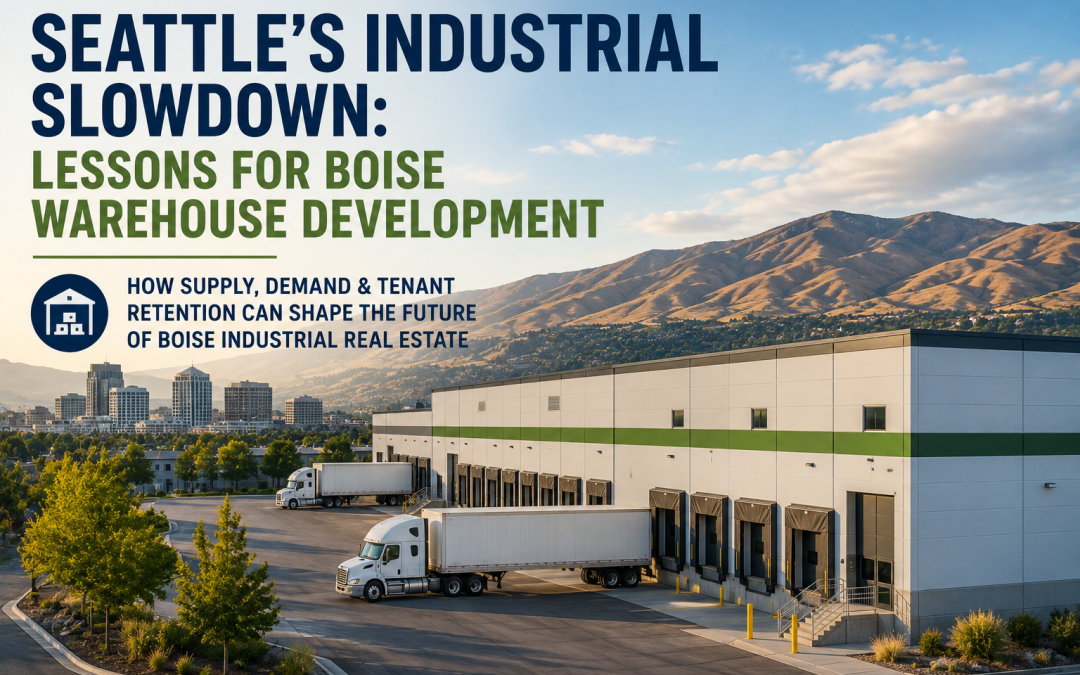
Seattle’s Industrial Slowdown Offers a Lesson for Boise Warehouse Development
Industrial real estate can go from undersupplied to overbuilt faster than many people expect.
Greater Seattle is seeing that cycle play out now. Millions of square feet of new warehouse space have been delivered while leasing demand has cooled, pushing industrial vacancy into double digits.
Against that backdrop, one major tenant deciding to stay suddenly becomes a meaningful market event.
According to reporting by Randyl Drummer of CoStar News, Serta Simmons Bedding has renewed its lease on a large manufacturing and distribution facility near Tacoma, Washington.
You can read the original CoStar News article.
For Boise commercial real estate, the story provides a useful reminder: strong population growth and long-term demand do not eliminate the risk of building too much industrial space too quickly.
Seattle Shows How Fast Industrial Supply Can Catch Demand
Serta Simmons Bedding renewed approximately 273,000 square feet at its manufacturing and warehouse facility in Puyallup, south of Seattle.
The company has operated from the property since 2018 after combining other Washington operations into the facility.
According to CoStar, the plant employs more than 200 people and produces roughly 1,000 mattresses per day for distribution throughout the western United States.
In a stronger industrial market, a renewal like this might receive relatively little attention.
Today, it matters.
Greater Seattle’s industrial vacancy rate has climbed to 10.4%, according to CoStar data cited in the article. Two years earlier, around midyear 2024, vacancy was approximately 7.4%.
That is a significant change in a relatively short period.
And new supply continues arriving.
CBRE data cited by CoStar showed developers completed five speculative industrial projects totaling about 1.8 million square feet during the second quarter of 2026 alone.
None of that space had been leased before completion.
That combination—rising vacancy plus continued speculative deliveries—is worth watching.
Industrial development doesn’t stop immediately when demand slows
Commercial construction has a long lead time.
A developer may identify land, secure entitlements, arrange financing and begin construction when market conditions look strong.
By the time the building opens 18 or 24 months later, the leasing environment can be completely different.
That lag is one of the biggest risks in speculative industrial development.
Several developers can independently look at the same strong market fundamentals and reach the same conclusion:
We need more warehouse space.
The problem appears later when all of those projects deliver around the same time.
Demand may still be healthy.
There can simply be more space than tenants need at that moment.
That appears to be part of the challenge facing the Puget Sound market.
And it provides a useful comparison for Boise industrial real estate.
Boise Industrial Development Needs to Follow Tenant Demand
The Treasure Valley has experienced substantial industrial growth.
Boise, Meridian, Nampa, Caldwell and surrounding communities have added warehouse, distribution, flex and manufacturing space as the metro population and business base have expanded.
The long-term argument for industrial development remains compelling.
The Treasure Valley continues to grow.
Companies need warehouse space.
Construction companies need yards.
Service businesses need flex buildings.
Manufacturers need production facilities.
Retailers and distributors need regional logistics locations.
Micron’s massive investment in Boise also has the potential to generate additional supplier and support-company demand.
But none of that means every speculative industrial project automatically works.
The Seattle example demonstrates why developers should distinguish between long-term demand and immediate leasing velocity.
Those are different things.
A market can have an excellent 10-year outlook while still experiencing an 18-month period where supply temporarily exceeds tenant demand.
That distinction matters for Boise development.
Tenant size matters too
Another important consideration is the type of industrial space being built.
A 20,000-square-foot local service business has very different requirements from a 250,000-square-foot regional distributor.
Small-bay industrial users may need:
- Smaller suites
- Grade-level doors
- Outdoor storage
- Easy highway access
- Reasonable rents
- Flexible lease terms
Larger logistics and manufacturing users may focus on:
- Clear height
- Trailer storage
- Dock-high loading
- Power capacity
- Large employee parking areas
- Highway connectivity
- Labor availability
- Building depth and configuration
Supply needs to match actual demand.
Simply saying that Boise needs “industrial space” does not tell developers what should be built.
The better question is:
Which industrial users are actually looking for space, and what kind of buildings do they need?
Existing Tenants Become More Valuable When Vacancy Rises
The Serta Simmons renewal also highlights something landlords sometimes underestimate during strong markets.
Existing tenants are extremely valuable.
When vacancy is low and rents are rising rapidly, landlords can become comfortable assuming another tenant will appear if an existing company leaves.
That calculation changes when vacancy increases.
Replacing a departing tenant can require:
- Months of downtime
- Tenant improvement allowances
- Leasing commissions
- Free rent
- Building modifications
- Marketing expenses
- Lower starting rents
Suddenly, keeping a good tenant can be far more profitable than chasing the highest possible renewal rate.
That is particularly true with a 273,000-square-foot industrial tenant.
Losing a tenant of that size could create a major vacancy that takes considerable time to refill.
For Boise industrial landlords, this is an important lesson.
Tenant retention should begin long before lease expiration.
Landlords should understand whether tenants need additional space, less space, more power, outdoor storage, better loading, facility improvements or different lease structures.
Waiting until six months before expiration may be too late.
Manufacturing Users Can Be Especially Valuable
Serta Simmons is also more than a warehouse tenant.
The facility actually produces products.
That distinction matters.
Distribution facilities can sometimes relocate relatively easily if another building provides better economics.
Manufacturing operations are often more difficult to move.
Equipment may need to be relocated.
Production can be interrupted.
Employees may need to commute to a different location.
Power and utility requirements may need to be recreated.
Supply chains can be affected.
New permits may be necessary.
That can make a well-designed manufacturing facility particularly valuable to both the tenant and landlord.
It also reinforces the importance of building industrial properties capable of accommodating more than simple product storage.
For Boise commercial real estate, buildings with strong power, loading, yard areas, fiber, ventilation and other infrastructure may have a broader range of potential users over time.
What Boise Investors and Developers Should Watch
Seattle’s current industrial conditions do not mean Boise will follow exactly the same path.
The markets are different in size, geography, tenant mix and development patterns.
But real estate cycles tend to follow familiar patterns.
Demand increases.
Vacancy falls.
Rents rise.
Developers respond.
Construction accelerates.
Eventually, supply catches demand—and sometimes passes it.
That is why Boise industrial investors should look beyond headline vacancy rates and monitor what is coming next.
A market with 5% vacancy today can behave very differently if several million square feet are scheduled for delivery.
Likewise, a market with higher vacancy can improve quickly if construction stops while tenants continue absorbing space.
The development pipeline matters almost as much as current vacancy.
Local Insight: Don’t Build Industrial Space Just Because Boise Is Growing
Boise’s growth story is powerful.
But “Boise is growing” should never be the entire feasibility study for an industrial project.
The better approach is to work backward from the tenant.
Who is going to occupy the building?
How many companies need that size?
What rent can they afford?
How many competing buildings exist?
What is under construction?
What makes this project different?
And perhaps most importantly:
What happens if lease-up takes twice as long as expected?
That last question can separate a strong industrial investment from a risky one.
For developers, this may mean being more cautious about speculative construction when multiple competing projects are already underway.
For investors, it means examining future supply before assuming today’s occupancy will continue.
For tenants, periods of higher vacancy can create opportunities to negotiate better economics, expansion rights or building improvements.
And for landlords, it reinforces the importance of protecting strong existing tenant relationships.
There is another lesson here for the Treasure Valley.
Retention is economic development too.
Cities often focus heavily on recruiting new employers.
New companies generate headlines.
But keeping an existing manufacturer with hundreds of employees can be equally important.
Commercial real estate professionals, landlords, cities and economic development groups should be asking established Boise-area employers what they need to remain and grow here.
Sometimes the best new deal in the market is the company that decides not to leave.
Seattle’s industrial market provides a useful warning about the supply side of commercial real estate.
Warehouses can be built relatively quickly.
Tenant demand cannot.
For Boise industrial development, the opportunity remains substantial—but the strongest projects will likely be those designed around real tenant demand rather than growth projections alone.
Mike Gioioso (joy-OH-so) has for 16+ years been helping companies of all sizes buy, build, and lease perfect places for business in greater Boise, Idaho and beyond.
www.streetsmartidaho.com mike@streetsmartidaho.com 208-209-9166
Tags: #boisecommercialrealestate, #boiseindustrialrealestate, #boisedevelopment, #boisewarehousespace, #treasurevalleycommercialrealestate, #idahocommercialrealestate, #industrialdevelopmentboise, #boiseinvestmentproperty, #nampaindustrialrealestate, #caldwellindustrialrealestate, #meridianindustrialrealestate, #treasurevalleyindustrial, #warehousedevelopment, #industrialleasingboise, #commercialrealestateinvestment