
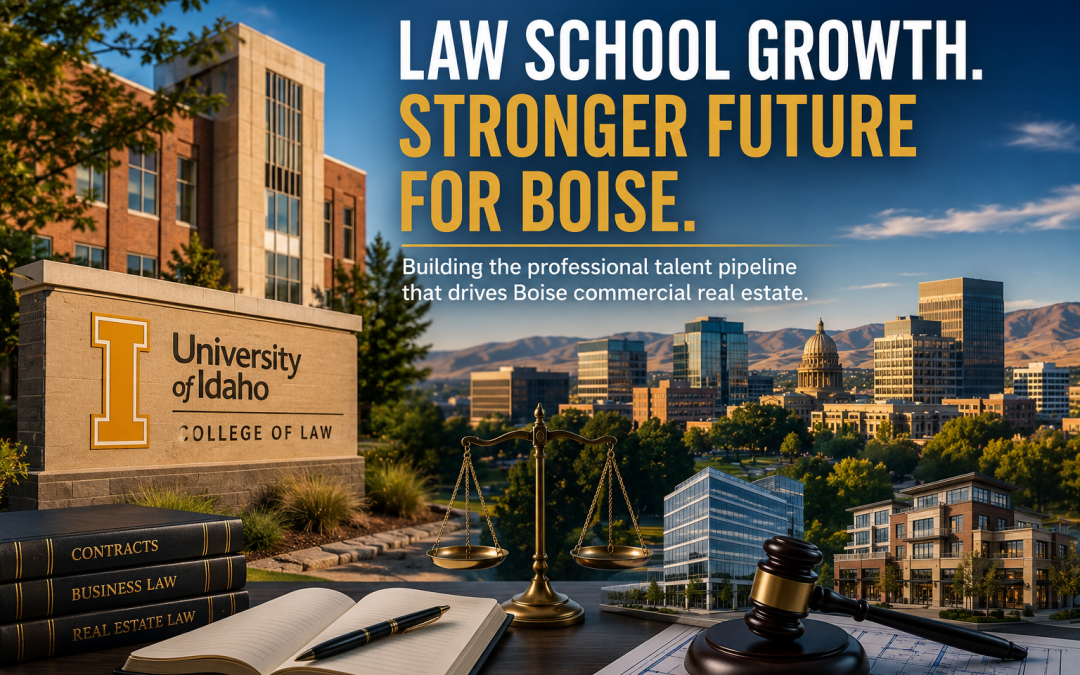
University of Idaho Law School Growth Could Create Long-Term Demand for Boise Office and Professional Real Estate
Boise’s professional economy continues getting deeper — and that matters for the future of Boise commercial real estate.
One of the quieter trends shaping the Treasure Valley right now is the continued growth of higher education programs tied to law, business, healthcare, and professional services. Those programs help create the workforce pipeline many companies look for before expanding into a market.
According to reporting by Idaho Business Review staff in this article — “University of Idaho appoints Brian Kane dean of College of Law amid enrollment growth” — the University of Idaho has appointed Brian Kane as the new dean of its College of Law as enrollment continues rising across the program.
While the announcement focuses on university leadership, the broader implications may extend into Boise development, office leasing, and long-term economic growth throughout the region.
Why Boise’s Professional Talent Pipeline Matters
Kane reportedly begins the role July 31 and currently serves as CEO and executive director of the National Association of Attorneys General. Before that, he spent roughly two decades with the Idaho Attorney General’s Office and has also taught at the law school as adjunct faculty.
The appointment comes during a period of meaningful enrollment growth for the law program.
According to the article, fall 2025 enrollment climbed nearly 10% to 502 students, including the largest incoming first-year law class in school history.
That may sound like a higher education story — but for Boise commercial real estate professionals, it also connects directly to workforce development.
Professional service firms often expand where they believe they can consistently recruit talent.
That includes:
- law firms,
- financial companies,
- healthcare organizations,
- consulting firms,
- government contractors,
- and technology companies needing legal and compliance expertise.
As Boise continues growing into a larger regional business hub, institutions creating professional talent become increasingly important economic drivers.
The Boise Campus Continues Gaining Importance
One particularly important detail in the Idaho Business Review reporting is that the law school dean oversees both the Moscow and Boise campuses.
That matters because Boise increasingly functions as Idaho’s primary economic center for professional services and corporate activity.
The Boise legal market has expanded significantly over the past decade alongside:
- population growth,
- corporate relocations,
- healthcare expansion,
- real estate development,
- and rising business formation activity.
As more legal professionals enter the market, demand can eventually ripple across multiple property types, including:
- downtown office space,
- mixed-use developments,
- multifamily housing,
- retail centers,
- and hospitality properties serving business travel.
Educational growth often acts as an early signal of broader economic maturation.
Higher Education Growth Often Supports Commercial Real Estate Demand
One of the more overlooked aspects of Boise development is how universities contribute to long-term real estate stability.
Growing professional programs can help:
- attract outside employers,
- retain younger talent,
- increase internship and startup activity,
- and strengthen regional business ecosystems.
In many fast-growing western cities, universities have become major anchors supporting innovation districts, office development, and urban revitalization efforts.
Boise may increasingly move in that direction as the metro continues evolving.
The Treasure Valley already benefits from strong population migration and business growth. Expanding educational and professional infrastructure can help reinforce those trends over time.
Local Market Impact
The University of Idaho law school announcement highlights several broader Boise real estate themes:
- Continued growth in Idaho’s professional workforce
- Rising demand for higher education tied to business sectors
- Long-term strengthening of Boise’s office economy
- More institutional investment in professional training
- Increasing importance of Boise as Idaho’s economic hub
For office landlords, these trends matter because workforce growth ultimately drives office occupancy demand.
For developers, it reinforces the importance of mixed-use environments that appeal to younger professionals entering the workforce.
For investors, expanding educational and professional infrastructure may support longer-term economic durability in the Boise metro.
My Take
One of the biggest changes happening in Boise right now is that the city is becoming more economically diversified.
A decade ago, Boise’s growth story was often tied mostly to population migration and housing demand.
Today, the market increasingly includes:
- technology,
- healthcare,
- finance,
- legal services,
- advanced manufacturing,
- and professional business services.
That evolution matters for Boise commercial real estate because deeper professional ecosystems tend to create more stable long-term demand across office, retail, and multifamily sectors.
Announcements like this may not generate the same headlines as a major industrial lease or apartment project, but they are often part of the foundation supporting sustained economic growth.
Mike Gioioso (joy-OH-so) has for 16+ years been helping companies of all sizes buy, build, and lease perfect places for business in greater Boise, Idaho and beyond.
www.streetsmartidaho.com mike@streetsmartidaho.com 208-209-9166
Tags: #boisecommercialrealestate, #boisedevelopment, #boiseofficespace, #officeleasingboise, #boiserealestate, #downtownboise, #universityofidaho, #collegeoflaw, #boisebusiness, #professionalservices, #legalindustry, #idahocommercialrealestate, #treasurevalleyrealestate, #economicdevelopment, #workforcedevelopment