
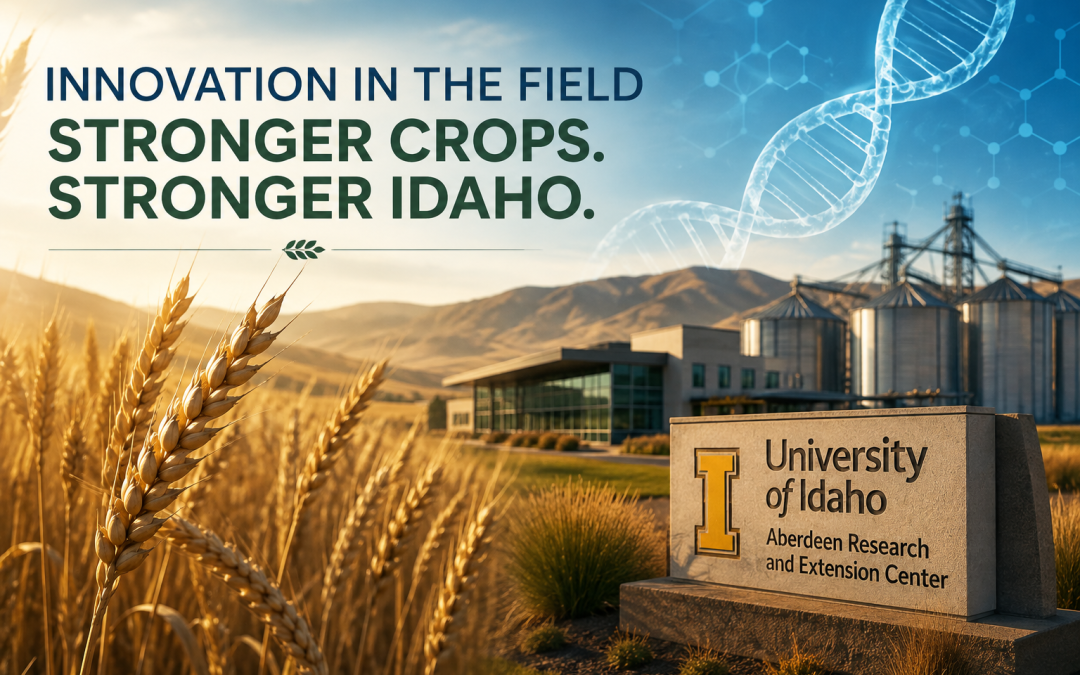
Idaho Wheat Breakthrough Could Strengthen Agriculture—and the Commercial Real Estate Behind It
A small change in a wheat plant’s DNA could eventually have a much larger economic impact across Idaho.
Researchers at the University of Idaho have identified a naturally occurring genetic mutation linked to wheat yield gains of roughly 5% to 10%. While this is first and foremost an agricultural research story, the potential impact goes beyond the farm. Higher productivity and more efficient crop development can influence Idaho’s food-processing industry, agricultural suppliers, transportation networks, industrial facilities and the commercial real estate that supports them.
According to reporting provided by the University of Idaho and published by the Idaho Business Review on August 4, the research is being led by wheat breeder Jianli Chen at the Aberdeen Research and Extension Center. The original Idaho Business Review article provides the full research overview.
A Small Genetic Change With a Potentially Big Payoff
The University of Idaho research team has been studying wheat genetics to identify traits that can improve crop performance.
Researchers discovered a naturally occurring deletion in wheat DNA associated with later flowering and the development of additional spikelets—the structures on a wheat head that eventually produce grain. The mutation has been found in several strong-performing wheat lines, including UI Gold, a hard white spring wheat variety released by the university’s breeding program in 2022.
The important number for Idaho agriculture is the potential yield improvement: researchers have associated the mutation with increases of approximately 5% to 10%.
Even relatively modest improvements in agricultural productivity can become significant when multiplied across thousands of acres.
Researchers have also developed molecular markers that allow breeders to identify wheat lines carrying the beneficial mutation. That could make it easier for breeding programs to incorporate the trait into future varieties rather than relying solely on years of traditional field testing.
Technology Is Making Crop Development Faster and Cheaper
The genetic discovery is only part of the story.
Chen’s program is also using genomic selection to predict which wheat varieties have the best chance of producing desirable traits. Instead of waiting through multiple growing seasons before determining whether a new line performs well, researchers can use genetic information to narrow the field much earlier.
The University of Idaho team found that a testing platform using about 4,000 genetic markers could predict yield-related performance as effectively as a much larger system using approximately 90,000 markers. The smaller platform has reduced testing expenses by about $60 per sample for Chen’s program.
That combination—better crops and lower development costs—is especially interesting.
If breeding programs can identify promising varieties sooner and at a lower cost, new agricultural technology may move from research plots to commercial farms more efficiently.
The next step could broaden the impact even further. Chen plans to evaluate whether the smaller testing platform can help identify other valuable characteristics, including drought tolerance and baking quality.
Why This Matters for Idaho Commercial Real Estate
At first glance, wheat genetics may seem far removed from Boise commercial real estate.
But commercial real estate follows economic activity.
Agriculture remains deeply connected to Idaho’s economy, and improvements in agricultural productivity can ripple through businesses that store, process, package, transport, research and sell agricultural products.
For commercial real estate professionals, investors and developers, there are several areas worth watching:
- Industrial and food-processing space: Greater agricultural output can support demand for processing, manufacturing, cold storage, warehousing and distribution facilities.
- Agricultural technology: More sophisticated breeding and genomic research creates opportunities for laboratories, research facilities, specialized flex buildings and technology companies serving agriculture.
- Transportation and logistics: Higher agricultural production ultimately means more products moving through Idaho’s transportation and distribution network.
- Supplier businesses: Equipment dealers, seed companies, testing operations and other agricultural service providers all require commercial property.
- Rural economic development: Agricultural innovation can help strengthen communities outside the Boise metro, which may create additional opportunities for industrial development and investment property.
That doesn’t mean a new wheat variety suddenly creates warehouse demand in Boise. Commercial real estate rarely works that directly.
Instead, it illustrates something more important: Idaho’s traditional industries are becoming increasingly technology-driven.
That evolution can change the types of buildings businesses need.
Research Investment Builds Idaho’s Economic Infrastructure
The research is part of a much larger national effort.
A five-year, $15 million USDA National Institute of Food and Agriculture grant supported the Wheat Coordinated Agricultural Project, bringing together researchers from 22 institutions. The University of Idaho received spending authority of $537,644 through a grant subaward for its portion of the work.
That matters from an economic-development perspective.
Universities aren’t simply educational institutions. Research programs can become part of a state’s business infrastructure.
Successful university research can attract federal funding, specialized employees, private-sector partnerships and eventually commercialization opportunities. Those activities require laboratories, offices, manufacturing facilities and industrial space.
For Boise development and the broader Idaho commercial real estate market, the long-term opportunity is the intersection between established Idaho industries and new technology.
Agriculture is one of the clearest examples.
Local Insight: Watch the Industries Behind the Headlines
When I look at a story like this from a commercial real estate perspective, I’m less interested in whether one scientific discovery immediately changes property demand.
I’m interested in the direction of travel.
Idaho already has a strong agricultural foundation. If technology allows farmers to produce more with the same amount of land—or helps crops perform better under difficult growing conditions—the businesses surrounding agriculture may become more productive as well.
That creates potential opportunities across industrial real estate, flex space, research facilities, food manufacturing and logistics.
It’s also another reminder that Boise commercial real estate doesn’t operate in isolation. Boise and the Treasure Valley serve as a major business, financial and distribution center for a state economy influenced by agriculture, manufacturing, technology and population growth.
For investors, landlords and developers, following innovations in those industries can provide clues about where future commercial real estate demand may emerge.
Sometimes the next real estate trend doesn’t start with a new building.
It starts in a research lab—or, in this case, in a wheat field.
Mike Gioioso (joy-OH-so) has for 16+ years been helping companies of all sizes buy, build, and lease perfect places for business in greater Boise, Idaho and beyond.
www.streetsmartidaho.com mike@streetsmartidaho.com 208-209-9166
Tags: #boisecommercialrealestate, #idahocommercialrealestate, #idahoagriculture, #universityofidaho, #universityofidahoresearch, #idahowheat, #idahowheatproduction, #idahoagriculturalresearch, #idahoagribusiness, #idahoeconomicdevelopment, #boisedevelopment, #boiseindustrialrealestate, #idahoindustrialrealestate, #idahoinvestmentproperty, #agriculturaltechnology