
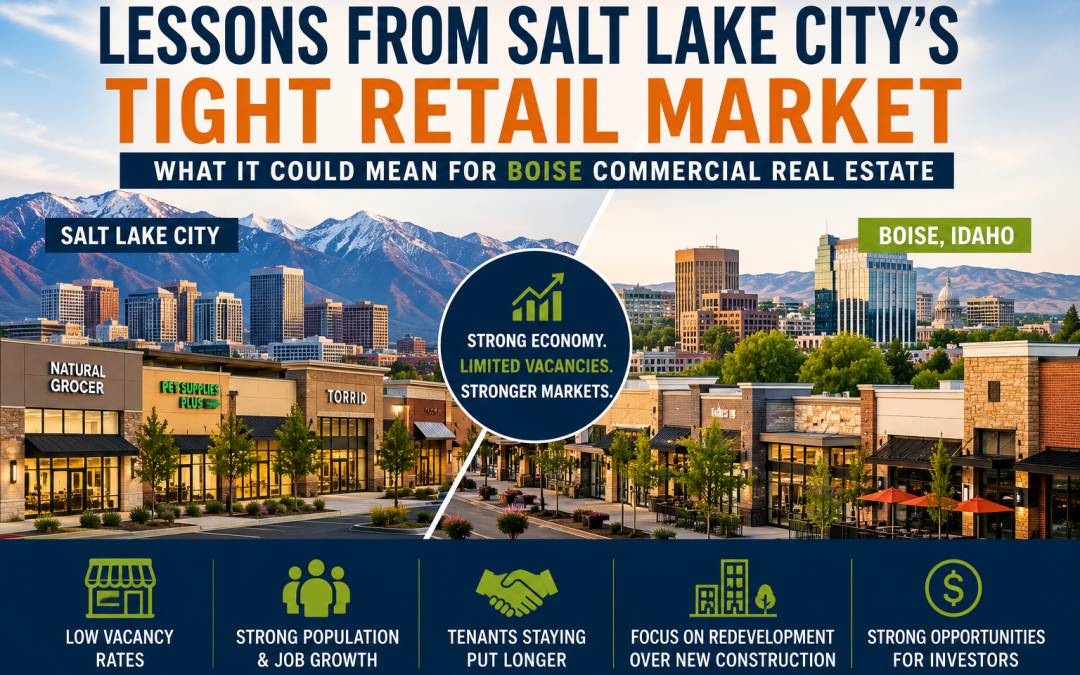
Why Salt Lake City’s Tight Retail Market Could Offer Valuable Lessons for Boise Commercial Real Estate
Retail space doesn’t have to be booming with new leasing activity to be considered healthy.
Sometimes, a slower pace of lease signings simply means there aren’t many vacancies left to lease. That’s the situation developing in the Salt Lake City market, where strong economic fundamentals and limited retail availability continue supporting landlords even as leasing volume has cooled. For Boise commercial real estate, this is a trend worth watching because the Treasure Valley shares many of the same long-term growth drivers.
According to reporting by John Gillem of CoStar Analytics, Salt Lake City’s retail market remains one of the tighter markets in the western United States despite a recent slowdown in leasing activity. You can read the original CoStar News article here: https://product.costar.com/home/news/527125603. This article is based on that reporting while exploring what Salt Lake City’s retail trends could mean for Boise commercial real estate, retail leasing, development, and investment opportunities across the Treasure Valley.
A Slow Leasing Market Doesn’t Always Signal Weak Demand
At first glance, fewer new retail leases might suggest businesses are becoming more cautious.
However, Salt Lake City’s market tells a different story.
According to CoStar Analytics, available retail space has increased modestly to roughly 3.2 million square feet, aligning with the area’s long-term historical average. Even with additional construction over the past decade, retail vacancies remain limited.
Several factors continue supporting the market:
- Population growth remains strong.
- Job creation continues to outperform national averages.
- Wage growth is increasing consumer purchasing power.
- National retailers continue expanding into the region.
- Retail uses continue diversifying beyond traditional shopping.
Rather than a lack of demand, the biggest challenge is simply finding available space.
Businesses Are Staying Put Longer
One of the most important trends highlighted in the CoStar report is that retailers are giving up space less often.
Move-outs during the past year have remained below historical norms, meaning fewer storefronts are returning to the market for new tenants.
This creates a ripple effect:
- Existing tenants renew more frequently.
- Vacancies remain limited.
- New businesses have fewer options.
- Landlords maintain stronger negotiating positions.
- Second-generation retail space becomes increasingly valuable.
One recent example involved an indoor entertainment operator leasing a former big-box retail location after it became available, demonstrating how quickly quality space can be absorbed when vacancies occur.
What This Could Mean for Boise Commercial Real Estate
Many of the same economic forces supporting Salt Lake City’s retail sector are also present in the Treasure Valley.
Boise continues benefiting from:
- Population growth
- Business relocation
- Higher household incomes
- Expanding suburban communities
- Continued consumer spending
These trends have helped keep retail leasing in Boise relatively healthy despite broader economic uncertainty.
As more national and regional retailers enter Idaho, competition for well-located shopping centers could continue increasing—particularly in high-growth areas such as Meridian, Eagle, Star, Kuna, and Nampa.
If tenant turnover remains low, available retail space may stay limited even if overall leasing activity slows.
Boise Development May Shift Toward Redevelopment
One lesson from Salt Lake City is that limited vacancies often encourage redevelopment instead of constant new construction.
When retailers struggle to find existing space, developers typically pursue opportunities such as:
- Redeveloping aging shopping centers
- Repositioning vacant big-box stores
- Expanding neighborhood retail centers
- Adding mixed-use retail projects
- Modernizing older commercial properties
Rather than building speculative retail everywhere, developers often focus on creating higher-quality space where long-term demand already exists.
That trend is becoming increasingly relevant across Boise development, especially as construction costs remain elevated and many prime commercial sites have already been developed.
Why Investors Should Pay Attention
Retail fundamentals often look strongest when vacancies remain low—even if leasing statistics appear less impressive on the surface.
Properties with stable occupancy and limited nearby competition generally provide landlords with greater pricing power and more predictable cash flow.
For investors evaluating Boise commercial real estate, markets that continue adding residents while maintaining disciplined retail development may offer attractive long-term opportunities.
Understanding tenant retention may become just as important as tracking new lease announcements.
My Take
From my perspective as someone working daily in Boise commercial real estate, Salt Lake City’s experience reinforces an important point: leasing volume doesn’t tell the entire story.
Healthy retail markets aren’t measured only by how many leases get signed—they’re also measured by how rarely quality tenants leave.
If Boise continues attracting new residents and employers while existing retailers remain successful, demand for well-located shopping centers should remain strong. That creates opportunities for landlords, investors, and developers who focus on quality locations, thoughtful redevelopment, and long-term tenant relationships rather than simply adding more retail inventory.
Mike Gioioso (joy-OH-so) has for 16+ years been helping companies of all sizes buy, build, and lease perfect places for business in greater Boise, Idaho and beyond. www.streetsmartidaho.com mike@streetsmartidaho.com 208-209-9166
Tags: #boisecommercialrealestate, #boiseretailmarket, #retailleasingboise, #boisedevelopment, #saltlakecityretail, #utahcommercialrealestate, #retailinvestment, #shoppingcenters, #commercialproperty, #retaildevelopment, #treasurevalleyrealestate, #mixedusedevelopment