
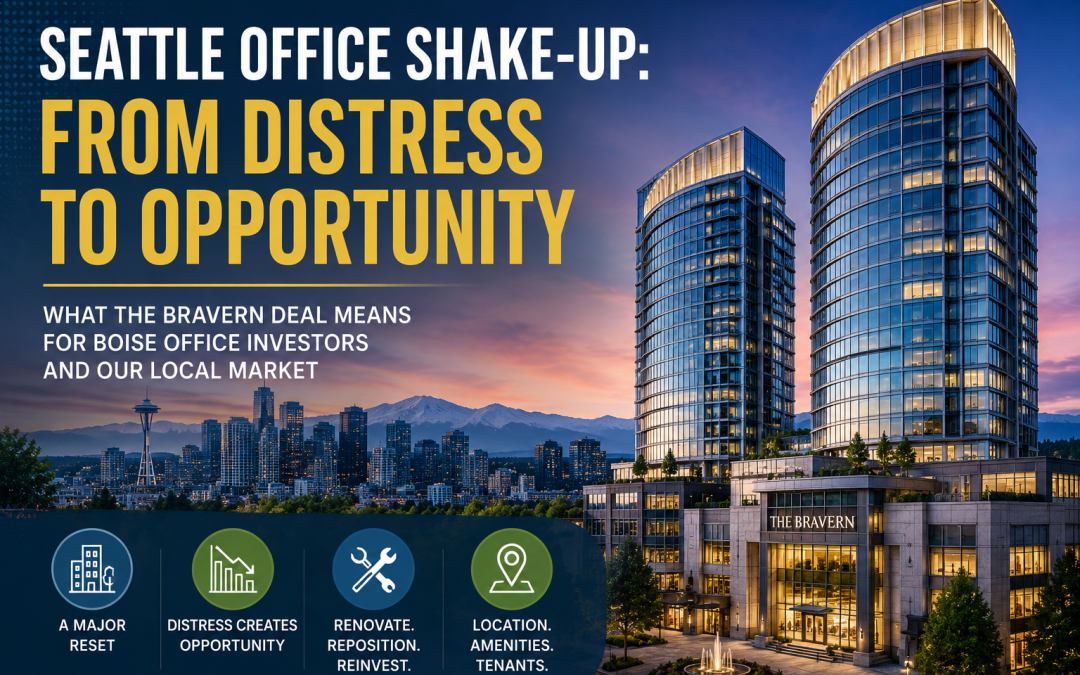
What a Distressed Seattle Office Deal Can Teach Boise Property Owners
A nearly empty office building can be a problem.
It can also be an opportunity.
That’s the interesting lesson coming out of Bellevue, Washington, where the original developer of a major office complex is working to reacquire the property after the loss of Microsoft pushed the towers into financial distress.
For Boise commercial real estate, the story offers a useful look at what may happen next in the office market.
Some buildings will struggle with vacancies and old financing structures. Others will be purchased at new values, renovated and repositioned for tenants with very different expectations than the companies that occupied them a decade ago.
According to reporting by Randyl Drummer of CoStar News, Seattle-based developer Schnitzer West has reached an exclusive agreement to reacquire The Bravern, a two-building office complex in downtown Bellevue that the company originally developed.
You can read the original CoStar News article here:
https://product.costar.com/home/news/825447028
The situation provides an important reminder for office investors everywhere:
A great building and a bad capital structure can exist at the same time.
One Tenant Can Change the Economics of an Entire Property
The Bravern contains approximately 750,000 square feet of office space across two towers, along with a parking structure containing more than 3,100 stalls.
Schnitzer West originally developed the complex in 2009.
The developer sold it the following year for approximately $410 million.
The property later traded again in 2019, when Australian Retirement Trust—then known as QSuper—acquired it for about $585 million.
Then the office market changed.
Microsoft, which occupied the office complex, decided not to renew its lease as the technology company consolidated operations around its expanded headquarters in nearby Redmond.
When Microsoft departed, The Bravern lost the tenant supporting essentially the entire office component.
The consequences were significant.
The property’s owner defaulted on financing last year, according to CoStar, and approximately $304 million of mortgage debt was eventually transferred to special servicing.
Now the property’s original developer sees another opportunity.
Schnitzer West plans to reacquire the towers and upgrade them before attempting to lease the vacant space to new tenants.
That cycle—development, sale, distress, reacquisition and repositioning—is an extreme example of something commercial real estate investors may see more frequently as the office market works through its post-pandemic reset.
Today’s Office Market Punishes Concentration Risk
One of the clearest lessons from The Bravern is tenant concentration.
Having Microsoft occupy an entire office complex probably looked like an enormous strength when the lease was signed.
And it was.
A major credit tenant can provide stable income, improve financing options and make an office property extremely attractive to institutional buyers.
But concentration creates another kind of risk.
If one tenant represents most or all of the rent, losing that tenant can transform a fully occupied building into a major leasing challenge almost overnight.
That’s especially difficult with large office properties.
Replacing a small tenant occupying 5,000 square feet may be manageable.
Replacing a company occupying hundreds of thousands of square feet is entirely different.
The owner may need to divide floors.
Common areas may require upgrades.
New tenant amenities may be necessary.
Building systems may need modernization.
Leasing commissions and tenant improvement packages can become substantial.
And the lease-up period can stretch for years.
For Boise office real estate investors, that makes tenant diversification worth considering carefully.
A fully occupied building isn’t automatically low-risk.
You also need to understand who occupies it, how much space each tenant controls and when those leases expire.
Older Office Buildings Need to Compete With New Expectations
Schnitzer West reportedly plans to upgrade The Bravern after reacquiring it.
That’s another important part of this story.
The office towers were completed in 2009 and haven’t undergone a major renovation since Microsoft initially occupied the property.
A building that was considered modern when it opened may be competing against properties offering newer amenities, technology and workplace designs nearly two decades later.
That matters because companies have become much more selective about office space.
Employees aren’t necessarily coming into an office five days per week simply because their employer has a lease.
Companies increasingly need workplaces that give employees a reason to show up.
That can mean:
- Better common areas
- Outdoor spaces
- Fitness facilities
- Conference amenities
- Food and beverage options
- Improved technology
- Flexible workplace configurations
- Better natural light
- Convenient parking
- Strong surrounding retail and restaurants
This is where the office market increasingly resembles other parts of commercial real estate.
Experience matters.
Retail learned that lesson years ago.
Hotels have always understood it.
Office landlords are learning it now.
Quality Office Space Can Still Attract Tenants
The Bellevue story isn’t simply about office distress.
It also provides evidence that companies are still leasing significant amounts of office space.
Former Microsoft properties elsewhere in Bellevue have attracted tenants including OpenAI, Wells Fargo, HDR Engineering and TikTok.
Schnitzer West also owns The Artise, a newer Bellevue office tower completed in 2024 that CoStar reports is approximately 99% leased.
That contrast is important.
Some office properties are struggling while others are attracting major tenants.
This suggests that the future of office real estate may not be a simple question of whether companies want offices.
The better question may be:
Which offices do companies want?
That’s a much more important distinction for Boise commercial real estate.
What This Could Mean for Boise’s Office Market
Boise doesn’t have the same concentration of giant technology companies as Seattle or Bellevue.
That’s probably an advantage in some respects.
The Treasure Valley office market is generally made up of smaller users across industries including professional services, healthcare, finance, technology, government, construction and other businesses.
That can create a more diversified tenant base.
But Boise landlords still face many of the same questions.
What happens when a major tenant leaves?
How expensive will it be to divide the space?
How much tenant improvement money will the next user require?
Does the building still feel modern?
Can the property compete with newer construction?
And perhaps most importantly:
What is the building worth based on today’s rent and financing environment—not yesterday’s valuation?
That last question may create opportunities.
Distress Can Reset the Cost Basis
Office distress sounds negative, but commercial real estate cycles often create opportunity by resetting property values.
Imagine an office building originally developed at a high cost and later sold at an even higher valuation.
If occupancy falls while interest rates rise, the property’s previous value may no longer make sense.
Eventually, someone may acquire the asset at a lower basis.
That changes the equation.
A new owner may be able to spend money renovating the building, offer competitive tenant improvements and lease space at market rents while still generating an acceptable return.
The building hasn’t changed location.
The parking hasn’t disappeared.
The structure is still standing.
What changed is the cost basis.
That can create opportunity for investors with capital and patience.
For Boise investment property, this is something worth watching over the next several years.
Some older office assets may trade because owners face loan maturities, vacancies or expensive renovation requirements.
The next owner may have a completely different financial position.
Mixed-Use Environments May Have an Advantage
Another interesting element of The Bravern is its surrounding environment.
The larger development includes retail and residential components, although those portions are separately owned and aren’t included in Schnitzer West’s proposed office acquisition.
That mixed-use setting can still matter.
Today’s office tenants increasingly care about what exists outside the building.
Restaurants.
Coffee shops.
Fitness.
Housing.
Hotels.
Walkability.
Services.
These amenities can make an office location more appealing to employees.
That lesson applies directly to Boise development.
Downtown Boise has an advantage because office workers can walk to restaurants, entertainment, hotels and services.
Mixed-use areas elsewhere in the Treasure Valley may offer similar benefits.
As companies become more selective, landlords may increasingly compete on the quality of the surrounding environment—not just the quality of the office suite.
Local Insight: Office Isn’t Dead—Undifferentiated Office Is Vulnerable
The Bravern story captures where I think the office market is heading.
The future isn’t necessarily about companies abandoning office space.
It’s about companies becoming much more selective about which space deserves their rent dollars.
That creates both winners and losers.
A building with outdated interiors, limited amenities and an owner carrying an unrealistic cost basis may struggle.
A well-located building acquired at the right price and upgraded for today’s tenants could have a very different future.
For Boise commercial real estate investors and landlords, the opportunity may increasingly be in repositioning.
That could mean renovating common areas.
Adding amenities.
Improving outdoor space.
Modernizing mechanical systems.
Breaking large suites into smaller spaces.
Improving signage and identity.
Or even converting portions of a property to different uses where zoning and economics allow.
The important thing is recognizing that an office building’s past doesn’t guarantee its future.
The Bravern went from a major development to a high-value institutional investment, then into financial distress after losing Microsoft.
Now its original developer wants another shot at it.
That’s commercial real estate in a nutshell.
Markets change.
Values reset.
Buildings get reinvented.
And sometimes the best opportunity begins when yesterday’s business plan stops working.
Mike Gioioso (joy-OH-so) has for 16+ years been helping companies of all sizes buy, build, and lease perfect places for business in greater Boise, Idaho and beyond.
www.streetsmartidaho.com mike@streetsmartidaho.com 208-209-9166
Tags: #boisecommercialrealestate, #boiseofficemarket, #boiseofficerealestate, #boiseinvestmentproperty, #boisedevelopment, #treasurevalleycommercialrealestate, #idahocommercialrealestate, #officeinvestment, #officeleasingboise, #commercialpropertyrepositioning, #distressedcommercialrealestate, #officebuildingrenovation, #adaptivereuseboise, #downtownboiseoffice, #treasurevalleyofficemarket