
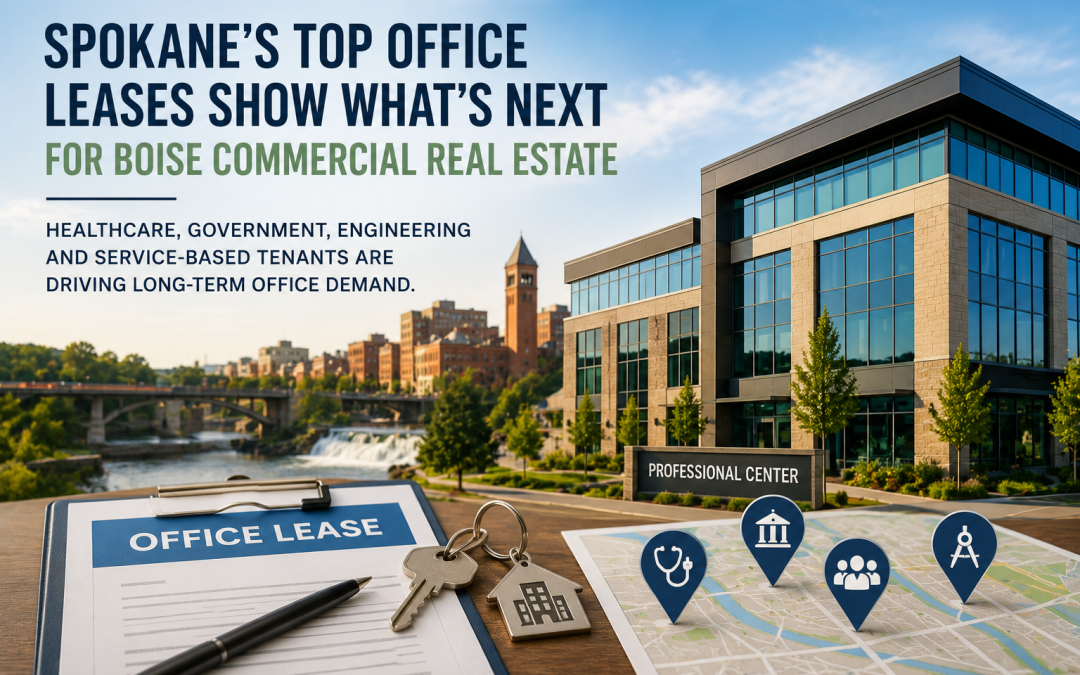
Spokane’s Biggest Office Leases Offer Clues for Boise’s Office Market
The office market may have changed, but businesses haven’t stopped leasing space.
Spokane’s largest office deals from the second quarter of 2026 show something important for anyone following Boise commercial real estate: tenants are still willing to make significant, long-term commitments when the building, location and business need line up.
Healthcare, government, engineering and infrastructure-related companies were behind several of Spokane’s notable leases. That’s especially relevant to Boise because many of those same industries are helping drive office demand across the Treasure Valley.
According to reporting by CoStar Research, five Spokane-area leases were recognized among the market’s second-quarter 2026 Power Broker Quarterly Deal Awards. You can read the original CoStar News article for CoStar’s reporting and complete deal information.
Instead of looking at these transactions simply as Spokane deals, let’s look at what they may tell us about the direction of Boise office real estate.
Healthcare and Specialized Users Are Driving Real Demand
The biggest transaction on CoStar’s Spokane list wasn’t a traditional corporate headquarters.
It was healthcare.
Revive Counseling leased 23,694 square feet at Rock Pointe West at 1330 N. Washington St. Even more notable was the commitment: the lease runs for more than 10 years.
That is significant in today’s office environment.
Many office users have been trying to preserve flexibility since the pandemic. A behavioral health provider committing to nearly 24,000 square feet for more than a decade shows how differently space-intensive service businesses can behave compared with companies capable of shifting employees to remote work.
There’s also an Idaho connection.
Rock Pointe West is owned by Alturas Capital Partners, an Idaho-based investment company with office and industrial holdings in western U.S. growth markets.
Another healthcare-related organization appeared among Spokane’s largest transactions.
Leaps and Beyond, an Applied Behavior Analysis therapy provider, leased the entire 8,281-square-foot building at 1131 E. Westview Court. Its lease extends for more than six years.
For Boise landlords, that’s worth noting.
Medical, counseling, behavioral health, therapy and other service providers often need physical locations to deliver their services. Remote work simply can’t replace many of those functions.
That can make these users especially valuable in an office market where traditional corporate demand has become harder to predict.
Government, Engineering and Infrastructure Users Remain Active
The rest of Spokane’s notable deals reinforce the same theme: necessity-based office users are still making moves.
The U.S. General Services Administration leased 8,605 square feet at the historic Broadview Dairy building near the Spokane River and Riverfront Park.
National engineering and planning firm Kimley-Horn took 7,500 square feet at Downtown Spokane Financial Center under a lease extending more than seven years.
Infrastructure consulting platform Trilon Group leased another 6,910 square feet at Iron Bridge Corporate Campus.
Put those tenants together and a pattern emerges.
These aren’t businesses taking office space simply because employees need desks.
They represent healthcare, government, engineering and infrastructure services.
Those industries tend to have reasons for maintaining physical locations: client meetings, specialized staff, project collaboration, regulatory requirements and access to local markets.
That distinction matters.
The future of office real estate may increasingly depend less on how many companies “return to the office” and more on which industries actually require space to operate effectively.
What Spokane’s Deals Could Mean for Boise Office Real Estate
Spokane isn’t Boise, and five transactions don’t define an entire regional office market.
But the tenant mix looks familiar.
Boise has strong employment and business activity tied to healthcare, government, engineering, construction, technology and professional services.
Those sectors could become increasingly important when landlords evaluate future leasing strategies.
For years, office owners could broadly market space to almost any growing company.
Today, successful leasing may require more specialization.
A behavioral health provider may need private treatment rooms and sound control.
A medical user could require plumbing, specialized HVAC or additional parking.
An engineering company might value large collaborative spaces and easy access to major transportation corridors.
Government tenants can bring another set of building, security and procurement requirements.
That means owners may need to think beyond simply offering a competitive rental rate.
The question becomes:
What type of tenant is this building actually designed to attract?
That could be one of the most important questions facing Boise office landlords over the next several years.
Long Lease Terms Still Have Value
Another thing that stands out is lease duration.
The Revive Counseling deal runs more than 10 years. Kimley-Horn committed for more than seven years. Leaps and Beyond signed for more than six.
That’s encouraging for landlords.
Longer leases can create predictable income, improve financing prospects and potentially increase property value.
But there is usually a tradeoff.
Tenants making long commitments often expect landlords to invest in the relationship.
That could mean tenant improvement allowances, free rent, building upgrades or other concessions.
This is especially important in today’s environment because construction remains expensive.
A tenant may love a building but still be unable—or unwilling—to personally fund hundreds of thousands of dollars in improvements.
Owners with the capital and flexibility to solve that problem can have an advantage.
That’s increasingly relevant for retail leasing in Boise, office leasing and medical space alike.
Boise’s Older Office Buildings Have an Opportunity—and a Challenge
These Spokane transactions also highlight something important for existing buildings.
Not every successful lease needs to occur in brand-new construction.
The GSA transaction, for example, involved the historic Broadview Dairy property.
That reinforces the potential of adaptive reuse and repositioning.
Boise has plenty of older office properties that may not compete directly with newly built Class A space based on finishes alone.
But older buildings can offer other advantages:
- Established locations
- Existing parking
- Lower occupancy costs
- Unique architecture
- Smaller floorplates
- Opportunities for customized improvements
- Proximity to neighborhoods and services
The challenge is determining whether investing additional capital into the property will produce enough rent and occupancy to justify the expense.
For some buildings, the answer will be yes.
Others may eventually be better suited for redevelopment or conversion.
That calculation will become increasingly important as Boise development continues and newer buildings compete against older inventory.
Local Insight: Stop Treating “Office” as One Market
One of the biggest mistakes we can make when discussing commercial real estate today is saying, “the office market is weak,” and stopping there.
Office isn’t one market anymore.
A downtown corporate office building serving large professional firms can behave very differently from a suburban medical building.
A small owner-user property isn’t competing with a large Class A tower in the same way.
Behavioral healthcare space isn’t the same product as a call center.
Government space isn’t the same product as a tech office.
The Spokane transactions illustrate that distinction.
The largest recognized deal involved behavioral healthcare. Another involved ABA therapy. Others involved government, engineering and infrastructure consulting.
That’s why Boise property owners should increasingly evaluate office demand industry by industry and building by building.
If I owned an office property today, I’d be asking:
Who are the five or six tenant categories most likely to need this specific building?
Then I would design the leasing strategy around those users.
That’s much more effective than simply putting an “Office Space Available” sign outside and waiting.
Why Investors Should Pay Attention to Tenant Quality
These deals also matter for Boise investment property buyers.
In a higher-interest-rate environment, predictable income becomes even more valuable.
Imagine two similar office buildings.
One has several small tenants with short leases and uncertain renewal prospects.
The other has healthcare, government or engineering tenants committed under longer-term leases.
Even if their current net operating income looks similar, the risk profiles can be very different.
Investors should look beyond occupancy percentages.
Lease duration, tenant credit, industry exposure, renewal probability, improvement obligations and future capital requirements all matter.
A building that’s 100% occupied isn’t automatically a safe investment if half the leases expire next year.
Conversely, a property with a strong service-oriented tenant locked into a long lease could offer much more predictable cash flow.
That distinction becomes especially important when debt is expensive.
The Bigger Lesson for Boise Commercial Real Estate
Spokane’s second-quarter leasing activity doesn’t suggest that the traditional office market has suddenly returned to its pre-pandemic form.
It suggests something more useful.
Demand is becoming more selective.
Healthcare providers need treatment space.
Government agencies need secure and functional facilities.
Engineering and infrastructure companies still benefit from physical offices.
Growing service businesses need places where employees and customers can interact.
Those users could help define the next phase of Boise office leasing.
For landlords, the opportunity is to understand which tenants genuinely need physical space and make buildings easier for those businesses to occupy.
For tenants, today’s market can provide opportunities to negotiate improvements, flexibility and better locations.
And for investors, the lesson is to pay close attention to who’s paying the rent—not simply how much space is occupied.
The office market isn’t disappearing.
It’s becoming more specialized.
And in Boise commercial real estate, specialization may ultimately create some of the best opportunities.
Mike Gioioso (joy-OH-so)
has for 16+ years been helping companies of all sizes buy, build, and lease perfect places for business in greater Boise, Idaho and beyond.
www.streetsmartidaho.com mike@streetsmartidaho.com 208-209-9166
Tags: #boisecommercialrealestate, #boiseofficespace, #boiseofficeleasing, #boisedevelopment, #idahocommercialrealestate, #spokanecommercialrealestate, #medicalofficeboise, #healthcarerealestate, #retailleasingboise, #boiseinvestmentproperty, #commercialrealestateinvestment, #treasurevalleycommercialrealestate, #officeinvestment, #boisemedicaloffice, #commercialpropertyleasing