
Why Reliable Power Is Becoming the Next Big Driver of Commercial Real Estate—and What It Could Mean for Boise
For years, the biggest question in commercial real estate was location.
Today, another factor is rapidly moving to the top of the list: power.
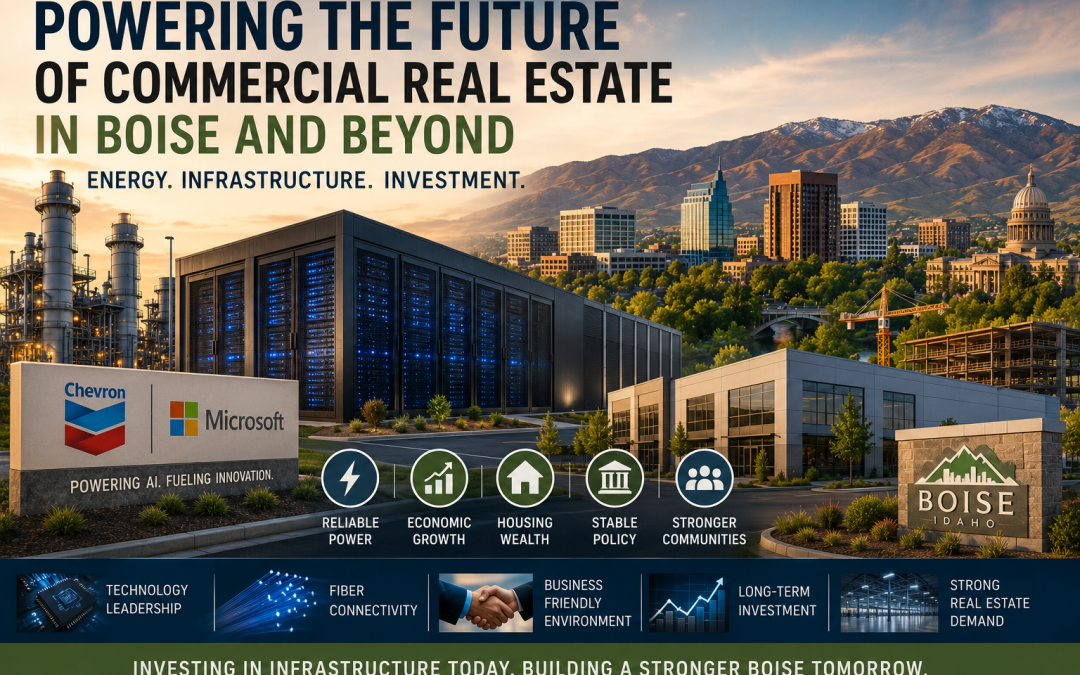
Artificial intelligence, cloud computing, and large-scale data centers are consuming enormous amounts of electricity, forcing technology companies and energy providers to rethink how future developments will be powered. According to reporting by Lou Hirsh and Madeleine D’Angelo in CoStar News, Chevron and Microsoft have announced a long-term partnership to develop a major natural gas-powered energy facility in West Texas to support a planned Microsoft AI data center. You can read the original CoStar News article here: https://product.costar.com/home/news/824105927. This article is based on that reporting while exploring what this growing focus on energy infrastructure could mean for Boise commercial real estate, economic development, and future investment opportunities.
AI Growth Is Changing Site Selection
The planned Texas project highlights how quickly data center development is evolving.
Chevron’s subsidiary, Energy Forge One LLC, plans to build a power generation facility near Pecos, Texas that will supply electricity under a 20-year agreement with Microsoft. The project is expected to be developed in multiple phases and eventually provide approximately 2.67 gigawatts of generating capacity.
Rather than depending entirely on the traditional electric grid, the facility is designed to deliver dedicated, reliable energy to support Microsoft’s rapidly expanding AI and cloud computing operations.
This reflects a growing national trend.
As artificial intelligence workloads increase, developers are placing far greater emphasis on access to dependable, scalable, and affordable energy when selecting future data center locations.
Why This Matters for Boise Commercial Real Estate
Boise already has several advantages that position it well for future technology investment.
The region offers:
- An expanding technology workforce
- Semiconductor manufacturing led by Micron
- Strong fiber connectivity
- Business-friendly policies
- Continued population and job growth
However, one competitive advantage is becoming increasingly important: available power capacity.
Large industrial users, advanced manufacturers, research facilities, and AI companies all require substantial electrical infrastructure.
Communities that can provide reliable power may become more attractive destinations for future corporate investment.
For Boise commercial real estate, that could influence demand across several property types, including:
- Industrial buildings
- Advanced manufacturing facilities
- Office campuses
- Flex space
- Research and development properties
- Data center development sites
Housing Wealth Continues to Support Investment
The CoStar report also highlighted another encouraging economic indicator.
According to Federal Reserve data, the value of owner-occupied residential real estate reached a new national high during the first quarter of 2026.
Total household housing wealth climbed to approximately $48.7 trillion, representing continued long-term growth despite a higher interest rate environment.
Baby boomers continue to hold the largest share of housing wealth, while millennials have experienced some of the fastest percentage gains over the past several years.
Although elevated mortgage balances remain a challenge, rising homeowner equity can strengthen consumer confidence, increase household financial flexibility, and support broader economic activity.
Those trends often benefit commercial real estate through stronger retail spending, business formation, and long-term investment demand.
Remembering Alan Greenspan’s Influence
The article also noted the passing of former Federal Reserve Chairman Alan Greenspan, who served more than 18 years leading the nation’s central bank.
Greenspan’s tenure is widely associated with long periods of economic expansion and relatively stable monetary policy, although later debates emerged over how low interest rates and asset valuations may have contributed to the housing downturn that followed.
Today, the Federal Reserve continues balancing inflation, employment, and interest rates—factors that remain central to commercial real estate financing, investment decisions, and development activity.
My Take
One message stands out from all three stories.
Infrastructure is becoming just as valuable as location.
Whether it’s dependable electricity for AI, homeowner wealth supporting consumer spending, or interest rate policy influencing capital markets, commercial real estate is increasingly shaped by forces that extend far beyond individual buildings.
For Boise development, this reinforces an important reality: communities that invest in infrastructure, workforce development, and long-term planning will likely have the strongest competitive position as technology companies continue expanding.
Power may soon become one of the most valuable amenities a commercial property—or an entire region—can offer.
Mike Gioioso (joy-OH-so) has for 16+ years been helping companies of all sizes buy, build, and lease perfect places for business in greater Boise, Idaho and beyond. www.streetsmartidaho.com mike@streetsmartidaho.com 208-209-9166
Tags: #boisecommercialrealestate, #boisedevelopment, #artificialintelligence, #datacenters, #energyinfrastructure, #microsoft, #chevron, #micron, #industrialrealestate, #officedevelopment, #commercialrealestateinvestment, #idahoeconomicdevelopment, #treasurevalleyrealestate, #housingmarket, #commercialrealestatetrends