
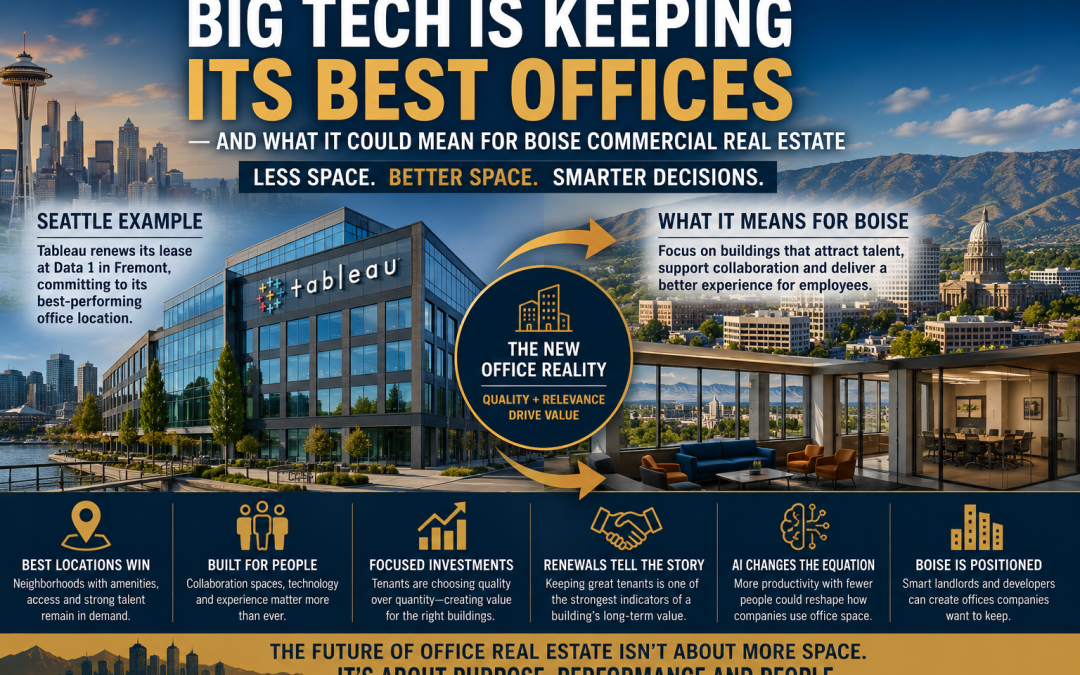
Big Tech Is Keeping Its Best Offices—and That Could Matter for Boise Commercial Real Estate
The office market may not be returning to its old normal.
Something different appears to be happening.
Companies are cutting unnecessary space while holding onto the offices they believe still matter.
A major lease renewal in Seattle provides a good example—and it offers an important lesson for Boise commercial real estate landlords, investors, developers, and businesses trying to understand where office demand goes from here.
According to reporting by Randyl Drummer of CoStar News, Tableau, the data analytics company owned by Salesforce, has renewed its approximately 114,000-square-foot office lease in Seattle’s Fremont neighborhood.
You can read the original CoStar News article here:
https://product.costar.com/home/news/1854827544
The renewal is notable because Seattle still has enormous amounts of empty office space.
Yet major technology companies are signing substantial leases anyway.
That suggests the future office market may increasingly be divided into two categories:
Space companies want—and space they can live without.
Office Demand Is Becoming More Selective
Tableau’s decision is particularly interesting because the company has already reduced its real estate footprint elsewhere.
Since the pandemic, Tableau has cut staff and given up office space in Seattle, Kirkland, and Bellevue.
Yet it decided to retain its approximately 114,000-square-foot Data 1 building in Fremont.
That distinction matters.
The company is not simply expanding everywhere.
It appears to be concentrating around a location it considers strategically important.
Tableau first occupied the building in 2018. Salesforce acquired the company the following year in a transaction valued at approximately $15.7 billion.
The existing Data 1 lease runs through 2029, with the new long-term agreement taking effect afterward.
That is a meaningful commitment.
For Boise office real estate, the takeaway is not that every company will suddenly start leasing large amounts of space again.
The more likely lesson is that companies may keep their best-performing locations while eliminating weaker or unnecessary offices.
That can create a very different office market.
Instead of every building benefiting equally from an economic recovery, demand may concentrate in properties offering the right combination of location, design, amenities, accessibility, parking, neighborhood environment, and employee experience.
Seattle Shows How Two Office Stories Can Exist at Once
Seattle provides an extreme example of this new reality.
According to CoStar News, nearly one-third of the area’s office inventory is currently vacant.
Normally, that level of vacancy would suggest very weak tenant demand.
Yet several major technology companies have recently made large commitments.
Docusign signed a lease for approximately 115,000 square feet at JPMorgan Chase Center.
Artificial intelligence company Anthropic agreed to occupy roughly 113,000 square feet at Dexter Yards in South Lake Union.
And now Tableau is keeping approximately 114,000 square feet in Fremont.
These transactions do not mean Seattle’s office problems have disappeared.
Far from it.
But they demonstrate that a weak overall market can still contain very strong individual buildings and submarkets.
That is an important distinction for investors.
Office vacancy is usually reported as one market-wide percentage.
Tenants do not lease percentages.
They lease buildings.
And companies compare individual properties based on what those buildings can provide.
That means two office buildings sitting only a few blocks apart can have dramatically different leasing outcomes.
The Flight to Quality May Be Turning Into a Flight to Relevance
For several years, the commercial real estate industry has talked about a “flight to quality.”
Companies downsizing their footprints often moved into newer or more heavily amenitized buildings.
But quality may not tell the whole story anymore.
The better description could be a flight to relevance.
A company’s office needs to provide something employees cannot easily replicate at home.
That might include:
- Collaboration space
- High-quality meeting rooms
- Access to restaurants and services
- Strong neighborhood amenities
- Convenient transportation
- Flexible work areas
- Technology infrastructure
- Employee gathering spaces
- Training facilities
- Client-facing environments
If an office is simply rows of desks, companies may question why they need it.
If the office functions as a hub for collaboration, culture, recruiting, customers, and innovation, its value becomes easier to justify.
Salesforce’s real estate leadership described Data 1 as an important hub for employees and customers.
That word—hub—may help explain where office demand is heading.
Companies may need fewer offices.
But the offices they keep may become more important.
What This Could Mean for Boise Office Landlords
The implications for Boise commercial real estate are significant.
Boise does not have Seattle’s enormous office inventory or the same level of vacancy.
But many of the forces affecting Seattle are also affecting employers here.
Hybrid work.
Artificial intelligence.
Employee expectations.
Smaller office footprints.
Higher construction costs.
Changing workplace design.
Businesses evaluating Boise office space may increasingly ask:
“What does this location actually do for our company?”
That puts pressure on landlords.
Simply offering square footage may not be enough.
Older Boise office buildings may need investment to remain competitive.
That could include better common areas, upgraded conference facilities, improved outdoor spaces, modern finishes, stronger signage, improved technology, showers and bike storage, fitness amenities, or more flexible suite configurations.
Some buildings will justify those investments.
Others may not.
That is where office ownership becomes more complicated.
Smaller Footprints Could Still Support Better Buildings
There is another interesting possibility for the Boise office market.
Companies may lease less space overall while spending more per square foot for the space they keep.
Imagine a company that once occupied 20,000 square feet.
Hybrid work might allow it to reduce its footprint to 12,000 square feet.
The company could then potentially afford a better location, higher-quality building, improved amenities, or more customized tenant improvements.
The landlord loses some square footage.
But the tenant becomes willing to pay for quality.
Multiply that behavior across the market and you get a strange result:
Office demand can shrink while demand for the best office space remains strong.
That appears to be part of what is happening in larger markets.
And it could increasingly influence Boise office leasing.
Location Still Matters—But the Definition of Location Is Changing
Tableau’s commitment also reinforces the importance of neighborhood.
Data 1 is located in Fremont, a technology-oriented Seattle neighborhood near Lake Union.
Companies are not only evaluating the building.
They are evaluating everything around it.
Can employees get lunch nearby?
Can they walk somewhere?
Are there restaurants and coffee shops?
Is the area attractive?
Does it help with recruiting?
Is the office somewhere employees actually want to visit?
Those questions can influence Boise development as well.
Downtown Boise naturally benefits from restaurants, entertainment, hotels, government offices, and other amenities.
But suburban office locations can compete differently.
Meridian may offer easier parking and proximity to growing residential neighborhoods.
Eagle can provide access to affluent households and executives.
Southeast Boise can offer proximity to the airport, Micron, and Interstate 84.
Different submarkets can succeed for different reasons.
The key is that office location increasingly needs a clear value proposition.
Artificial Intelligence Could Complicate the Office Recovery
The Anthropic lease in Seattle adds another dimension to this story.
Artificial intelligence companies are becoming significant office tenants in several technology markets.
At the same time, AI could eventually allow companies to grow revenue without increasing headcount at the same pace.
That creates a complicated relationship between economic growth and office demand.
Historically, the formula was fairly simple:
Company grows.
Company hires.
Company needs more desks.
Company leases more office space.
That relationship may weaken.
A technology company could grow rapidly while using AI and automation to increase employee productivity.
That might mean more revenue without dramatically more workers.
If that happens, office landlords cannot assume economic growth will automatically translate into greater space demand.
The office market may increasingly depend on how companies use space, rather than simply how quickly those companies grow.
Local Insight: Boise Should Watch Renewals More Closely Than Expansions
For Boise commercial real estate, lease renewals may become one of the most useful indicators of office building quality.
A new tenant moving into a building is obviously good news.
But an established tenant choosing to stay can tell us something even more important.
The company already knows the building.
It knows the parking.
It knows the landlord.
It knows the neighborhood.
It knows whether employees like the location.
It knows the operating costs.
And after considering alternatives, it chooses to remain.
That is valuable information.
When major tenants consistently renew in one building while leaving another, the market is telling us something about those properties.
Investors should pay attention.
Landlords should pay attention.
Developers should pay attention.
The future winners in office real estate may not simply be the newest buildings.
They may be the buildings tenants repeatedly decide are worth keeping.
What This Could Mean for Boise Commercial Real Estate
Tableau’s Seattle renewal does not mean the national office market has recovered.
Seattle itself still has a massive amount of vacant space.
But the transaction demonstrates why it is dangerous to treat the office market as one category.
Some buildings may continue struggling.
Others may remain highly desirable.
For Boise office landlords, that means investing in tenant experience and understanding why businesses choose particular locations.
For tenants, the current environment can create opportunities to improve office quality while potentially reducing overall square footage.
For developers, new office projects may need a much stronger reason to exist than they did before the pandemic.
And for investors, building-level performance could become far more important than market-wide vacancy statistics.
The future of Boise office real estate may not depend on companies returning to the office five days a week.
It may depend on companies deciding that certain offices are valuable enough to keep.
Tableau’s decision in Seattle shows what that can look like.
After reducing space elsewhere, the company still committed long term to a building it considers important.
That may be the real office recovery story:
Companies do not necessarily want more office space. They want better reasons to keep the space they have.
Mike Gioioso (joy-OH-so) has for 16+ years been helping companies of all sizes buy, build, and lease perfect places for business in greater Boise, Idaho and beyond.
www.streetsmartidaho.com mike@streetsmartidaho.com 208-209-9166
Tags: #boisecommercialrealestate, #boiseofficemarket, #boiseofficespace, #boiseofficeleasing, #boiseofficerealestate, #boiseofficevacancy, #treasurevalleycommercialrealestate, #treasurevalleyofficemarket, #idahocommercialrealestate, #boisedevelopment, #boiseofficedevelopment, #officeleasingtrends, #officemarkettrends, #futureofofficespace, #hybridwork