
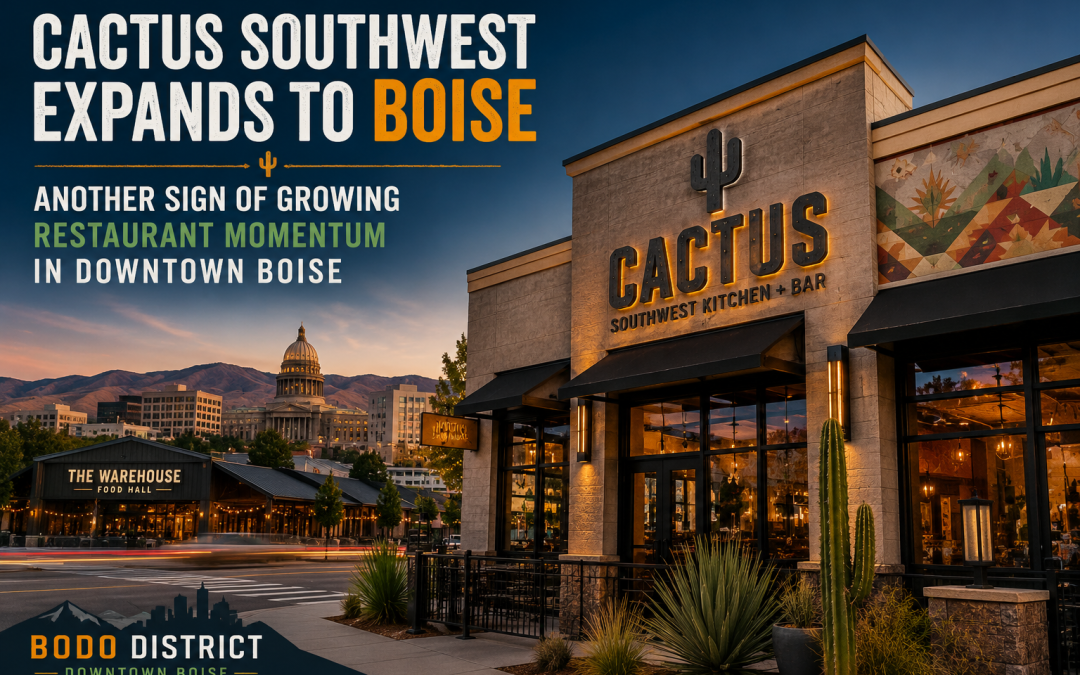
Why Cactus Southwest Kitchen + Bar’s Boise Expansion Signals Continued Momentum for BoDo Retail and Restaurant Growth
Downtown Boise continues attracting restaurant concepts that believe the city’s dining scene still has room to grow — and that could be another positive sign for Boise commercial real estate investors, landlords, and retail developers watching the urban core.
According to reporting by the Idaho Business Review staff in this article from the Idaho Business Review about Cactus Southwest Kitchen + Bar’s first Idaho location, the Washington-based restaurant group plans to open later this year in the former P.F. Chang’s space in Boise’s BoDo District.
While on the surface this may look like a simple restaurant opening, the bigger commercial real estate story is what it says about downtown Boise’s continued ability to attract regional brands looking for expansion opportunities.
Another National-Caliber Restaurant Concept Is Betting on Downtown Boise
Cactus Southwest Kitchen + Bar has operated in Washington since 1990 and currently runs multiple locations throughout the Seattle region.
Now the company is making its first move into Idaho by selecting one of Boise’s most visible restaurant corners near 8th and Broad streets.
That location matters.
The former P.F. Chang’s space sits directly across from The Warehouse Food Hall in one of the busiest pedestrian areas in downtown Boise. Even after several years of changing restaurant trends and economic uncertainty, BoDo continues drawing hospitality operators that want visibility, foot traffic, and proximity to Boise’s growing downtown population.
For Boise development professionals, this is another example of how downtown Boise remains competitive for regional expansion brands.
Key details from the announcement include:
- Cactus Southwest Kitchen + Bar plans to open in fall 2026
- The restaurant will occupy the former P.F. Chang’s location
- The space is currently being remodeled
- Ownership is led by brothers Marc and Bret Chatalas
- The concept focuses on Southwest and Mexico-inspired cuisine
- The restaurant emphasized local ingredients and seasonal menu rotation
The company also highlighted Boise’s growing food culture as a major reason for entering the market.
That trend is becoming increasingly important in retail leasing Boise conversations.
Boise’s Restaurant Scene Is Becoming a Major Leasing Driver
Restaurant operators today are not simply looking for cheap space.
They are targeting districts where dining activity helps create an experience-driven environment that keeps people downtown longer.
That is especially true in BoDo.
Over the past several years, downtown Boise has steadily evolved into a more mature mixed-use district with stronger entertainment, hospitality, residential, and food components all feeding off one another.
For landlords, that ecosystem creates stronger long-term value.
Restaurants often help activate surrounding retail space, increase evening traffic, and create momentum for nearby tenants. In many urban retail districts across the country, food-and-beverage users have become one of the most important categories for maintaining energy and occupancy.
Boise appears to be following that same pattern.
The fact that another established Pacific Northwest operator chose downtown Boise instead of a suburban location also says something important about the city’s urban growth trajectory.
Boise commercial real estate investors continue watching how downtown evolves as more residents, tourists, office workers, and event traffic support restaurant demand.
Why This Matters for Boise Commercial Real Estate
There are several broader market implications tied to this announcement.
1. Downtown Boise Still Has Expansion Appeal
Even with national concerns around restaurant costs and consumer spending, operators are still entering Boise.
That suggests confidence in the market’s long-term population and spending growth.
2. Second-Generation Restaurant Space Remains Valuable
The former P.F. Chang’s location already contains infrastructure that can reduce buildout costs compared to starting from scratch.
For retail landlords, quality second-generation restaurant space can become a major advantage when attracting tenants.
3. Experience-Oriented Retail Continues Growing
Consumers increasingly want destinations, not just transactions.
Restaurants, food halls, bars, and entertainment concepts are becoming key anchors in urban retail districts across the western United States.
BoDo continues leaning into that trend.
My Take: BoDo’s Identity Is Getting Stronger
One of the more interesting parts of this story is the way Cactus leadership described Boise’s food scene as authentic and unique rather than a smaller version of another city.
That matters.
Successful restaurant groups often spend significant time evaluating markets before expanding. Their decision-making usually includes demographics, tourism trends, downtown energy, consumer habits, and long-term growth expectations.
The continued interest from outside operators suggests Boise is increasingly viewed as a legitimate regional destination market — not just a secondary growth city.
For Boise commercial real estate professionals, that could support continued demand for downtown retail space, hospitality concepts, and mixed-use development opportunities in the years ahead.
Mike Gioioso (joy-OH-so) has for 16+ years been helping companies of all sizes buy, build, and lease perfect places for business in greater Boise, Idaho and beyond.
www.streetsmartidaho.com mike@streetsmartidaho.com 208-209-9166
Tags: #boisecommercialrealestate, #boiserealestate, #boisedevelopment, #downtownboise, #bododistrict, #retailleasingboise, #boiserestaurants, #restaurantrealestate, #hospitalityrealestate, #mixedusedevelopment, #treasurevalleyrealestate, #idahocommercialrealestate, #retaildevelopment, #boiseretail, #commercialrealestate