
Health Care Training Investment Could Strengthen Boise Commercial Real Estate Demand
Commercial real estate demand ultimately comes down to people.
Employers need workers. Workers need training. Growing industries need places where those employees can learn, work and serve customers.
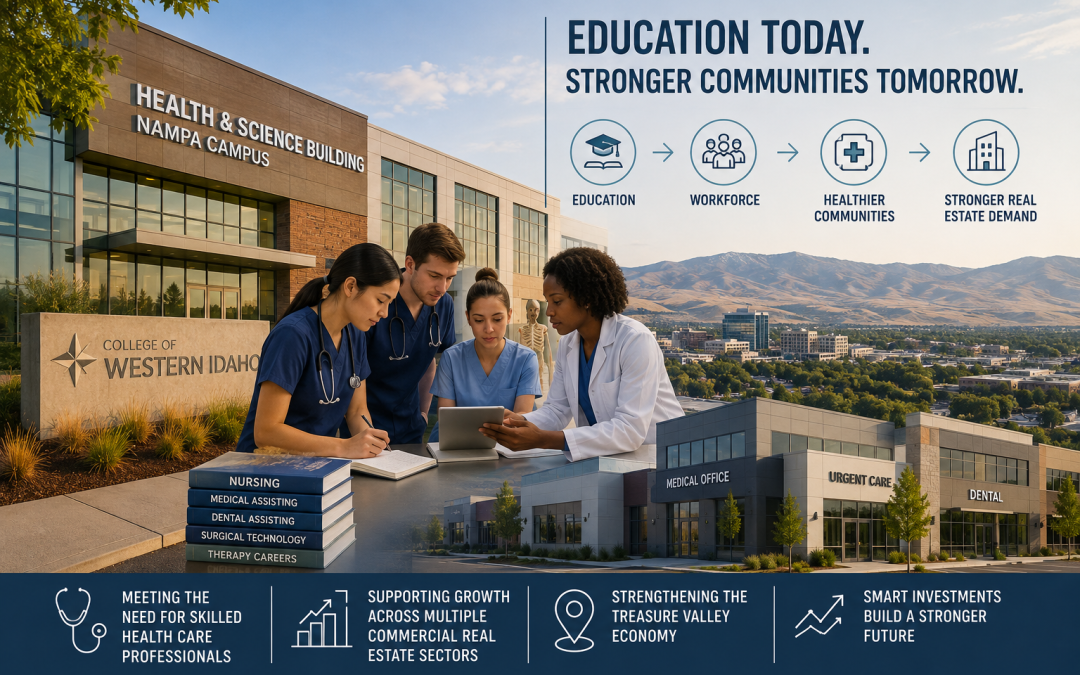
That is why a new investment in health care education at the College of Western Idaho could have implications well beyond the classroom.
According to reporting by IBR Staff in the Idaho Business Review, Norco Inc., St. Luke’s Health System and an anonymous donor are investing in health care education programs at CWI. As part of Norco’s support, CWI’s Health & Science Building on its Nampa campus will be renamed the Norco Health & Science Building.
The financial amounts were not disclosed.
You can read the original Idaho Business Review article here:
https://idahobusinessreview.com/2026/07/22/norco-st-lukes-invest-cwi-health-care-education/
For Boise commercial real estate, the bigger story is the connection between education, workforce development and real estate demand.
As the Treasure Valley grows, expanding the local pipeline of trained workers could help support continued growth in medical offices, clinics, hospitals, dental practices and other health-related businesses.
Workforce Development Is Also an Economic Development Tool
The CWI funding will support training across a wide range of health care careers.
Programs include nursing, medical and dental assisting, occupational and physical therapy, surgical technology and other clinical fields.
That matters because one of the biggest challenges facing a growing market isn’t simply finding enough buildings.
It’s finding enough people to work inside them.
A medical group considering another Treasure Valley location may look at rent, visibility, parking and demographics. But it also needs to know whether it can recruit nurses, assistants, technicians and other skilled employees.
A beautiful medical office doesn’t do much good if the tenant can’t staff it.
Investments that increase the supply of trained workers can therefore make the Boise-Nampa market more attractive to employers considering expansion.
And the impact isn’t limited to health care.
Norco has also supported workforce development at CWI in areas including electrical, plumbing, HVAC and semiconductor manufacturing.
Those are industries closely connected to Boise development.
Construction requires skilled trades. Advanced manufacturing requires specialized workers. Health care expansion requires trained clinical staff.
The stronger those workforce pipelines become, the easier it may be for the Treasure Valley to support additional economic growth.
Health Care Growth Can Create Multiple Layers of Real Estate Demand
From a commercial real estate perspective, health care is especially interesting because growth can affect several property types at once.
A growing medical workforce can support demand for:
- Medical office space for physicians, dentists, therapists and specialty practices
- Retail space for urgent care, dental, wellness and outpatient services
- Office space for administrative and support operations
- Industrial and flex space for medical suppliers and service companies
- Housing and neighborhood retail serving employees near major job centers
Health care tenants can also be attractive to landlords because many require significant investments in their locations.
Plumbing, specialized electrical systems, treatment rooms, imaging equipment and other improvements can make relocation expensive. Once the right facility is established, some medical users may have a strong incentive to remain there.
That can make health care an important part of tenant diversification for shopping centers, mixed-use projects and office properties.
For landlords involved in retail leasing in Boise, this is particularly relevant.
Many services that once clustered around hospitals are increasingly found closer to where people live and shop. Dental offices, physical therapy, urgent care and other medical uses can occupy neighborhood commercial space that historically might have gone primarily to conventional retailers.
Nampa’s Role in the Treasure Valley Economy Keeps Growing
The location of this investment is also worth watching.
CWI’s campus is in Nampa, placing workforce development close to one of the fastest-changing parts of the Treasure Valley.
For years, discussions about Boise commercial real estate could focus heavily on Boise itself.
That’s increasingly difficult to do.
Boise, Meridian, Nampa, Caldwell and the surrounding communities function as an interconnected economic region. Someone can train in Nampa, live in Caldwell and work in Meridian or Boise.
That means workforce investments in Canyon County can ultimately support employers throughout the metro area.
CWI was created by Ada and Canyon County voters in 2007 and remains the region’s community college. Its ability to connect education directly with local employers could become increasingly important as the Treasure Valley adds residents and businesses.
St. Luke’s relationship with CWI shows how that connection can work.
According to the Idaho Business Review, the health system has worked with CWI for nearly 20 years, including providing clinical training opportunities. Graduates of CWI programs regularly move into jobs within the St. Luke’s system.
That creates a relatively direct pipeline:
Education → training → employment → economic activity → real estate demand.
Local Insight: Follow the Workforce Before You Follow the Buildings
Commercial real estate professionals spend a lot of time tracking construction.
New medical buildings get attention.
New retail centers get attention.
New industrial projects get attention.
But buildings are often the result of something happening earlier in the economic cycle.
The workforce comes first.
When companies such as Norco and major employers such as St. Luke’s invest in education, they’re helping build the human infrastructure needed for future business growth.
For Boise-area developers and investors, that is worth watching.
Areas with expanding workforce training, strong population growth and nearby health care services could become increasingly attractive for medical office, neighborhood retail, multifamily and mixed-use development.
For landlords, it may also make sense to broaden the definition of a “retail tenant.” A physical therapy practice, dental office or outpatient medical provider may sometimes be just as important to a neighborhood shopping center as a traditional store.
And for health care businesses considering expansion, access to trained employees should be evaluated alongside rent, traffic counts, demographics and competing providers when choosing a location.
The CWI investment doesn’t guarantee another wave of commercial construction.
But it strengthens one of the ingredients that makes long-term development possible: a local workforce capable of supporting growing industries.
In a fast-growing market like the Treasure Valley, that could prove just as important as the buildings themselves.
Mike Gioioso (joy-OH-so) has for 16+ years been helping companies of all sizes buy, build, and lease perfect places for business in greater Boise, Idaho and beyond.
www.streetsmartidaho.com mike@streetsmartidaho.com 208-209-9166
Tags: #boisecommercialrealestate, #boisedevelopment, #nampacommercialrealestate, #treasurevalleycommercialrealestate, #medicalofficeboise, #healthcarerealestate, #collegeofwesternidaho, #cwi, #norco, #stlukeshealthsystem, #nampadevelopment, #boisemedicaloffice, #retailleasingboise, #workforcedevelopment, #idahoeconomicdevelopment