
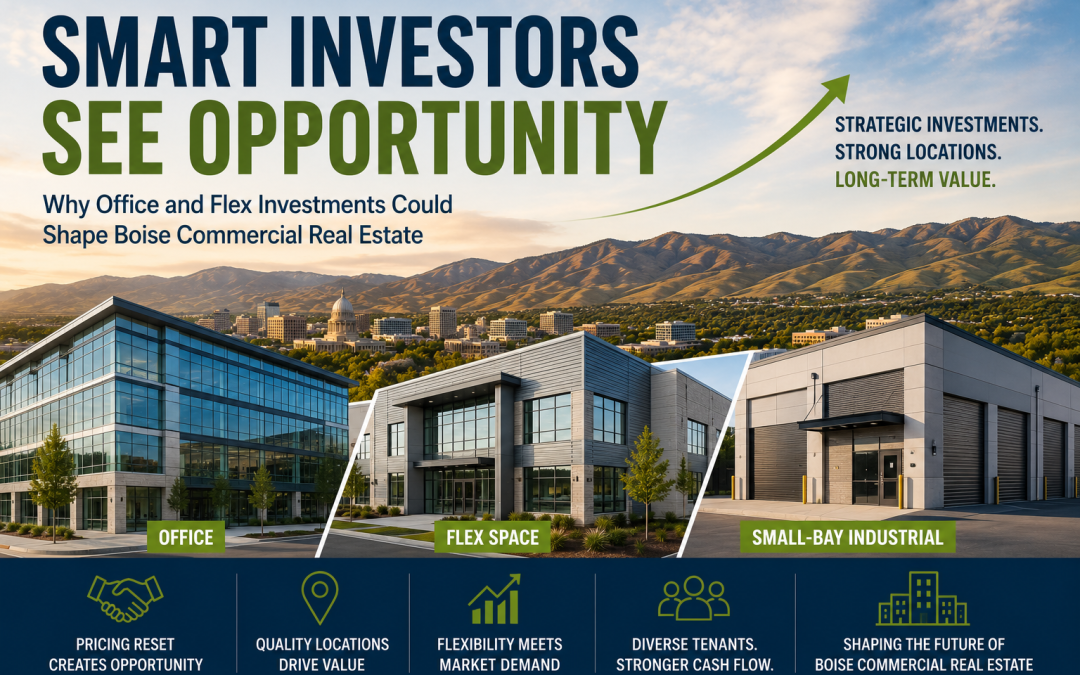
Why Investors Are Returning to Office and Flex Properties—and What It Could Mean for Boise Commercial Real Estate
Office real estate may not be making headlines for soaring prices anymore, but that doesn’t mean investors have lost interest.
Instead, many experienced buyers are seeing today’s market as an opportunity. As property values have adjusted from their previous highs, some investment firms are stepping back into office and flex real estate with a long-term strategy. For Boise commercial real estate, this could be an important signal about where private capital may be heading next.
According to reporting by Chris Sangiuliano of CoStar Research, newly formed Felton Stern Capital Partners has launched a private equity platform focused on acquiring office, flex, and small-bay industrial properties following the recent pricing reset across these sectors. You can read the original CoStar News article here: https://product.costar.com/home/news/1305151683. This article is based on that reporting while exploring what this investment strategy could mean for Boise commercial real estate, office leasing, flex space, and future investment opportunities throughout the Treasure Valley.
Smart Investors Are Looking Beyond Today’s Headlines
Office properties have faced significant challenges over the past several years.
Higher interest rates, remote work, and changing workplace habits have pushed values lower in many markets. While some investors remain cautious, others believe those price adjustments have created attractive buying opportunities.
Felton Stern Capital Partners is entering the market with a strategy centered on purchasing:
- Office buildings
- Flex properties
- Small-bay industrial assets
The firm’s approach focuses on acquiring well-located, high-quality buildings at prices below previous market peaks while positioning them for long-term income and appreciation.
Flex Space Continues to Gain Attention
One notable part of the firm’s strategy is its focus on flex properties.
Flex buildings combine office, warehouse, showroom, and light industrial uses into one space, making them attractive to a wide variety of businesses.
Typical flex tenants include:
- Technology companies
- Contractors
- Engineering firms
- Medical suppliers
- Manufacturing businesses
- Service companies
- Research and development users
Because these buildings serve multiple industries, they often remain adaptable as business needs evolve.
That flexibility has become increasingly valuable in today’s commercial real estate market.
What This Could Mean for Boise Commercial Real Estate
Boise has experienced many of the same trends affecting larger western markets.
Office demand has shifted, but demand has not disappeared.
Many companies now want:
- Smaller office footprints
- Higher-quality workspaces
- Flexible layouts
- Convenient suburban locations
- Buildings that support collaboration instead of rows of cubicles
At the same time, flex space remains one of the most difficult product types to replace because zoning, land availability, and construction costs have made new development increasingly expensive.
That combination could make existing office and flex properties more attractive to investors looking for stable long-term opportunities.
Boise Development Could Benefit From Private Capital
Institutional investors have generally been more cautious toward office assets during the past few years.
Private investment groups, family offices, and high-net-worth investors may now become increasingly active buyers as pricing adjusts.
For Boise development, this could support:
- Office repositioning projects
- Flex property renovations
- Adaptive reuse opportunities
- Small-bay industrial acquisitions
- Value-add commercial investments
Rather than waiting for office values to fully recover, some investors appear willing to purchase quality assets today and improve them over time.
Why Investors Should Watch Flex Closely
Small-bay industrial and flex buildings continue attracting strong interest because they serve a broad range of local businesses.
Unlike large distribution warehouses, these properties often lease to companies that provide services directly within their communities.
That creates diversified tenant demand while reducing dependence on any single industry.
As Boise’s economy continues expanding, demand for these smaller commercial spaces could remain healthy across Meridian, Nampa, Eagle, Caldwell, and other growing Treasure Valley communities.
My Take
From my perspective in Boise commercial real estate, this announcement says more about investor confidence than office fundamentals alone.
Experienced investors aren’t simply buying office buildings—they’re selectively targeting quality properties in strong locations where they believe values have become attractive again.
Boise’s continued population growth, expanding business community, and limited supply of well-located flex properties make the Treasure Valley a market worth watching. If private capital continues flowing into office and flex investments, owners who have maintained quality buildings may find increasing opportunities over the next several years.
Mike Gioioso (joy-OH-so) has for 16+ years been helping companies of all sizes buy, build, and lease perfect places for business in greater Boise, Idaho and beyond. www.streetsmartidaho.com mike@streetsmartidaho.com 208-209-9166
Tags: #boisecommercialrealestate, #boiseofficemarket, #flexspace, #flexindustrial, #smallbayindustrial, #boisedevelopment, #officeinvestment, #commercialrealestateinvestment, #officeleasingboise, #commercialproperty, #investmentproperty, #treasurevalleyrealestate