
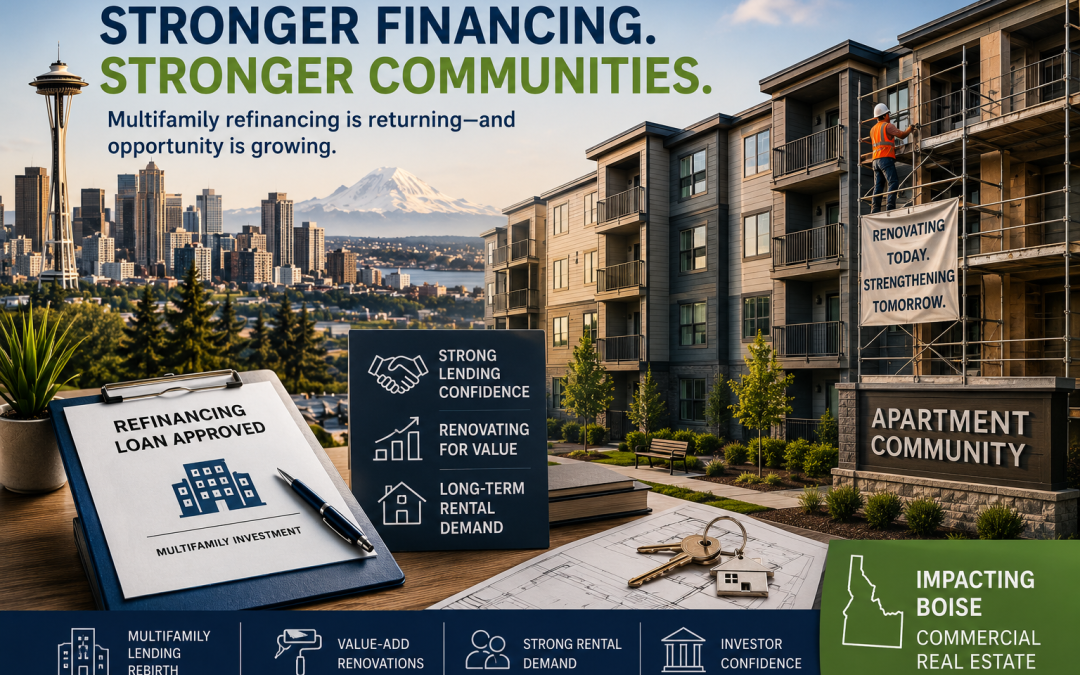
Why Apartment Refinancing Is Picking Up Again—and What It Could Mean for Boise Commercial Real Estate
After several years of higher interest rates and cautious lending, multifamily financing is beginning to show signs of life.
That’s important because refinancing activity often signals that lenders are becoming more confident about apartment properties and long-term rental demand.
According to reporting by Randyl Drummer in CoStar News, Seattle-based Security Properties and Harrison Street Asset Management recently secured an $82.5 million refinancing loan from Mesa West Capital for the 352-unit Olin Fields Apartments in Everett, Washington. This article is based on that reporting while exploring what renewed multifamily lending activity could mean for Boise commercial real estate, apartment investment, and future residential development. You can read the original CoStar News article here: https://product.costar.com/home/news/469723776
Multifamily Lending Is Beginning To Rebound
Apartment sales often receive the headlines, but refinancing tells an equally important story.
When lenders are willing to issue large loans on apartment communities, it usually reflects confidence in both the property’s future performance and the broader rental housing market.
The Everett refinancing illustrates that trend.
Mesa West Capital provided an $82.5 million first-mortgage loan for Olin Fields, a 352-unit apartment community located about 25 miles north of Seattle. Part of the financing will also support continued renovations at the property, where dozens of units have already been upgraded.
The transaction suggests that lenders are once again willing to back well-located apartment communities with experienced ownership groups.
Renovating Existing Apartments Is Becoming More Attractive
One of the most interesting parts of this transaction isn’t simply the refinancing.
It’s where the money is going.
Rather than building an entirely new community, ownership is investing additional capital into renovating existing apartments.
According to the report, the Holly neighborhood has experienced relatively little apartment construction over the past decade, while much of its housing inventory was built before the mid-1990s.
That creates an opportunity for owners to modernize existing communities instead of competing against large volumes of brand-new apartments.
This “value-add” investment strategy continues attracting both investors and lenders across many markets.
Why This Matters Beyond Seattle
Although this transaction occurred in Washington, many of the same market forces are influencing commercial real estate throughout the Northwest.
Communities experiencing population growth continue facing housing shortages, rising replacement costs, and limited development opportunities in established neighborhoods.
For investors, renovating existing apartment communities often becomes more financially attractive than starting new construction from the ground up.
That trend can create opportunities for:
- Apartment owners
- Multifamily investors
- Construction companies
- Property managers
- Lenders
- Local contractors
As financing conditions improve, more owners may choose to refinance aging properties and reinvest capital into renovations that extend the life of existing communities.
What This Could Mean for Boise Commercial Real Estate
Boise has experienced many of the same apartment market dynamics seen across the Pacific Northwest.
During periods of rapid growth, developers delivered significant numbers of new units. More recently, higher interest rates and construction costs have slowed development while increasing attention on existing apartment communities.
If lending continues improving, Boise could experience:
- More apartment refinancing activity
- Increased renovation projects
- Greater investor competition for stabilized multifamily assets
- Improved liquidity in the investment sales market
- More capital flowing into value-add apartment opportunities
Owners with older apartment communities may find it easier to secure financing for property improvements as lenders regain confidence in the multifamily sector.
That benefits residents while helping preserve existing housing inventory.
Financing Confidence Often Signals Market Confidence
Commercial real estate doesn’t move only because of buyers and sellers.
Capital markets play an equally important role.
When lenders begin making larger multifamily loans again, it often reflects improving expectations for occupancy, rental demand, and long-term property performance.
While every market has unique fundamentals, renewed financing activity in major Northwest cities is a positive sign that institutional investors continue viewing multifamily housing as a resilient asset class.
That confidence can eventually ripple into neighboring markets, including Idaho.
My Take
As someone who follows Boise commercial real estate every day, I pay close attention to lending activity—not just property sales.
Financing trends often tell us where investors believe future opportunities exist.
Boise continues to experience long-term population growth, and housing remains one of the region’s biggest challenges. If apartment lending becomes more accessible over the next several years, I expect more owners to renovate existing communities while investors continue pursuing quality multifamily assets throughout the Treasure Valley.
For developers, landlords, and investors, improving access to capital could become one of the biggest stories shaping Boise’s multifamily market.
Mike Gioioso (joy-OH-so) has for 16+ years been helping companies of all sizes buy, build, and lease perfect places for business in greater Boise, Idaho and beyond. www.streetsmartidaho.com mike@streetsmartidaho.com 208-209-9166
Tags: #boisecommercialrealestate, #boisedevelopment, #multifamilyrealestate, #apartmentinvestment, #apartmentrefinancing, #multifamilyfinancing, #commercialrealestatefinancing, #boiseapartments, #boisemultifamilymarket, #treasurevalleyrealestate, #housingdevelopment