
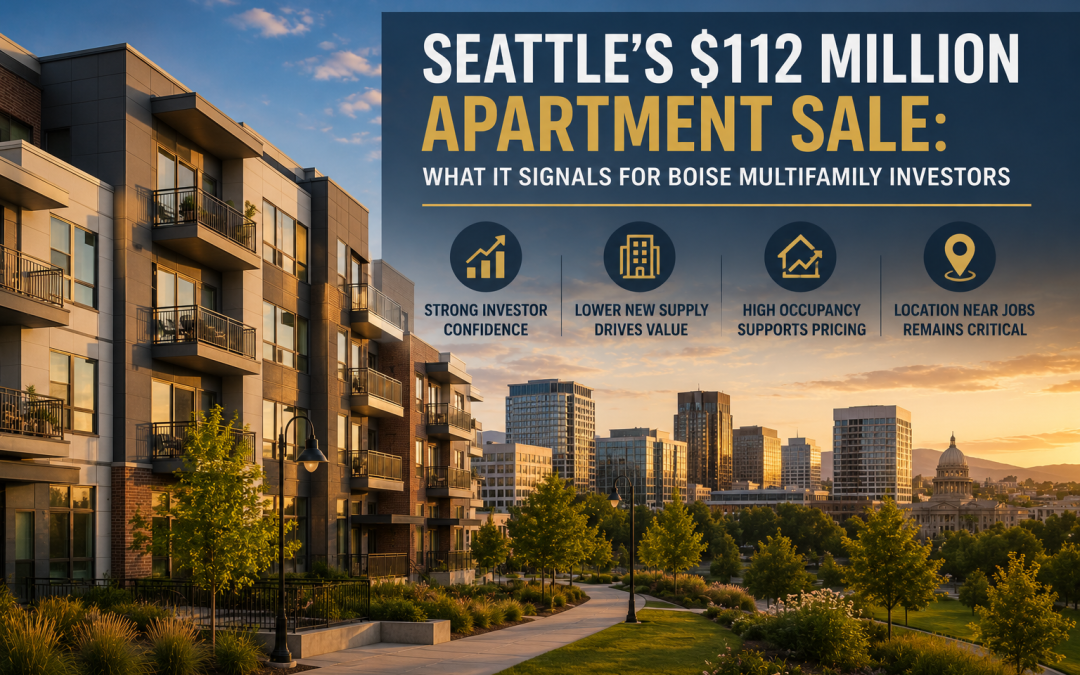
Why a $112 Million Seattle Apartment Sale Matters for Boise Multifamily Investors
Sometimes the most important number in a commercial real estate deal isn’t the sale price.
It’s the amount of competition coming next.
A major apartment transaction north of Seattle provides a good example. An older, nearly full multifamily property just sold for $112 million in a submarket where apartment construction has slowed significantly.
For Boise commercial real estate, that’s worth paying attention to.
Boise and Seattle are very different markets. But the investment logic behind this deal applies almost anywhere: when population and renter demand remain healthy while developers stop adding as many apartments, existing properties can become more attractive.
According to reporting by Randyl Drummer of CoStar News, Pacific Urban Investors purchased the 387-unit A’Cappella apartment community in Lynnwood, Washington, from Weidner Apartment Homes for $112 million.
You can read the original CoStar News article.
The transaction was one of the largest apartment sales in the Puget Sound region this year.
But the more interesting story may be why investors are putting money into Lynnwood.
Investors Are Looking Where New Supply Is Slowing
The A’Cappella apartments were built in 1989 and contain 387 units.
The property was reportedly 95% occupied at the time of the transaction, and the seller had already completed improvements to apartments and common areas.
At $112 million, the acquisition works out to roughly $289,000 per apartment.
The sale became the second-largest multifamily transaction in the Puget Sound region so far this year, behind a $130.7 million Seattle apartment deal completed in January.
Yet overall apartment investment activity across greater Seattle has slowed.
Lynnwood is moving in the opposite direction.
According to CoStar data cited in the article, approximately $387 million of multifamily properties traded in Lynnwood during the previous 12 months.
That’s significantly higher than the submarket’s five-year annual average of approximately $215 million.
Why are investors paying attention?
One reason appears to be location.
Lynnwood sits north of Seattle with access to major employment centers.
But another factor may be even more important:
Developers haven’t been adding many apartments.
Fewer than 200 apartments opened in Lynnwood last year, according to CoStar. During the previous four years, annual deliveries averaged around 750 units.
That is a dramatic reduction in new supply.
And according to CBRE data cited by CoStar, only one project containing more than 100 units was under construction within five miles of the A’Cappella property earlier this year.
For an apartment investor, that can create an interesting setup.
Existing apartments remain occupied.
Few competing units are being built.
And replacing the existing property with new construction may be extremely expensive.
That’s where the Boise comparison becomes interesting.
Boise Multifamily Could Face a Similar Supply Reset
The Treasure Valley has experienced an enormous apartment construction cycle.
Boise, Meridian, Nampa, Caldwell and other communities added thousands of multifamily units as developers responded to rapid population growth, rising rents and strong investor demand.
That wave of construction eventually created more competition.
New apartment communities had to offer concessions.
Rent growth slowed.
Lease-up periods became more important.
Developers became more cautious.
Higher interest rates and construction costs also made it much harder to justify new projects.
Those conditions can feel negative when you’re looking only at today’s numbers.
But multifamily markets operate in cycles.
When developers stop building, the supply pipeline eventually shrinks.
Population growth does not necessarily stop at the same time.
Household formation doesn’t stop.
People continue moving.
Young adults still leave home.
Couples separate.
Employees relocate.
And households priced out of homeownership continue renting.
Eventually, demand can catch up with the apartments already built.
That is why today’s slowdown in Boise multifamily development could influence investment performance several years from now.
The development pipeline matters more than today’s vacancy alone
Investors often focus heavily on current occupancy.
That’s understandable.
But current vacancy tells you what happened in the past.
The construction pipeline can tell you something about what might happen next.
Imagine two apartment markets.
Both have 8% vacancy today.
Market A has 3,000 apartments under construction.
Market B has 300.
Those markets may look similar in a current vacancy report.
Their future supply environments are completely different.
That’s one reason I think Boise apartment investors should pay close attention to permits, starts, projects under construction and proposed developments—not simply current vacancy and rents.
The question isn’t just:
How many apartments are empty today?
It is:
How many new apartments will compete with this property over the next three years?
That can significantly change the investment thesis.
Older Apartments Can Become More Valuable When Replacement Costs Rise
There is another interesting part of the Lynnwood transaction.
A’Cappella isn’t new.
It was built in 1989.
Yet an institutional investor still paid $112 million for it.
That tells us something important about multifamily investing.
New doesn’t automatically mean better.
An older apartment community can have several advantages.
The location may already be established.
Landscaping and amenities may be mature.
The property has an operating history.
Management knows what tenants are willing to pay.
The investor isn’t waiting years for construction and lease-up.
And perhaps most importantly, the cost to reproduce the property today may be substantially higher than its historical construction cost.
That last point is especially relevant to Boise commercial real estate.
Land prices have increased.
Labor costs have increased.
Construction materials remain expensive.
Development fees and infrastructure expenses have increased.
Financing costs are significantly higher than they were several years ago.
When replacement costs rise, existing buildings can become more valuable—even when they are decades old.
If an investor can buy an existing apartment property for meaningfully less than the cost of building a comparable project from scratch, that difference creates a form of protection.
The investor doesn’t need rents high enough to justify brand-new construction.
They only need rents high enough to justify the acquisition price and required improvements.
High Mortgage Rates Could Help Support Apartment Demand
The current housing market adds another layer to the Boise multifamily story.
Homeownership remains expensive.
Mortgage rates are elevated, and home prices throughout much of the Treasure Valley remain high relative to household incomes.
That can keep would-be buyers renting longer.
Someone who might have purchased a starter home at age 28 may stay in an apartment until 31 or 32.
A family saving for a down payment may renew its lease another year.
A newly relocated employee may decide to rent instead of immediately purchasing.
Individually, those decisions seem small.
Across thousands of households, they can meaningfully affect apartment demand.
This creates an interesting situation for multifamily investors.
High interest rates hurt property values because debt is more expensive.
But those same high rates can also make buying a home more difficult, potentially supporting rental demand.
That’s one of the reasons multifamily investment can be complicated.
The same economic force can hurt one side of the equation while helping another.
What Boise Apartment Investors Should Watch
For Boise and Treasure Valley multifamily investors, I think several indicators deserve close attention over the next few years:
- Apartment construction starts: Fewer starts today can mean less competition later.
- Projects under construction: These represent the supply most likely to actually reach the market.
- Concessions: Declining free rent or move-in incentives can signal improving landlord leverage.
- Occupancy: Stabilizing or rising occupancy may show that existing supply is being absorbed.
- Rent growth: Even modest rent growth becomes meaningful when concessions are simultaneously declining.
- Population and job growth: Long-term apartment demand still depends on household formation.
- Mortgage affordability: Expensive homeownership can keep households renting longer.
- Replacement costs: The more expensive new apartments become to build, the stronger the competitive position of existing properties may become.
Those indicators together provide a better picture than any single rent or vacancy number.
Local Insight: Today’s Construction Slowdown Could Become Tomorrow’s Opportunity
Multifamily real estate has a timing problem.
When rents are rising rapidly and apartments are full, everyone wants to build.
By the time those buildings open, the market may have too much inventory.
Then construction slows.
Developers cancel projects.
Lenders become cautious.
Land transactions fall apart.
And eventually, the pipeline becomes much smaller.
That’s often when the foundation for the next cycle begins.
For Boise multifamily, I think this is one of the most important trends to watch.
The question isn’t whether the Treasure Valley built a lot of apartments.
It did.
The more useful question now is:
How quickly is the next wave being built?
If apartment starts remain low while Boise continues adding jobs and households, today’s supply pressure could gradually turn into a tighter rental market.
That doesn’t happen overnight.
But commercial real estate investors don’t buy based solely on today’s conditions.
They buy based on where they believe conditions are heading.
The Lynnwood sale provides a good example.
Pacific Urban Investors wasn’t buying a brand-new trophy apartment tower.
It acquired a nearly four-decade-old property that was already 95% occupied in a submarket where new construction has slowed sharply.
That’s a very different investment thesis.
And it may become increasingly relevant in the Treasure Valley.
For Boise investors, existing apartment properties with good locations, strong occupancy and limited nearby future supply may deserve a closer look.
For developers, fewer competing projects could eventually improve the economics of carefully timed new construction.
For landowners, the challenge may be patience. Multifamily land values depend heavily on what rents and financing can support.
And for apartment owners, a slowdown in future construction may ultimately be one of the best things that can happen to existing inventory.
Sometimes the most important development in real estate is the project that doesn’t get built.
Mike Gioioso (joy-OH-so) has for 16+ years been helping companies of all sizes buy, build, and lease perfect places for business in greater Boise, Idaho and beyond.
www.streetsmartidaho.com mike@streetsmartidaho.com 208-209-9166
Tags: #boisecommercialrealestate, #boisemultifamily, #boiseapartmentmarket, #boisemultifamilyinvestment, #boiseinvestmentproperty, #treasurevalleycommercialrealestate, #idahomultifamilyrealestate, #apartmentinvestment, #boisedevelopment, #apartmentrentgrowth, #meridianapartments, #nampaapartments, #treasurevalleyapartments, #multifamilyfinancing, #commercialrealestateinvestment